

The half-life of a skill is now measured in months, not years, a stark reality that should give every business leader pause. This accelerating obsolescence is driven by the rapid deployment of Artificial Intelligence across every industry and job function, creating a global skills gap that threatens to become an economic divide. The stakes are too high to ignore this tectonic shift.

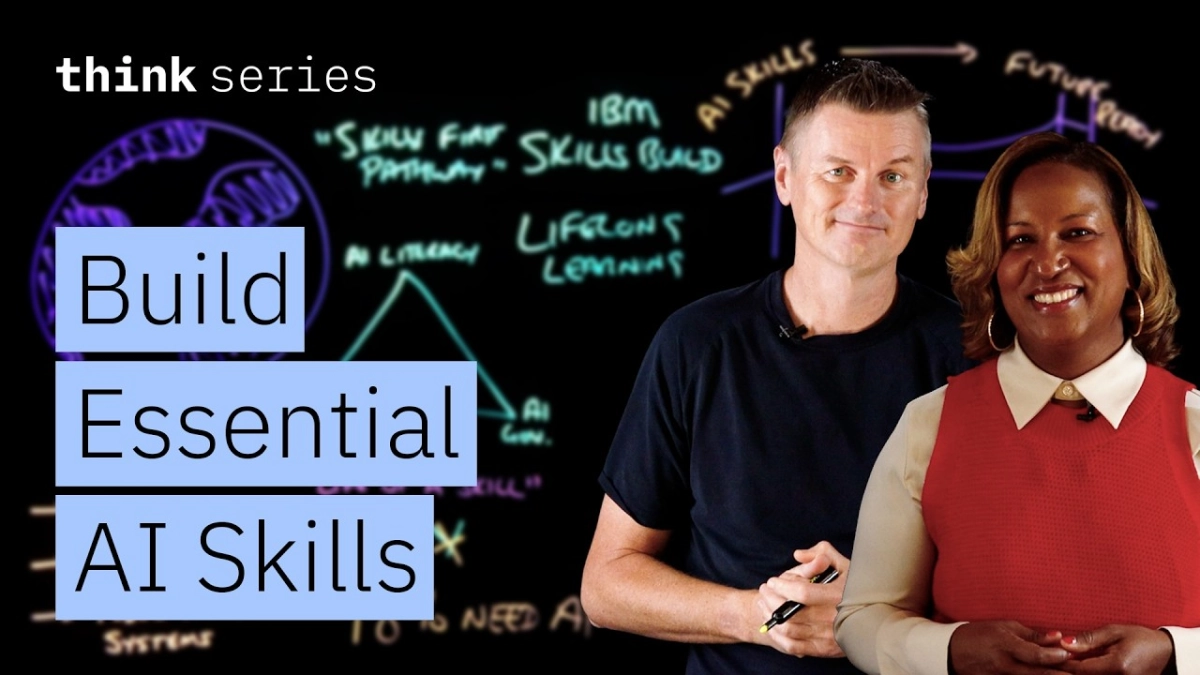
Martin Keen, Master Inventor at IBM, and Justina Nixon-Saintil, Vice President and Chief Impact Officer at IBM, recently discussed the imperative of building AI skills to thrive in this new economy. Their conversation underscored a critical paradigm shift: professionals across all sectors, regardless of their direct involvement in developing AI, must become AI-literate. As Keen illustrated with a simple graphic, the human role is transitioning from performing tasks to managing the intelligent systems that perform them. This shift necessitates a workforce fluent in AI tools and possessing the skills to guide and oversee these agents, rather than simply operating them.
Nixon-Saintil highlighted the urgency of this transition, citing a World Economic Forum finding that 39% of current skills may be outdated within five years. This data point is a flashing red light for employers, founders, and the public workforce systems that supply talent. She emphasized that without prioritizing AI literacy and the necessary tools, the existing digital divide will inevitably widen into an economic one. The solution, they argue, lies in adopting a "Skills First" pathway, a philosophy that prioritizes demonstrated expertise and capabilities over traditional educational credentials alone.
This Skills First approach is not about replacing traditional higher education, but rather augmenting it and opening pathways to a broader talent pool. It recognizes that in an AI-first world, relevant and resilient skills, often validated through credentials, are the new currency. This focus is crucial because the required competencies extend far beyond technical coding or data science roles. According to the AI Workforce Consortium, 78% of ICT jobs now require AI-related skills, a need that permeates non-technical fields like HR, marketing, and legal departments. Every field is effectively becoming a tech field.
The discussion framed AI leadership skills not as a linear track, but as a triangle anchored by three essential vertices: AI Literacy, AI Ethics, and AI Governance. For executives and founders, understanding this trifecta is paramount to successful AI adoption. AI Literacy ensures the entire workforce can effectively interact with AI agents. AI Ethics focuses on responsible deployment, ensuring systems are fair and transparent. Finally, AI Governance provides the necessary frameworks to guide and oversee these powerful tools. These are the foundational leadership skills required to harness AI’s potential without incurring significant risk.