
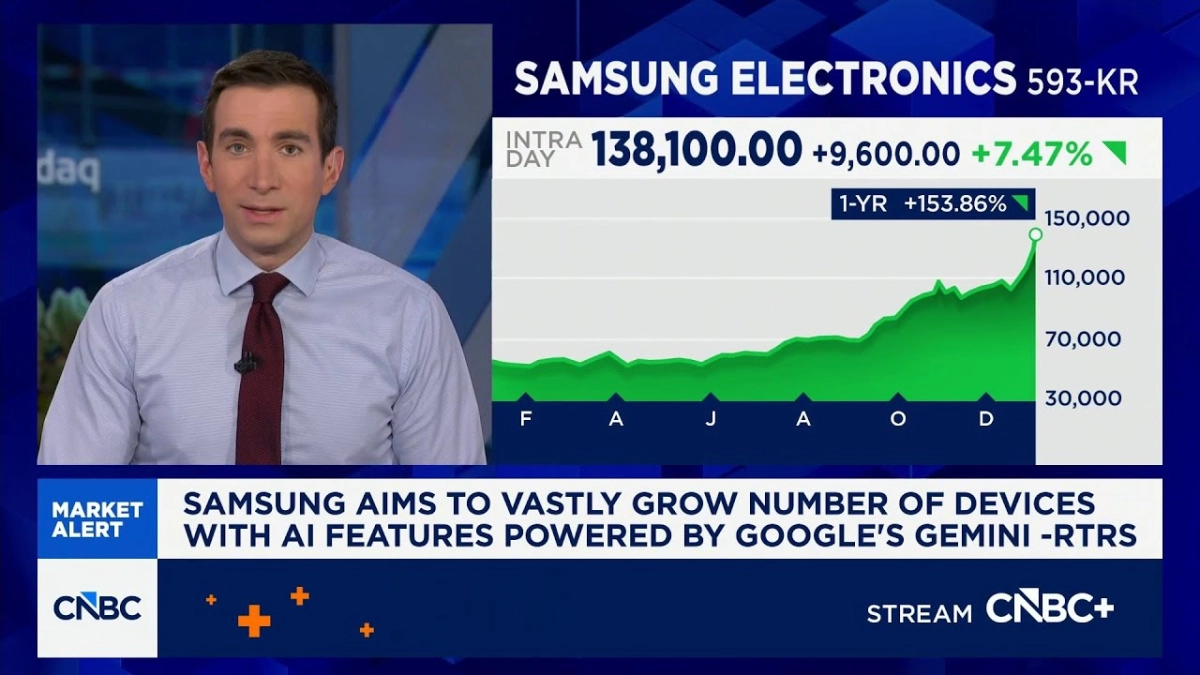
The battle for AI dominance is moving rapidly from the data center to the user’s pocket, and the latest move by Samsung signals a profound, high-volume shift in ecosystem dependencies. For years, the strategic alliance between Samsung and Google defined the Android hardware market; now, that alliance is being aggressively recast around generative AI, establishing a massive, unified front against competitors seeking to capitalize on the next mobile paradigm shift.
CNBC’s Andrew Ross Sorkin, reporting on Squawk Box, detailed a significant strategic announcement from Samsung Electronics, citing sources close to the company and a Reuters report. The core news centered on Samsung's aggressive intent to vastly grow its footprint of mobile devices equipped with artificial intelligence features, powered predominantly by Google’s Gemini models. This is not an incremental update; the plan, confirmed by a Samsung co-CEO, involves doubling the number of AI-enabled products—including phones, tablets, and potentially other consumer electronics—to approximately 800 million units.
This scale—800 million devices—is the critical metric for founders and investors tracking the transition from cloud-based Large Language Models (LLMs) to on-device, or "edge," AI. Samsung is leveraging its immense hardware distribution capability to rapidly democratize access to advanced generative AI functions. This strategy inherently addresses the persistent challenges of latency, connectivity dependence, and high operational cost constraints often inherent in purely cloud-based models, offering instantaneous, personalized AI utilities directly to the consumer. The sheer volume ensures that the Gemini model, specifically the lightweight versions optimized for mobile silicon, will achieve unprecedented real-world stress testing and user feedback loops, accelerating its deployment cycle far beyond competitors relying on niche hardware or slower rollout schedules.