

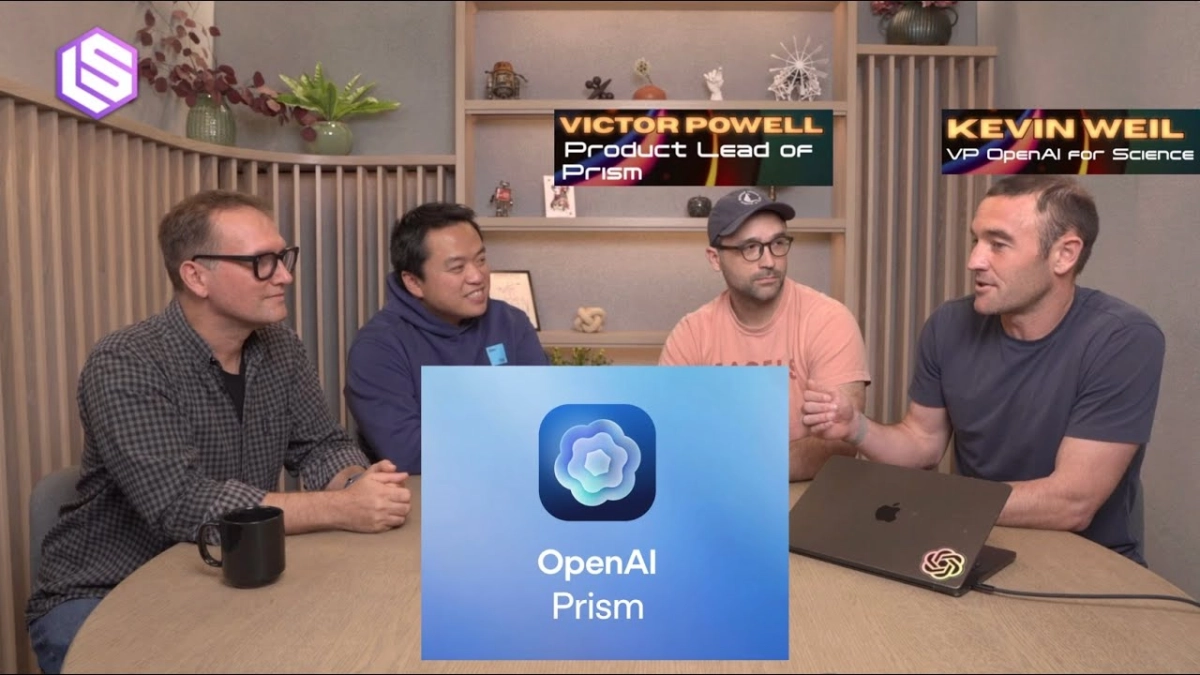
The era of copying complex LaTeX code between fragmented tools and large language models is officially over. OpenAI has launched Prism, a free, AI-native LaTeX editor designed to eliminate the tedious formatting and typesetting bottlenecks that historically slowed down scientific communication, embedding frontier reasoning directly into the writing workflow.
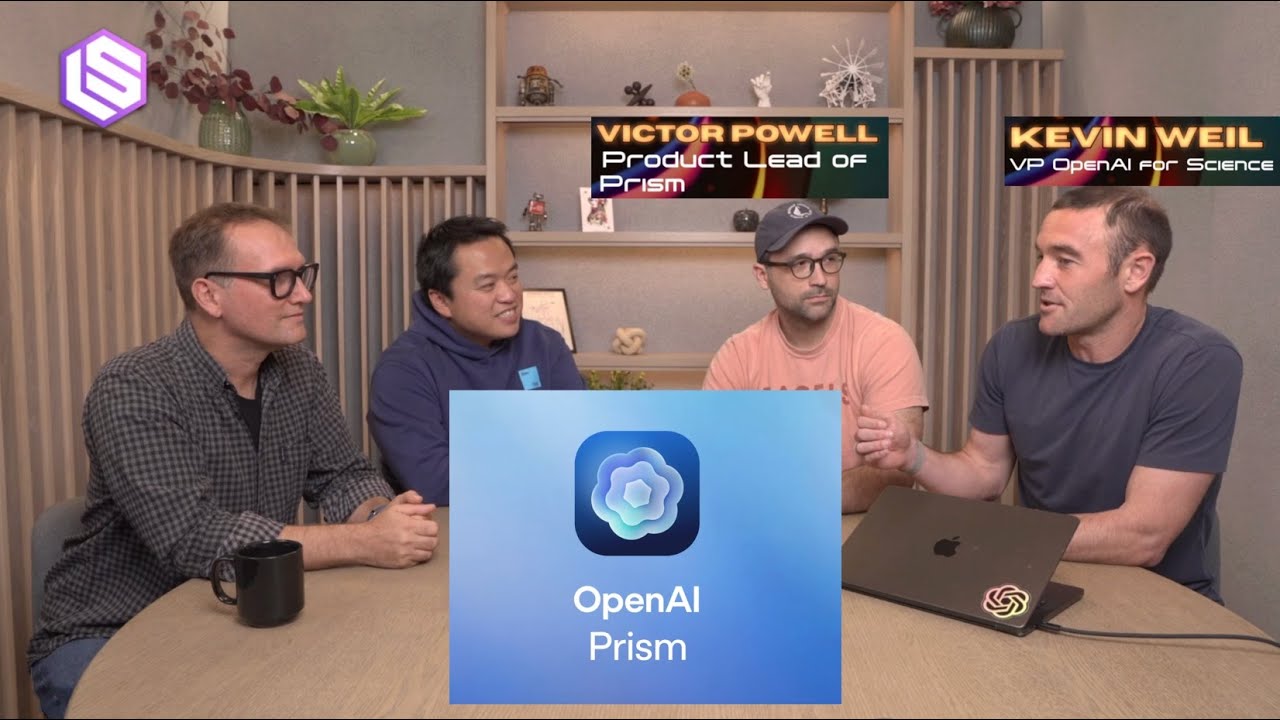
Kevin Weil, VP of OpenAI for Science, and Victor Powell, Product Lead on Prism, recently spoke with Swyx and RJ Honicky of the Latent Space Podcast about the launch of the product and the broader, mission-driven goal of accelerating frontier research through deep AI integration. They positioned Prism not merely as a better text editor, but as a crucial step in translating the massive leaps in AI reasoning, specifically leveraging GPT-5.2, into tangible productivity gains for researchers across physics, math, and chemistry.
Weil emphasized that true acceleration in technical fields requires embedding AI directly into the user’s core environment. He drew a compelling parallel to software development: "The real acceleration came when you embedded AI into the actual workflow." For scientists, this means moving beyond the inefficient loop of exporting LaTeX code from Overleaf, asking ChatGPT for corrections or diagrams, and pasting the results back. Prism holds the full context of a user's entire project, files, bibliography, equations, allowing the underlying model to act as an omniscient, collaborative research assistant.
The origin story of Prism itself is a testament to the fast-moving, product-first nature of the current AI ecosystem. Powell revealed that the technology began as his stealth side project, "Cricket," which caught Weil’s attention in an unconventional manner. Weil recounts finding the project on a Reddit forum and having to “hunt down Victor on Twitter and DM’d you out of the blue” to start the conversation that led to the team joining OpenAI. This highlights the reality that in today's landscape, solving genuine, high-friction niche problems, even in stealth, is the most reliable way to attract frontier talent and capital.
The live demonstration showcased Prism's capability to handle tasks that typically consume hours of a scientist's time, proving the immediate value proposition. The system seamlessly proofread an introduction paragraph-by-paragraph, simplifying complex language while preserving technical accuracy. More impressively, it converted a rough, hand-drawn commutative diagram, a notorious pain point for LaTeX users, into perfectly formatted TikZ code just by analyzing an uploaded image. Furthermore, the tool demonstrated deep reasoning capabilities by verifying complex symmetry equations and generating a 30-page set of general relativity lecture notes in seconds, functioning effectively as an expert collaborator.