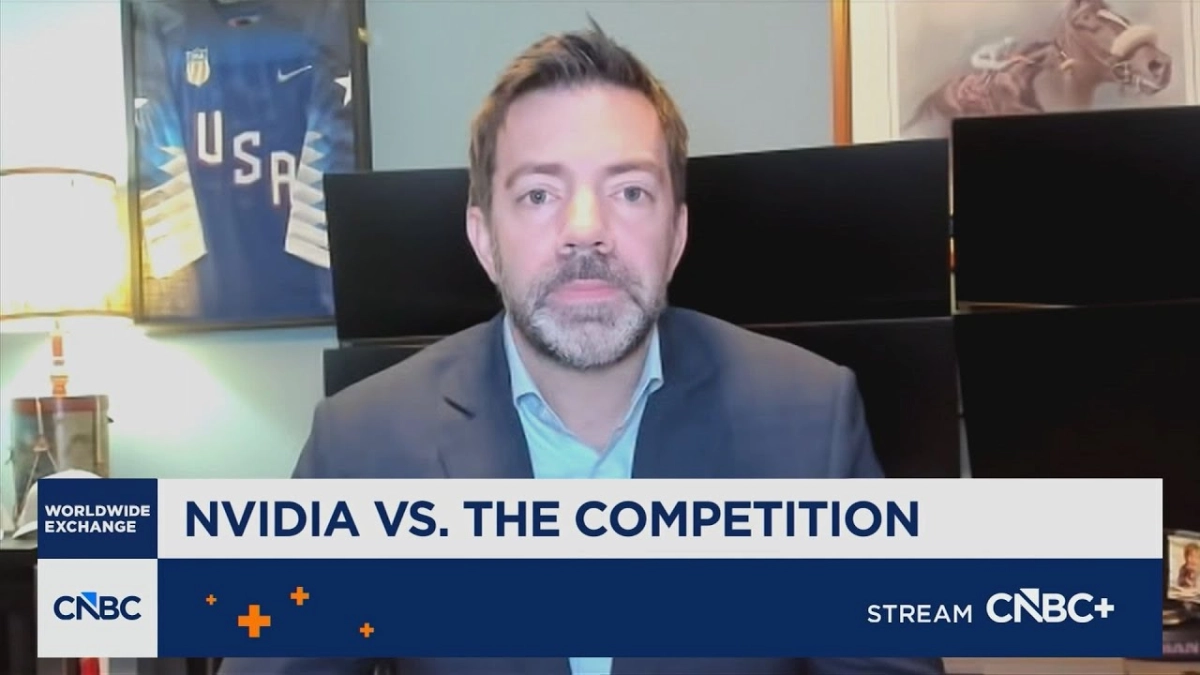
"Nvidia is still the 800-pound gorilla in the room." This assessment by Joel Kulina, Head of Technology and Media Trading at Wedbush Securities, encapsulates the core takeaway from a recent CNBC interview discussing Nvidia’s strategic positioning following its latest keynote announcements, including the next-generation Vera Rubin AI chip system. The conversation centered on how Nvidia is not just maintaining its leadership in the AI hardware race but is aggressively expanding its ecosystem to ensure long-term, diversified growth, despite the recent sideways movement in its stock price.
Kulina spoke with the CNBC anchor on Worldwide Exchange about the implications of Nvidia’s newest product announcements, the Vera Rubin platform, and the company's widening network of partnerships, particularly in the burgeoning field of physical AI and robotics. The analyst maintained a staunchly positive outlook, arguing that the fundamental math supporting Nvidia’s valuation remains unchallenged through 2026 and beyond.

The primary hardware announcement discussed was the confirmation that the Vera Rubin system is moving into full production, scheduled for the second half of the year. This is a crucial data point for investors, especially since the Vera Rubin architecture follows the highly successful Blackwell predecessor. Kulina noted that the confirmation of the launch date, given the sheer sophistication of the step-up in chip technology, was a significant positive for the company. The Vera Rubin platform, which includes the Vera CPU and the Rubin GPU, represents the continued, aggressive acceleration of Nvidia's technology roadmap—a foundational pillar of its market dominance.
Beyond the raw hardware performance, the conversation heavily emphasized Nvidia’s strategic move into "physical AI," encompassing robotics and autonomous systems. This was a dominant theme of the keynote, and Kulina highlighted the importance of this diversification. While the immediate stock narrative might not be driven by these long-term bets, the expansion into physical AI is strategically sound. It plays directly into the hands of major players like Elon Musk and Tesla, particularly concerning their plans for robotaxi rollouts and Cybercab initiatives, making it a "sweet spot" for Nvidia’s technology.
The Wedbush analyst stressed that Nvidia’s strategy is not about going it alone. Instead, it is focused on robust ecosystem development through strategic partnerships.
The company recently announced collaborations with key players across multiple industries, including Cadence, Synopsys, Palantir, and Siemens. Kulina views these constant, continuous streams of partnership announcements as a deliberate strategy to build "a very sound, strategic, healthy supply chain." This ensures that if any single partner or sector faces a setback, Nvidia can rely on other established relationships, effectively de-risking its vast market exposure.
While the fundamental story remains strong, the stock’s recent trading pattern—flat throughout Q4 despite explosive growth in the underlying AI demand—was addressed. Kulina explained that this temporary stagnation is a result of the AI trade broadening out across the market. Sectors like memory and optical components, as well as broader industrial names like Caterpillar, have seen aggressive re-ratings as the AI infrastructure build-out accelerates. Nvidia, having been the primary beneficiary and driver of the initial AI euphoria, is now seeing the market breadth expand. This creates a scenario where Nvidia's stock can be viewed as an "easy name to kind of for people to view as a source of funds" when reallocating capital across the broader tech ecosystem.
However, the analyst firmly dismissed any notion that this market breadth expansion signals a weakening of Nvidia’s position. The core demand narrative for AI remains intensely constructive. Data and checks across a wide range of industries—from semiconductors and hardware to LLM developers like Anthropic (with its Claude 4.5 rollout) and Google (with Gemini 3)—show consistent progress and escalating demand for high-performance compute.
Kulina provided a clear, quantitative perspective on the company’s forward trajectory, concluding that the bullish case for Nvidia is far from over. He cited a conservative earnings per share (EPS) projection of $9.00 for 2026, which, when paired with a modest 25x multiple, suggests a valuation target of $225. This figure, he suggested, is likely "pretty conservative as well," signaling significant runway for growth based on the strength of the new product cycle and the expansion of the AI ecosystem.