

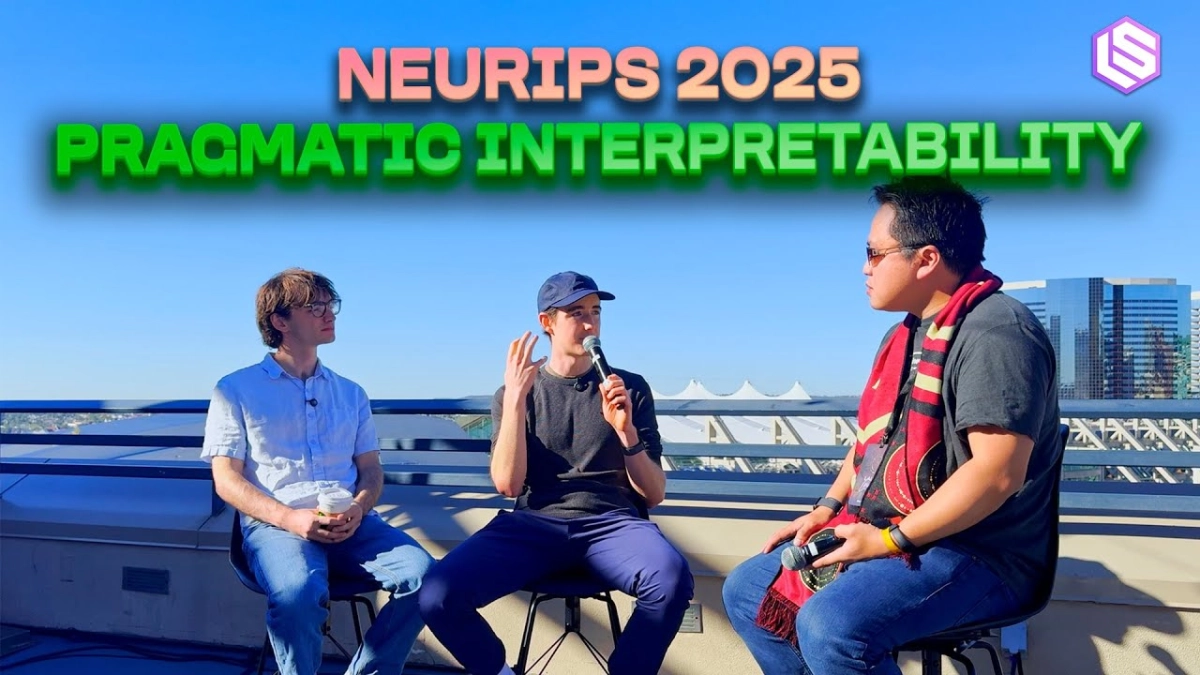
"The science of deep learning," according to Jack Merullo, Research Scientist at Goodfire, is centered on making models not just powerful, but understandable, robust, and safe enough to deploy in high-stakes industries. This fundamental shift, from treating large neural networks as impenetrable black boxes to viewing them as complex systems ripe for reverse engineering, formed the core of the discussion between Merullo, Mark Bissell (Applied Research at Goodfire), and Swyx (Editor of Latent Space) at NeurIPS. The conversation provided a sharp analysis of the state of mechanistic interpretability (MechInterp) heading into 2026, focusing heavily on how foundational research is now translating into immediate, practical applications across diverse domains, from creative tooling to life sciences and finance.
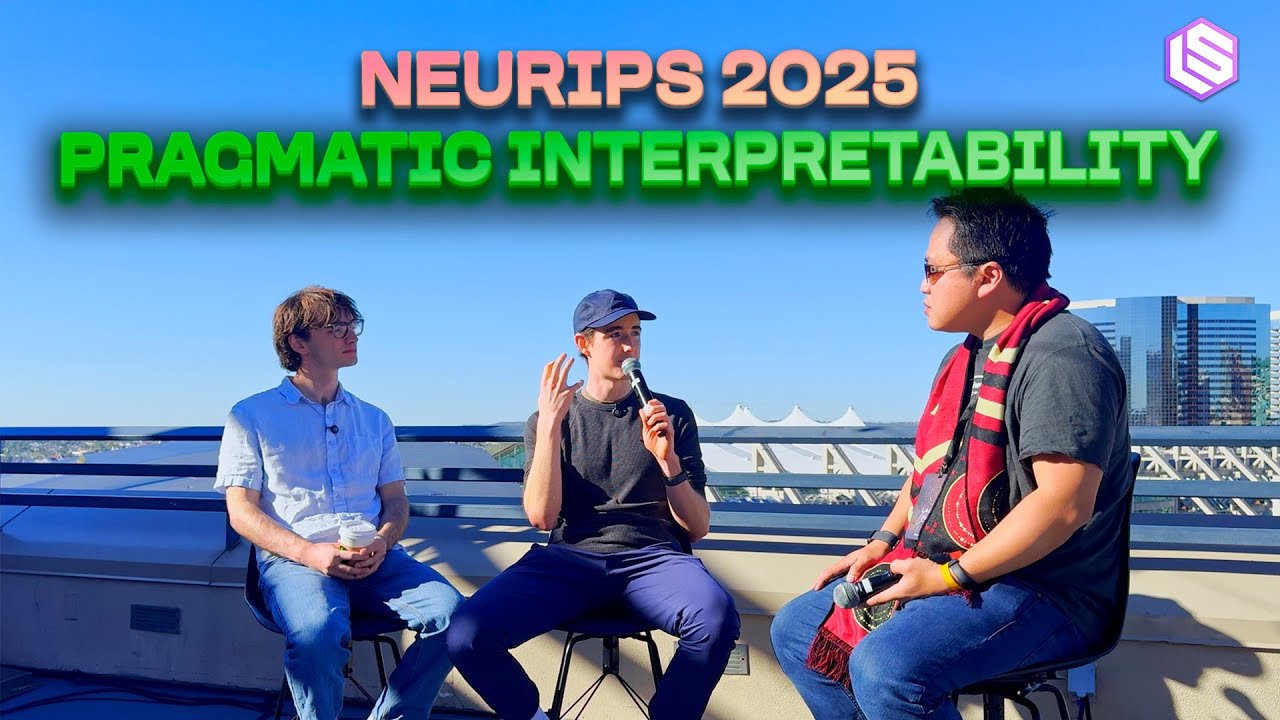
The discussion, hosted live at NeurIPS, centered on Goodfire’s mission: building an interpretability platform capable of cracking open these black boxes across modalities. Merullo, who transitioned from a PhD focused on language model grounding, articulated the foundational research path, while Bissell, coming from a background in healthcare engineering at Palantir, grounded the talk in applied use cases. The immediate utility of MechInterp is perhaps best illustrated by the company’s viral research preview, `paint.goodfire.ai`, which allows users to interact directly with the latent space of diffusion models.
This creative application demonstrates the core insight that interpretability unlocks direct control. Bissell explained that by employing unsupervised techniques to discover concepts internally represented by Stable Diffusion, such as animals, backgrounds, or scenes, users can directly select and “paint” these concepts onto a 2D canvas, manipulating the image generation process in a manner previously impossible with text-only prompts. This provides a set of "power user tools for accessing models and doing things with them that you might not have realized you could."
Mark Bissell highlighted immediate enterprise deployment, noting that their interpretability-based system for Personally Identifiable Information (PII) detection for Rakuten proved 500 times cheaper than using GPT-5 as a judge while achieving higher recall. This successful deployment in high-stakes environments validates that MechInterp is transitioning rapidly from an academic pursuit to a robust, cost-effective tool for critical business operations.
Beyond enterprise applications, the speakers emphasized the profound impact interpretability is having in scientific discovery. In areas like genomics, medical imaging, and materials science, AI models are achieving "narrowly superhuman" performance, operating in domains where human intuition struggles. Merullo and Bissell view interpretability as the key to unlocking the true scientific value of these models, enabling the discovery of novel biomarkers or material properties that might otherwise remain hidden within dense numerical outputs. They noted that models dealing with inputs like base pairs in and base pairs out are "especially uninterpretable because they are working in domains that we can't natively understand." Interpretability provides the necessary bridge.