

The open-source AI landscape just received a seismic jolt with the release of Kimi K2.5, an advanced visual agentic intelligence model. AI analyst Matthew Berman, discussing the launch, highlighted that this release is not just an incremental update but a direct challenge to proprietary frontier models, particularly in the critical areas of coding and complex task orchestration. Kimi K2.5, built upon continued pretraining over approximately 15 trillion mixed visual and text tokens, delivers state-of-the-art capabilities that are both powerful and remarkably accessible. The model is natively multimodal, excelling in vision and coding tasks, and introduces a self-directed Agent Swarm paradigm designed to drastically improve efficiency on complex workflows.
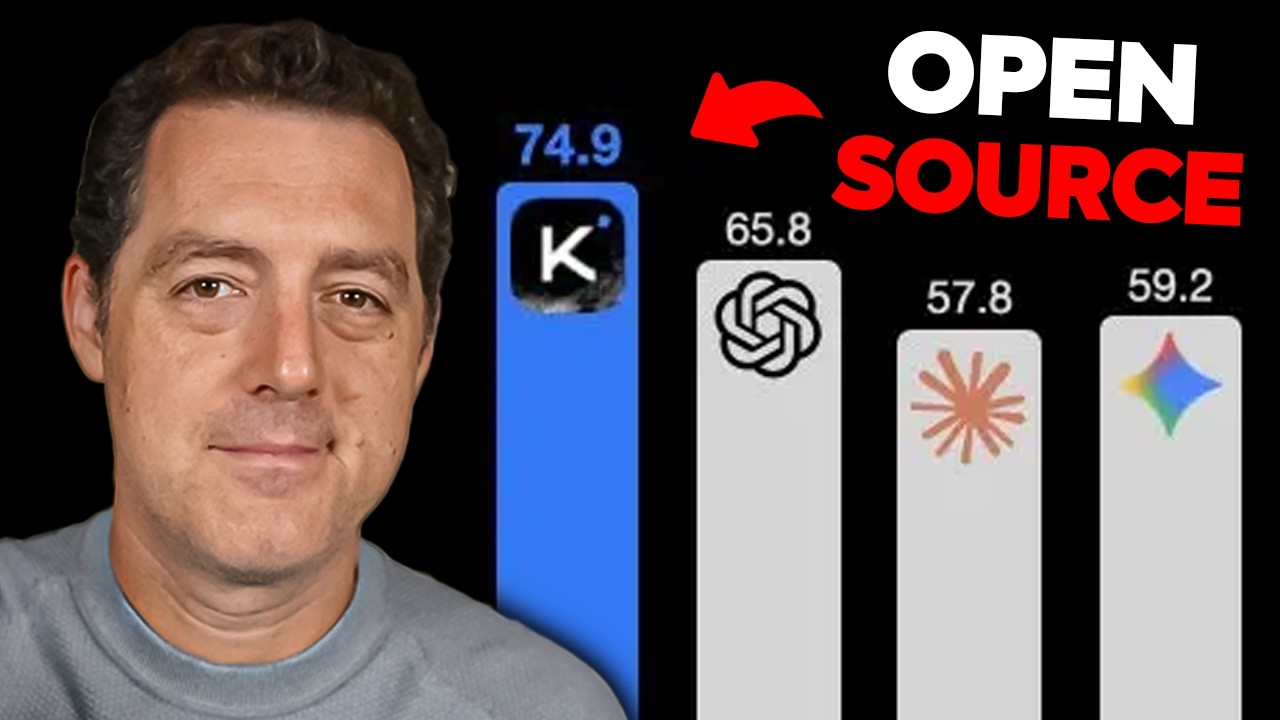
Kimi.ai’s performance charts immediately draw attention. On agentic benchmarks like HLE-Full and BrowseComp, Kimi K2.5 achieved scores of 50.2% and 74.9% respectively. These scores substantially outperform high-thinking level versions of closed models like Claude 4.5 Opus and Gemini 3 Pro. Berman noted this dominance in agentic tasks: "Look at this, BrowseComp, 74.9%. Absolutely destroying the other frontier models." This suggests a massive leap in the model's ability to navigate and interact with complex digital environments autonomously, a core requirement for next-generation AI agents. The model’s agentic search capabilities are clearly superior, winning across DeepSearchQA, WideSearch, and FinSearchComp benchmarks.
The model’s specialty lies in visual coding, branded as "Code with Taste." Kimi K2.5 is positioned as the "strongest open-source model to date for coding," exhibiting particular strength in front-end development by turning simple conversations, images, and videos into aesthetic websites with expressive motion. The demonstration of Kimi K2.5 reconstructing a website from a video input, without any direct code or links, underscores a breakthrough in how AI handles visual intent. This capability "stems from massive-scale vision-text joint pre-training," allowing the model to visually inspect its own output, identify errors, and iterate autonomously. This autonomous visual debugging loop significantly lowers the technical barrier for developers translating design concepts into functional code, moving beyond simple text-to-code generation. Furthermore, the model showcased its reasoning skills by successfully solving a highly complex maze puzzle, implementing pathfinding algorithms (BFS) and visualizing the shortest route, a task requiring sophisticated visual logic and code execution.
Perhaps the most significant architectural update is the introduction of K2.5 Agent Swarm, currently in beta. This paradigm marks a crucial shift from single-agent scaling to self-directed, coordinated execution. Trained with Parallel-Agent Reinforcement Learning (PARL), the orchestrator model learns to decompose complex tasks into parallelizable subtasks, dynamically managing up to 100 sub-agents and executing up to 1,500 tool calls simultaneously without predefined roles or hand-crafted workflows. The result is a substantial reduction in end-to-end runtime, with internal evaluations showing an 80% reduction for long-horizon workloads. Berman pointed out the benefit on complex tasks: "As tasks get more complex, it saves us more and more time." This parallel orchestration allows Kimi K2.5 to maintain near-flat execution times even as task complexity rises, directly addressing the serial collapse failure mode common in sequential agent architectures.
The Agent Swarm architecture allows Kimi K2.5 to handle high-density, large-scale office work end-to-end. It coordinates multi-step tool use, reasoning over large documents, spreadsheets, and slide decks directly through conversation. The model supports advanced tasks like adding annotations in Word, constructing financial models with Pivot Tables, and writing complex LaTeX equations in PDFs, scaling to long-form outputs like 10,000-word papers. The internal AI Office Benchmark shows Kimi K2.5 achieving a 59.3% improvement over its predecessor, K2 Thinking, reflecting stronger end-to-end performance on real-world knowledge tasks.