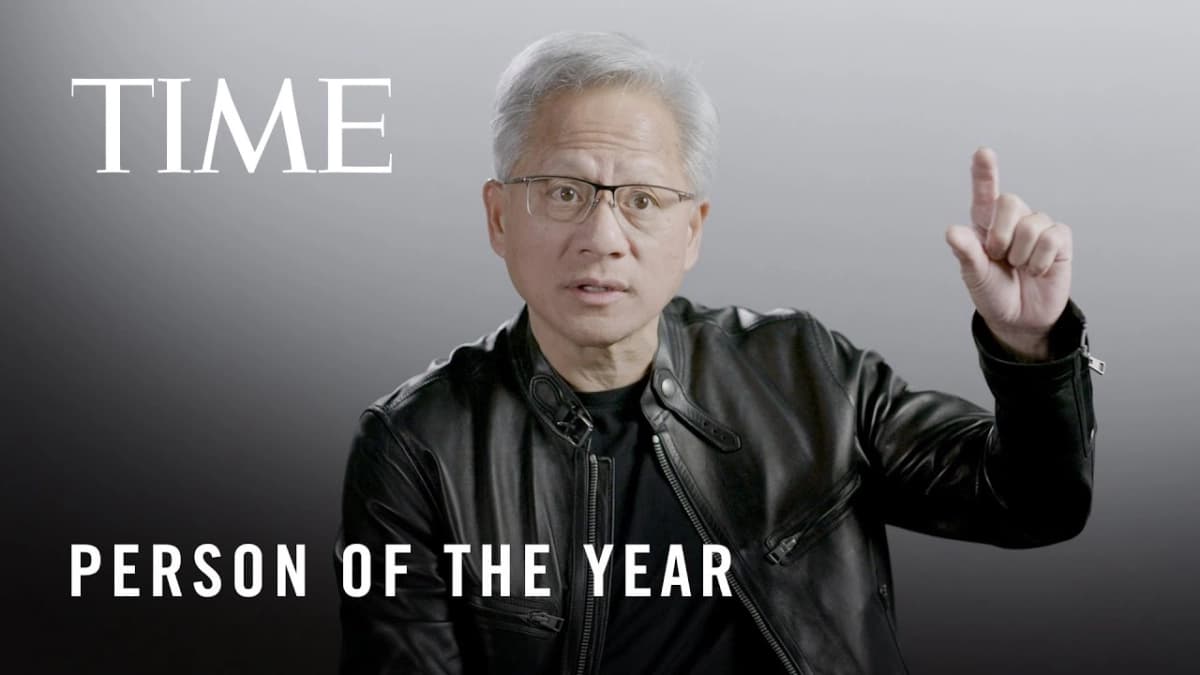
"This is for certain. Everybody's jobs will change as a result of AI. Some jobs will disappear... but a whole bunch of new jobs are created." This direct assessment from Jensen Huang, CEO of Nvidia, set the stage for a wide-ranging discussion with TIME’s Simon Shuster in November 2025 at Nvidia’s Bay Area headquarters. The conversation centered on the seismic shifts induced by artificial intelligence, specifically addressing market skepticism regarding the AI boom, the complex geopolitical dynamics governing technology exports, and the future of global competition between the U.S. and China.
Huang, whose company is the foundational engine of the generative AI revolution, quickly addressed the persistent question of whether the current massive valuation surge represents an irrational financial bubble. He acknowledged that there is "always some irrationality somewhere in the stock market." However, he argued that critics often miss the profound, structural changes happening beneath the surface of the chatbot hype. The true driver, Huang contended, is the shift from general-purpose computing to accelerated computing, a transformation powered almost exclusively by Nvidia’s advanced GPUs. When viewed against the vast opportunity presented by artificial general intelligence (AGI) and the complete overhaul of global computing infrastructure, Huang asserted that current investments are "very modest" in comparison to the overall computing market. For founders and investors concerned about a tech correction, Huang’s analysis suggests the current boom is merely the beginning of a fundamental industrial revolution, not an overextended cycle of hype.
Nvidia’s strategy reflects this long-term belief in accelerated computing. When questioned about Nvidia's practice of investing in high-profile AI startups—a practice some analysts view as creating a potentially circular risk if those startups fail to meet their capital commitments—Huang positioned the investments as strategic ecosystem expansion. He explained that Nvidia's stake in these companies, such as Open AI, is relatively small compared to their overall revenues. Crucially, these investments provide Nvidia with a "front row seat" partnership with the most consequential companies of our time, allowing them to gain early insight into the trajectory and success of the core AI technology stack. This is less about vendor financing, Huang implies, and more about securing influence and insight at the cutting edge of global innovation.
The conversation pivoted sharply toward geopolitics, specifically the growing friction and export controls between the United States and China. Huang, whose Taiwanese heritage and deep roots in Silicon Valley give him a unique perspective, offered a nuanced and firm rejection of the decoupling narrative. He stressed the profound and interwoven economic ties between the two superpowers, stating that the idea of the U.S. decoupling from China is "flawed." He warned that the world is "unaware of how deeply dependent United States and China are to each other." This interdependence extends beyond simple trade to the movement of human capital, particularly in the AI sector, where he noted that 50% of the world's AI researchers hail from China.
Huang’s core policy position is one of managed competition, advocating for resilience and collaboration rather than isolation. He believes that the U.S. must be determined to win at every layer of the AI stack—chips, cloud infrastructure, AI models, and applications—to maintain global leadership. In this context, he views the current administration’s attempts to restrict the sale of high-end chips not as a permanent solution, but as a delicate tightrope walk. He argued that it is in the interest of the U.S. to allow American companies to compete in the global market, including China, to ensure American technology remains the global standard. Huang believes that “the ability for us to engage the China market, compete freely there, earn our business, is great for America.”
This philosophy was further evidenced in his discussion of the Middle East, where U.S. export controls also apply. He argued that the fundamental choice is whether the Middle East builds its burgeoning AI capabilities on the American technology stack or on a competitor’s. “The idea of conceding technology leadership, the idea of conceding a massive market, made no sense to President Trump,” Huang said, reflecting on his interactions with the former president regarding the sale of less powerful, but still advanced, chips to Saudi Arabia. Huang characterized the former President as an "extraordinarily good listener" and praised his commitment to energy growth, which Huang sees as vital to powering the energy-intensive AI industry. Ultimately, Huang sees Nvidia’s role in global markets as contributing to national security by ensuring that American technological dominance—and the economic prosperity that funds military might—is maintained. The wisest approach, he concluded, is enhancing resilience through diversification and redundant supply chains, rather than pursuing an isolationist strategy that forces competitors to become self-sufficient.