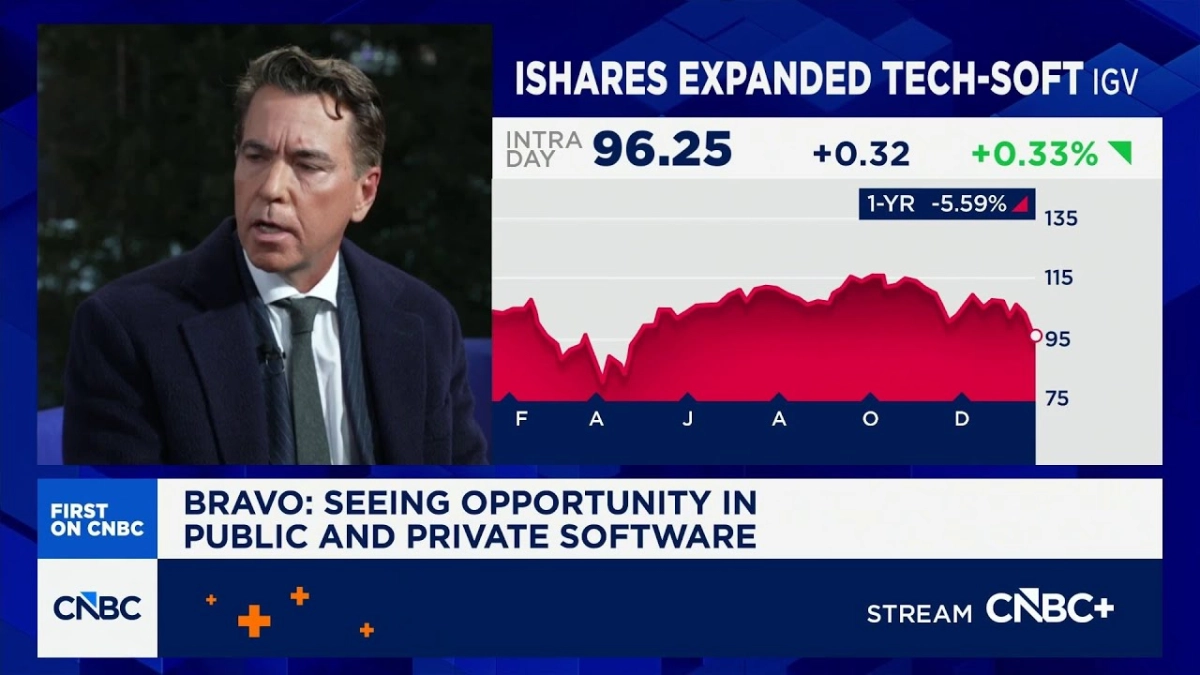
The prevailing narrative that generative AI will swiftly cannibalize the existing enterprise software ecosystem is, according to Thoma Bravo Founder and Managing Partner Orlando Bravo, “absolutely wrong.” Speaking on CNBC’s Squawk on the Street from the World Economic Forum in Davos, Bravo offered a sharp, grounded counterpoint to the breathless Silicon Valley hype, arguing that the technological transformation facing corporations will be evolutionary, not revolutionary, creating immense consolidation opportunities for patient investors who understand the enduring value of deep domain expertise.
Bravo spoke with Sara Eisen and Carl Quintanilla about the intersection of AI, current market valuations, and the private equity landscape. His central thesis is that AI is not a disruptive force poised to obliterate established software vendors, but rather an "enormous infrastructure, much bigger than cloud," that these vendors are uniquely positioned to leverage. The current downturn in software valuations, marked by compressed P/E multiples, is not a sign of existential threat but a prime buying signal for firms looking to consolidate market leaders.

The value proposition of established enterprise software, Bravo explained, lies not merely in the lines of code, but in the accumulated knowledge and deep integration within specific industry workflows—what he terms the "domain franchise." This is a moat that AI startups cannot easily breach. He emphasized that the immense value of these existing platforms lies in the fact that they "cannot be copied by an AI code, because you have to prompt it, or cannot be copied by somebody in Silicon Valley." The proprietary data, the customer relationships, and the workflow integration act as massive barriers to entry, meaning AI will be integrated into these existing systems, not replace them entirely.
This integration, however, will be slow, aligning with the cautious nature of large corporate adoption. When asked about the timeline for this transformation, Bravo agreed with Ken Griffin’s assessment of 10 to 15 years, but then went further, suggesting it could take "even longer." He stressed that the corporate world is fundamentally "evolutionary, not revolutionary." While consumer tech can pivot quickly, enterprise adoption requires meticulous planning, security guarantees, and deep integration into mission-critical systems. This reality dictates a multi-decade growth opportunity, favoring established players who can responsibly deploy AI tools to enhance productivity within their existing customer base, rather than pure-play AI startups trying to build enterprise trust from scratch.
This slow pace of adoption and the current mispricing of assets create a perfect environment for consolidation, a strategy Thoma Bravo has perfected. Bravo noted that the lower PE multiples in software mean that large strategic buyers are now less at risk of multiple compression when they execute acquisitions. This trend favors the biggest players who can broaden their platforms and position themselves to better serve customers in the AI world.
Thoma Bravo’s strategy is explicitly centered on identifying and acquiring the number one player in a given domain, even if they have to "pay up for it." The subsequent step is to radically improve operational efficiency, often by boosting margins from 10% to 40%. This operational overhaul prepares the acquired companies to be more attractive targets for strategic buyers down the line. Bravo cited the example of Anaplan, which they acquired with an eye toward consolidation, transforming it from a company valued in the $20–25 billion range to one they believe could be worth $50–70 billion after strategic growth and market consolidation.
The immediate impact of AI is already visible in the financial performance of Thoma Bravo’s portfolio companies, with Bravo noting a "big boom in the quarterly bookings" partly attributable to the immediate, productivity-enhancing applications of AI. This suggests that while full corporate transformation is a long-term project, companies are already investing in tools that make existing labor more productive, a key theme of enterprise AI adoption.
For founders and investors navigating this environment, Bravo’s message is clear: the underlying franchise value of specialized enterprise software remains robust. The true winners in the AI era will be those who possess the domain expertise, the established customer base, and the operational maturity to integrate AI capabilities incrementally and effectively over the long arc of corporate evolution, rather than those relying solely on revolutionary technology without a foundational market position. The current market volatility merely provides an opportune moment for well-capitalized private equity firms and strategic buyers to acquire these foundational assets at favorable valuations, preparing them for the multi-decade boom ahead.