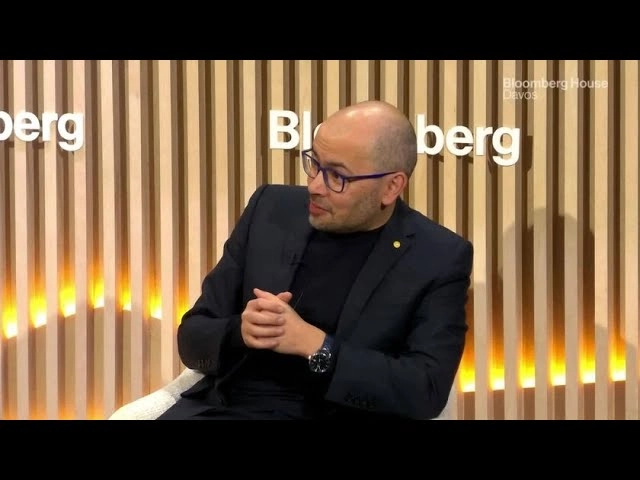
“It’s going to be 10 times bigger and 10 times faster than the Industrial Revolution.” This bold declaration by Demis Hassabis, Co-Founder and CEO of Google DeepMind, set the tone for a candid discussion on the state of artificial general intelligence (AGI) and the future of global technology. Speaking with Bloomberg’s Emily Chang at Bloomberg House in Davos during the 2026 World Economic Forum, Hassabis provided a sharp assessment of Google’s competitive position, the immediate challenges in achieving true AGI, and the societal implications of this unprecedented technological acceleration.

The conversation immediately addressed the intense competitive dynamics that have characterized the AI race over the last few years. Chang noted the perception that Google had previously lost some of its "mojo," particularly compared to rivals launching high-profile products. Hassabis countered this, asserting that Google and DeepMind’s foundational contributions, from the Transformer architecture to deep reinforcement learning breakthroughs like AlphaGo, have always underpinned the modern AI industry. He emphasized that the company had spent the last couple of years intensely focused on getting its models back to state-of-the-art, a goal successfully realized with the release of Gemini 3 and its imaging counterpart, Imagen.
Hassabis views Google’s structural setup as its most significant long-term advantage. Unlike pure-play AI labs or competitors reliant on external infrastructure, Google controls the entire stack: the specialized Tensor Processing Units (TPUs) and hardware, the data centers, the frontier research lab (DeepMind), and the billion-user product surfaces that are a natural fit for AI integration, from Search and Gmail to Chrome. This vertical integration, coupled with what Hassabis describes as a newly adapted "startup energy" for rapid deployment, positions them strongly for the next phase of innovation. “We’re the only organization that has the full stack,” he stated, emphasizing that this holistic control allows them to push the boundaries of research and commercialization simultaneously, promising significant “headroom” yet to be realized.
The path to AGI remains DeepMind’s primary, long-term focus, and Hassabis maintained his previously stated timeline: a 50% chance of achieving AGI by 2030. He clarified that AGI, by his definition, requires a system that exhibits all the cognitive capabilities humans possess. The current generation of large language models (LLMs) falls short of this mark, suffering from what he terms “jagged intelligence”, systems that are brilliant at some tasks but surprisingly poor or inconsistent at others. To bridge this gap, fundamental breakthroughs are still required beyond mere scaling. These include advancements in reasoning, long-term planning, and, crucially, integrating physical intelligence.
Hassabis spent considerable time on the frontier of physical intelligence, particularly robotics. He believes the world is on the cusp of an "AlphaFold moment" for the physical world, driven by multimodal models like Gemini that can understand and interact with the environment. DeepMind is collaborating closely with partners like Boston Dynamics and Hyundai to apply these models to automotive manufacturing. However, he noted that the complexity of the physical world requires algorithms that are far more robust and can learn effectively with less data than is typically used for digital models. Furthermore, the hardware itself remains a limiting factor. Hassabis expressed a "newfound appreciation for the human hand," noting that evolution has designed an intricate mechanism whose reliability, strength, and dexterity are currently impossible to match with robotics. He estimates that widespread, reliable deployment of robots capable of complex tasks is still 18 to 24 months away, requiring more dedicated research to solve these algorithmic and hardware constraints.
Beyond the technical hurdles, the magnitude of the coming AI shift demands immediate global attention. Hassabis reiterated his view that this disruption will be 100 times the scale of the Industrial Revolution, fundamentally altering the global economy. When pressed on the widespread anxiety regarding job displacement, specifically the prediction that 50% of entry-level white-collar jobs could be wiped out in five years, Hassabis offered a longer, more nuanced timeline. While acknowledging that disruption will happen, he suggested that the true impact of AGI transcends the labor market; it pushes humanity toward a "post-scarcity world" by solving fundamental problems like energy and materials science.
However, achieving this benevolent future requires international collaboration, which is currently fragile. Hassabis advocated for a unified, rigorous, and scientific approach to the final steps toward AGI, perhaps through an international body akin to CERN, involving philosophers, social scientists, and economists alongside technologists. This cooperation is essential for establishing safety and security protocols that hold global weight, especially given the rapid advancements being made by Chinese companies like ByteDance, which he believes are capable and perhaps only six months behind the leading Western frontier labs. He stressed that without global agreement, any safety measures implemented by a single company or nation are largely ineffective.
For founders and business leaders navigating this landscape, Hassabis offered clear advice focused on adaptability and partnership. The biggest mistake is underestimating the speed and scale of the change. For the next generation, the key skill is "learning to learn", the ability to quickly adapt, absorb new information, and use the powerful tools being created. For leaders, he advised partnering with companies whose mission and ethics align with their own vision for the future. Hassabis concluded by emphasizing that Google’s deeply ingrained culture as a scientific, research-led organization, a culture dating back to its founders’ PhD projects, makes it the right entity to navigate this complex, high-stakes moment, focusing on building tools that enhance human scientific endeavor and exploration.