


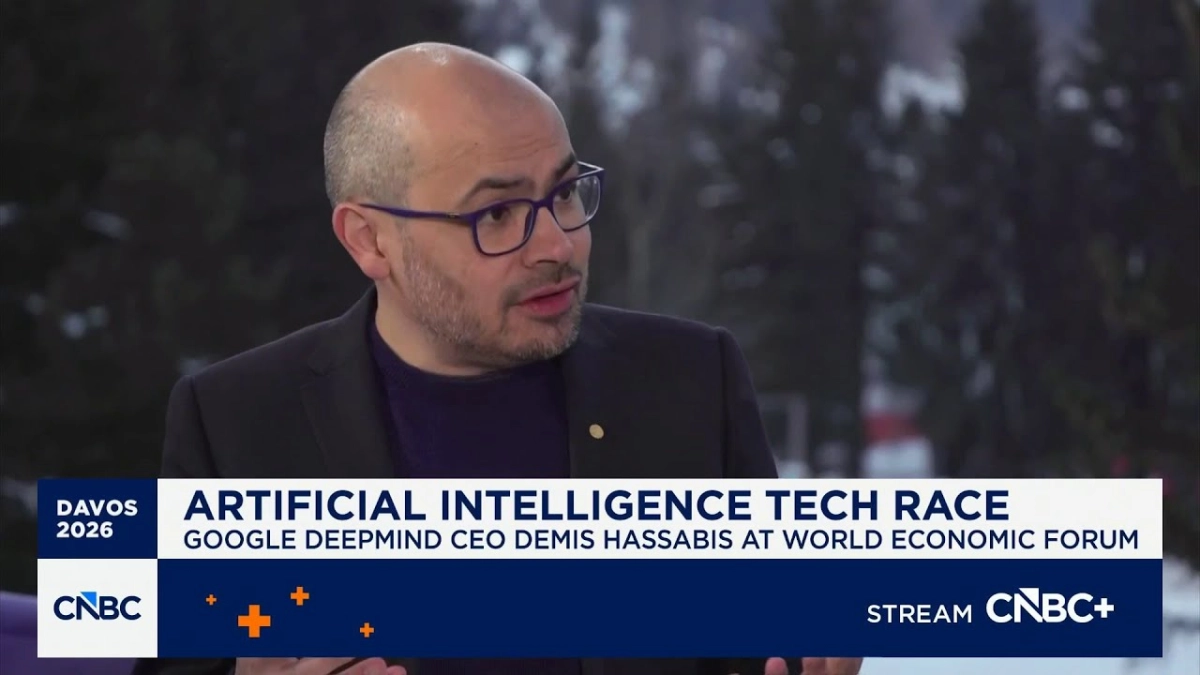
Demis Hassabis, Co-founder and CEO of Google DeepMind, offered a measured yet assertive view on the state of artificial intelligence, suggesting that while the industry is currently reaping massive gains from scaling existing foundation models, the journey to true Artificial General Intelligence (AGI) still demands fundamental scientific breakthroughs. Speaking with Andrew Ross Sorkin at the World Economic Forum in Davos, Hassabis addressed the dual challenges facing Google: integrating its powerful Gemini models across its massive product surfaces and simultaneously pushing the boundaries of core research required to achieve human-level intelligence.
The interview, captured during the Davos 2024 proceedings, centered on three main pillars: the rapid productization of Gemini, the technical roadmap toward AGI, and the socioeconomic implications of this technological acceleration, particularly regarding the perceived AI bubble and the future of work. Hassabis framed Google’s recent successes, including the integration of Gemini into Apple’s Siri, as the culmination of years of strategic organizational alignment. He noted that the last couple of years have been spent “to kind of corral together all of the assets that we have as Google and DeepMind: incredible research bench, our TPUs, and all of the kind of research we’ve been doing over the last decade plus really that underpins a lot of the AI industry.” This perspective underscores the competitive advantage held by hyperscalers who control both the cutting-edge research and the proprietary compute infrastructure necessary to train and deploy these models efficiently.
The deployment of Gemini 3 is now moving rapidly beyond the initial research bench and into consumer products. Hassabis confirmed that the focus this year is accelerating the infrastructure necessary to inject the latest model quality “as quickly as possible into our product surfaces.” This is evident in the simultaneous rollout across Search, the dedicated Gemini app, and soon, deeper integration into core services like Gmail. For enterprise and startup audiences, this signals Google’s decisive shift from foundational research exhibition to pervasive product integration, ensuring that the fruits of DeepMind’s labor immediately reach billions of users, transforming existing workflows and application layers. This speed of deployment is a critical metric in the current AI race, where marginal improvements in model quality must translate into immediate, tangible user value to maintain market leadership.
A core point of divergence in the current AI landscape is whether AGI can be achieved simply by scaling up current Large Language Models (LLMs) or if a paradigm shift is necessary. Hassabis offered a nuanced, empirically grounded answer, stating, “I think it’s an empirical question.” He elaborated that while models like Gemini continue to improve with each iteration and scale, providing "lots of amazing gains out of pushing the existing paradigms," there remain several crucial missing capabilities necessary for full AGI. These missing elements—which include true continual learning, long-term planning, reasoning, and genuine creativity—cannot be solved by brute force scaling alone. This suggests that the next major inflection point will not be purely an engineering feat but a scientific one, requiring new algorithmic architectures or training methodologies that mimic human cognitive abilities far more closely than current transformer models.
The discussion also touched upon the financial exuberance surrounding the sector, specifically the question of an "AI bubble." Hassabis carefully avoided a binary classification, suggesting that the industry is now large and complex enough to contain both legitimate value creation and speculative froth. He observed that certain parts of the market, particularly nascent startups “raising billions of dollars in a seed round with no product or technology yet, that seems a little bit frothy to me and perhaps unsustainable.” However, he contrasted this venture capital enthusiasm with the reality of widespread, impactful use cases already materializing across major platforms. This insight is crucial for VCs and investors seeking to distinguish between vaporware built atop existing APIs and genuinely defensible foundational technology.
Regarding the massive capital expenditure on data centers and advanced chips (TPUs), Hassabis confirmed the necessity of compute power for training, serving, and exploring new ideas. However, he also emphasized the importance of efficiency. He pointed to the Gemini 3 Flash model, designed as the workhorse for broad deployment, noting that making leading models “as efficient as possible” is paramount because it allows them to be deployed ubiquitously. This focus on efficiency indicates that while the race for raw compute power continues, the ability to deploy powerful models cheaply and widely will be the ultimate determinant of market penetration and profitability.
Finally, addressing widespread concerns at Davos about AI’s impact on the job market, Hassabis maintained an optimistic stance focused on augmentation and new opportunity creation. While acknowledging minor impacts at the entry level (internships), he believes that over the next five years, job displacement will be "more than made up for with extraordinary new opportunities these tools are going to deliver." His advice to the next generation is pragmatic and sharp: “Get unbelievably proficient with the new tools, immerse yourself in it, become native with it, and then leapfrog whatever professional ladder you’re trying to get onto, leapfrog the incumbent people on that with these new skills.” Hassabis sees AI as fundamentally changing the workplace not through elimination, but through radical productivity enhancement, rewarding those who master the new technological instruments.


