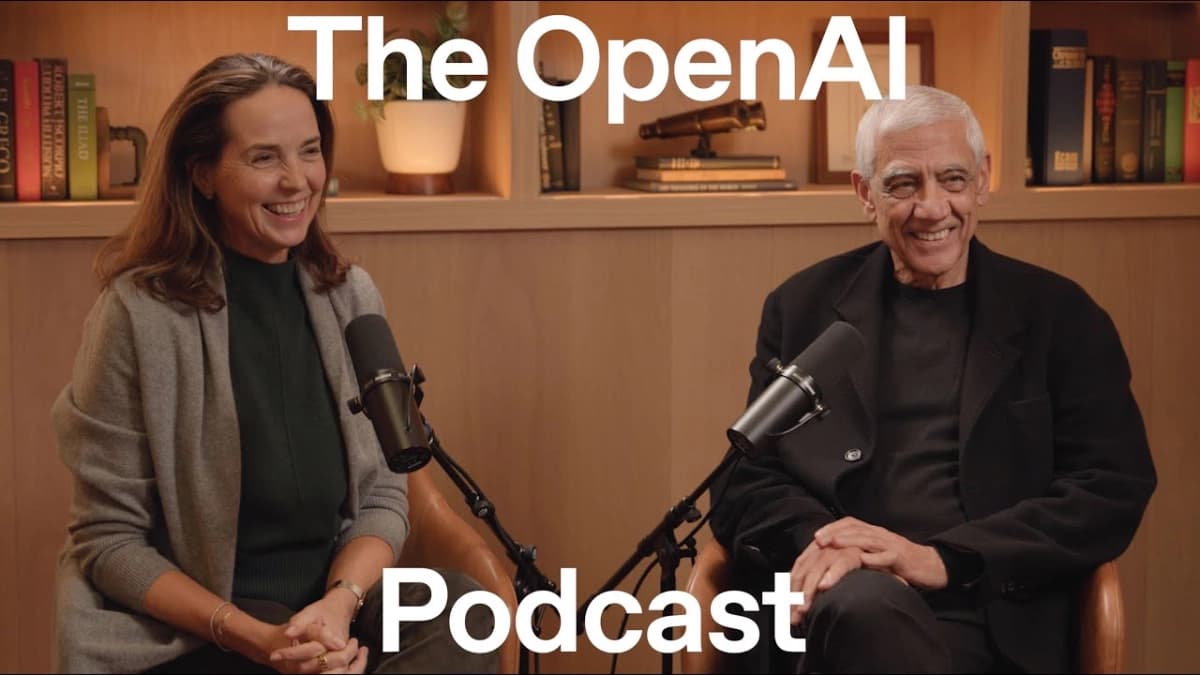
“Demand is limited not by anything other than availability of compute today.” This stark assessment by legendary venture capitalist Vinod Khosla cuts directly to the core challenge facing the artificial intelligence industry, a challenge that is simultaneously a massive opportunity. Khosla, founder of Khosla Ventures and an early investor in OpenAI, joined Sarah Friar, OpenAI’s Chief Financial Officer, on the OpenAI Podcast to discuss the state of the AI ecosystem, arguing that the current phase is less a speculative bubble and more an infrastructural revolution limited only by the physical resources required to sustain its explosive growth.
The conversation between Khosla and Friar provided a rare, high-level perspective on the technological and financial dynamics driving the current AI boom. Their central consensus was that the industry has decisively moved past questions of capability and now faces a two-fold constraint: scaling the enormous computational infrastructure required to meet demand, and helping consumers and enterprises learn how to fully leverage the intelligent tools they now possess.
The discussion quickly centered on the staggering scale of investment necessary for true frontier AI development. Friar provided concrete figures illustrating the rapid escalation of OpenAI’s infrastructure needs, noting that the company’s compute consumption has grown exponentially alongside its revenue. She explained that this growth isn’t just linear; it’s accelerating to keep pace with an insatiable market appetite. “We exited 2023 at 2 billion in ARR... We exited last year a little over 20 billion,” she stated, correlating this revenue growth with a corresponding massive increase in compute, moving from megawatts to gigawatts of capacity needed. This level of investment signals a fundamental shift: AI is not merely a feature layer but a new utility, akin to electricity, requiring foundational infrastructure that must be provisioned years in advance.
This commitment to scaling compute capacity is essential because the capabilities being unlocked are transitioning from simple question-and-answer interactions to complex, multi-step operations performed by intelligent software agents. Khosla emphasized that the true impact of AI will be seen not when the models get marginally smarter, but when these agents mature enough to execute full, complicated tasks autonomously. He projects that 2026 will be a key year for this shift, particularly in multi-agent systems capable of managing entire enterprise functions. He envisions a world where AI agents handle complex workflows, "like running an ERP system for you... doing all the reconciliation every day, accruals every day, tracking contracts every day." This evolution moves the value proposition from simple automation to deep operational transformation.
The challenge now lies in bridging the gap between the phenomenal capability of current models and the actual usage patterns of the masses. Khosla notes that only a “single-digit percentage” of users today are utilizing even 30% or 50% of the AI’s capability, suggesting a vast latent demand waiting to be unlocked once usability improves and agents become truly task-oriented. Friar highlighted this adoption deficit, comparing it to the early mobile revolution where users initially just replicated desktop websites before leveraging native capabilities like GPS and cameras. AI is currently in the "desktop website" phase of mobile adoption—the power is there, but users are still learning the profound new things they can do with it.
Nowhere is this transformation more critical than in highly regulated, high-stakes verticals like healthcare. Friar cited remarkable internal data showing that “230 million people every week ask ChatGPT a health question,” and critically, “66% of US physicians say they use ChatGPT in their daily work.” This suggests AI is already serving as a powerful cognitive augment for both patients and practitioners. Khosla reinforced this, stating that AI will "revolutionize health... by making expertise be a commodity." He acknowledged that regulatory hurdles, such as the FDA or AMA institutional control, slow down the process—for instance, AI cannot legally write a prescription yet—but the fundamental cost of medical intelligence is dropping year over year for the first time, a trend that is impossible to ignore.
This real, measurable utility is why Khosla dismisses the frequent comparison of the current AI boom to the dot-com bubble. He argues that observers conflate stock prices with underlying technical adoption. "Bubbles should be measured by the number of API calls," Khosla asserted, distinguishing market excitement driven by "fear and greed among investors" from the actual, exponential growth in real usage. The underlying demand for compute power and the demonstrable productivity gains in companies that successfully deploy AI agents—such as one firm managing $150 million in annual recurring revenue with only a single human controller overseeing AI-driven ERP systems—are tangible realities that underpin the current valuations.
Ultimately, the consensus was that AI represents a massive shift in how value is created, driving productivity gains by automating drudgery and allowing human capital to shift toward growth-oriented tasks. For enterprises, this means shifting human talent from mundane tasks like reading contracts for non-standard terms to high-value areas like business strategy. For startups, success lies not in building the foundation, which is now dominated by giants like OpenAI, but in building specialized, sophisticated applications on top of the foundational models, solving deep vertical problems in ways that align with the core mission of democratizing intelligence. The future of AI is not a fragile bubble waiting to burst, but an infrastructure that demands continuous, massive investment, driven by the unprecedented utility it delivers across every sector of the global economy.