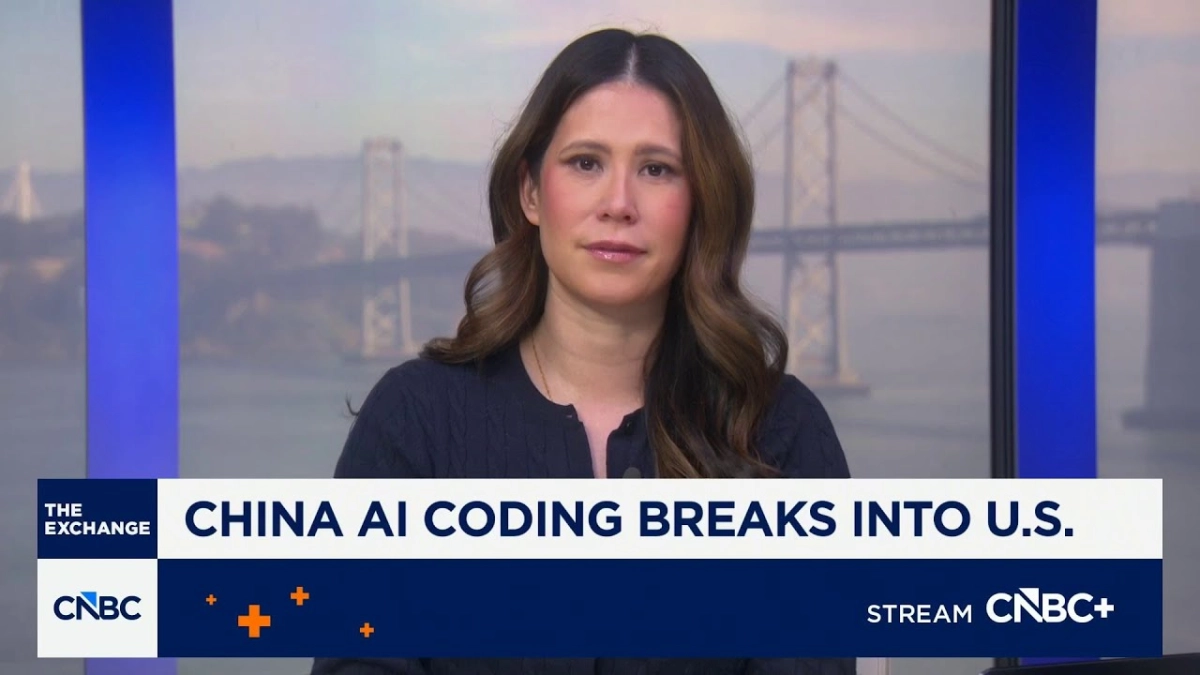
Coding is rapidly becoming the key battleground in the artificial intelligence race, and according to CNBC's Deirdre Bosa, a major surprise is emerging from the East: a top-ranking Chinese AI startup is seeing overwhelming demand for its coding agents not just domestically, but right here in the United States. This development signals a critical shift in the competitive dynamics of generative AI, demonstrating that technological excellence, especially when paired with an open-source distribution strategy, can easily transcend national borders and geopolitical tensions.
Bosa reported on the unexpected success of Zhipu AI, a company that recently went public in Hong Kong, and its GLM Coding Plan. Following the release of its latest model, GLM 4.7, the company saw a fivefold jump in online traffic. The truly striking data point, however, was the geographic concentration of this new user base. Bosa noted that the company confirmed, "The user base of the Zhipu GLM Coding Plan is primarily concentrated in the United States and China, followed by countries such as India, Japan, Brazil, and the United Kingdom." This revelation—that a Chinese model is achieving a breakout moment among US developers, the very audience targeted by OpenAI’s and Google’s most advanced tools—underscores a growing realization among VCs and tech leaders: the AI talent and innovation pipeline is now truly globalized, and US regulatory efforts are failing to contain the flow of cutting-edge models.
The anchor framed the context clearly, stating, "Coding is really the key battleground in AI. It’s the first place where models turn into daily tools and where agents do real work." This focus on coding agents—AI tools capable of generating, debugging, and maintaining complex software autonomously—represents the next frontier beyond basic chatbots. The ability of Zhipu to capture significant US developer mindshare suggests an achievement of performance parity, or even superiority in specific tasks, relative to Western counterparts. This performance is amplified by the model’s open-source nature, a strategy that is proving highly effective for rapid, global distribution.
The shift toward open-source models is accelerating the commoditization of foundational AI capabilities. Just as general-purpose chatbots became ubiquitous and easily replicated, coding agents are following suit. Bosa and her team tested the Zhipu agent, prompting it to create a functional market tracker for top Hong Kong public companies, complete with a modern aesthetic and real-time notifications. The agent delivered the complex, self-contained application from a single prompt. This real-world capability demonstrates that high-quality, specialized AI agents are becoming readily accessible, making proprietary closed models vulnerable to competition based on cost, customization, and community adoption.
China’s competitive edge here relies heavily on the open-source model. Zhipu, much like DeepSeek, leverages open models as a core distribution strategy. Open-source models are inherently cheaper to run, easier for enterprises to customize for specific internal tasks, and critically, "they’re harder to be cut off from," Bosa observed, touching upon the acute geopolitical risks facing US-China tech exchange. For founders and large enterprises, the ability to fine-tune a powerful open-source model offers significant advantages over reliance on opaque, expensive, and potentially restricted closed APIs. This flexibility allows for faster iteration and deployment in specialized domains.
The success of Zhipu is not an isolated incident but rather indicative of a broader trend where Chinese AI research is excelling outside the constraints of US-centric ecosystems. While Western leaders often focus on the perceived safety and alignment advantages of their closed models, the practical utility and accessibility of Chinese open-source models are winning over developers globally. If the performance benchmarks are the measure, the Chinese firms are demonstrating significant capability. The reporter concluded her segment by noting that if you look at the leaderboards of models, "especially open-source, the Chinese ones are right at the top." This confirms that Zhipu's viral demand is built on genuine technical strength, cementing the rise of open-source AI as a truly global, and highly competitive, technological force.