


China’s AI IPO Surge Highlights US Private Market Paradox

4 min read
China’s AI IPO Surge Highlights US Private Market Paradox

“China’s AI boom, it’s showing up in public markets, forcing price discovery, real-time feedback on how much risk investors are actually willing to underwrite.” This is the stark divergence defining the global artificial intelligence landscape, as reported by CNBC’s Deirdre Bosa. The core distinction lies in the accessibility of capital and the willingness of regulatory bodies to push frontier technology onto public exchanges. While America’s foundational AI companies remain locked in the secretive, high-valuation world of private funding, China is experiencing a government-backed IPO revival that is rapidly injecting liquidity and market visibility into its domestic AI ecosystem.

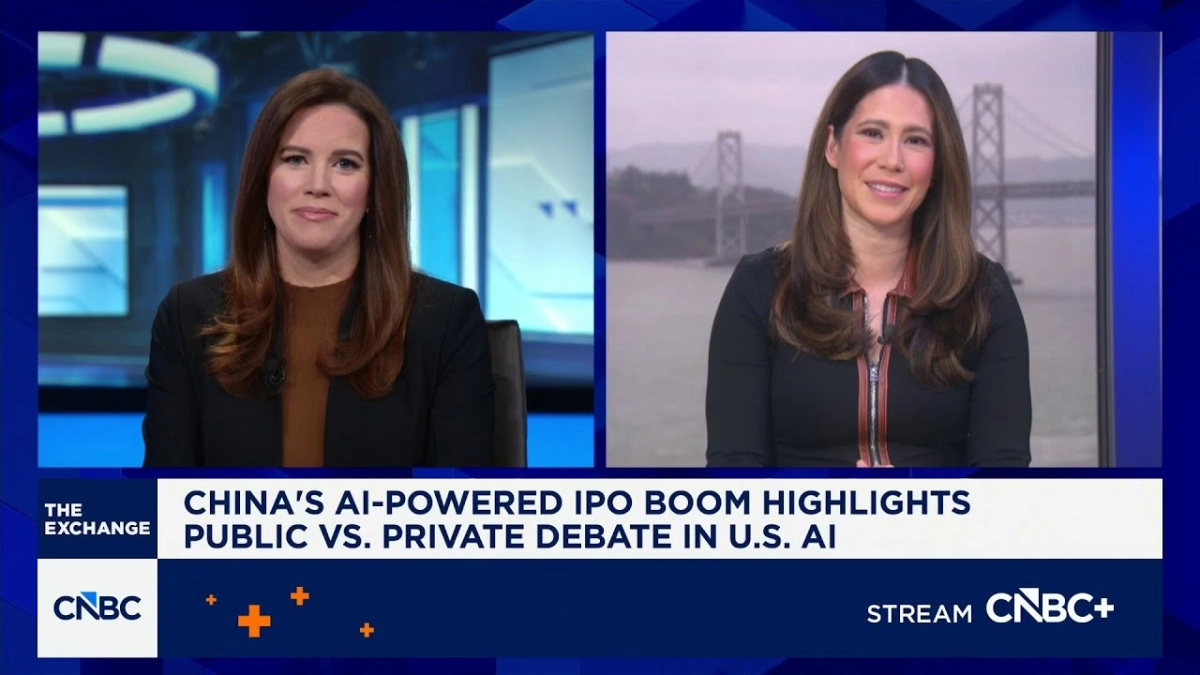
CNBC’s Deirdre Bosa reported on this dynamic during a segment on The Exchange, outlining how China’s AI-driven public market revival directly contrasts with the heavily guarded, privately priced core of American generative AI innovation. This shift signals a crucial difference in how the two superpowers are capitalizing on the AI revolution, creating disparate opportunities and risks for global investors and founders alike.

The evidence of this public boom in China is irrefutable. Recent debuts by AI chipmakers have demonstrated explosive growth. Moore Threads, often dubbed China’s answer to Nvidia, listed in early December and soared 500% on its debut. Another chipmaker, Metax Integrated Circuits, surged nearly 700%. These chip-focused IPOs are now being followed by model builders like MiniMax and Zhipu AI, expected to list soon, signaling that the entire vertical stack of Chinese AI—from hardware to large language models—is moving toward public exposure. This immediate liquidity contrasts sharply with the challenges many Chinese startups face in accessing late-stage private capital, making the IPO route one of the few viable ways to raise substantial funds.

Related startups

The situation in the United States is the inverse. The most important model builders, such as OpenAI, remain privately valued at staggering sums. Investors are left trading around the core AI asset, placing bets on companies like Nvidia, Microsoft, and Oracle, whose fates are inextricably linked to the private giants but offer no direct equity access to the models themselves. This results in less visibility, more guesswork, and reduced access for ordinary investors seeking a direct play on the foundational AI technology. As Bosa noted, "The core of the AI race, that’s model builders, it remains locked up and privately priced."

This dichotomy is not solely driven by market dynamics; it is fundamentally a matter of strategic government intervention. Beijing’s strategy appears calculated to foster domestic champions and mitigate the impact of U.S. chip export controls. The state is actively creating market conditions that favor local development, even if the initial demand appears artificially inflated.

Beijing is using its market levers to ensure that domestic AI firms prioritize homegrown hardware. This accelerates the development cycle for local chipmakers who might otherwise struggle to compete globally.

The government’s influence goes beyond mere encouragement. The massive demand driving the chipmaker IPOs is often rooted in state mandates. Chinese AI firms are being strongly incentivized, and in some cases explicitly told, to shift their procurement away from foreign suppliers, regardless of performance parity. This creates a guaranteed customer base for domestic firms like Moore Threads. Bosa described this regulatory push critically, stating the government is not just "allowing, encouraging, I would say propping up, creating artificial demand." This intervention ensures that capital is channeled directly into the strategic areas Beijing deems critical for technological self-sufficiency, particularly in advanced silicon.

For founders and investors in the U.S. AI sector, the Chinese public surge presents a crucial benchmark and a competitive warning. While U.S. private capital pools are deep enough to sustain companies like OpenAI and Anthropic through successive mega-rounds, the lack of public price discovery introduces opacity and risk that the Chinese market, ironically, is currently circumventing. Chinese investors now have access to a "purer play" AI trade encompassing both chipmakers and model builders.

The long-term implications of these divergent strategies are profound. China is sacrificing the immediate global quality advantage of U.S. chips for the sake of accelerated domestic capacity and national security. By forcing its AI ecosystem into public markets, China is achieving a form of price discovery and liquidity that, while potentially volatile, validates the domestic technological trajectory. Meanwhile, the U.S. continues to rely on massive, opaque private valuations, concentrating the wealth and knowledge surrounding the core AI assets among a handful of venture capitalists and corporate giants. This capital allocation strategy in the U.S. may preserve flexibility for the private firms, but it ultimately restricts broad market participation in what is arguably the most transformative technology sector globally.

© 2026 StartupHub.ai. All rights reserved. Do not enter, scrape, copy, reproduce, or republish this article in whole or in part. Use as input to AI training, fine-tuning, retrieval-augmented generation, or any machine-learning system is prohibited without written license. Substantially-similar derivative works will be pursued to the fullest extent of applicable copyright, database, and computer-misuse laws. See our terms.