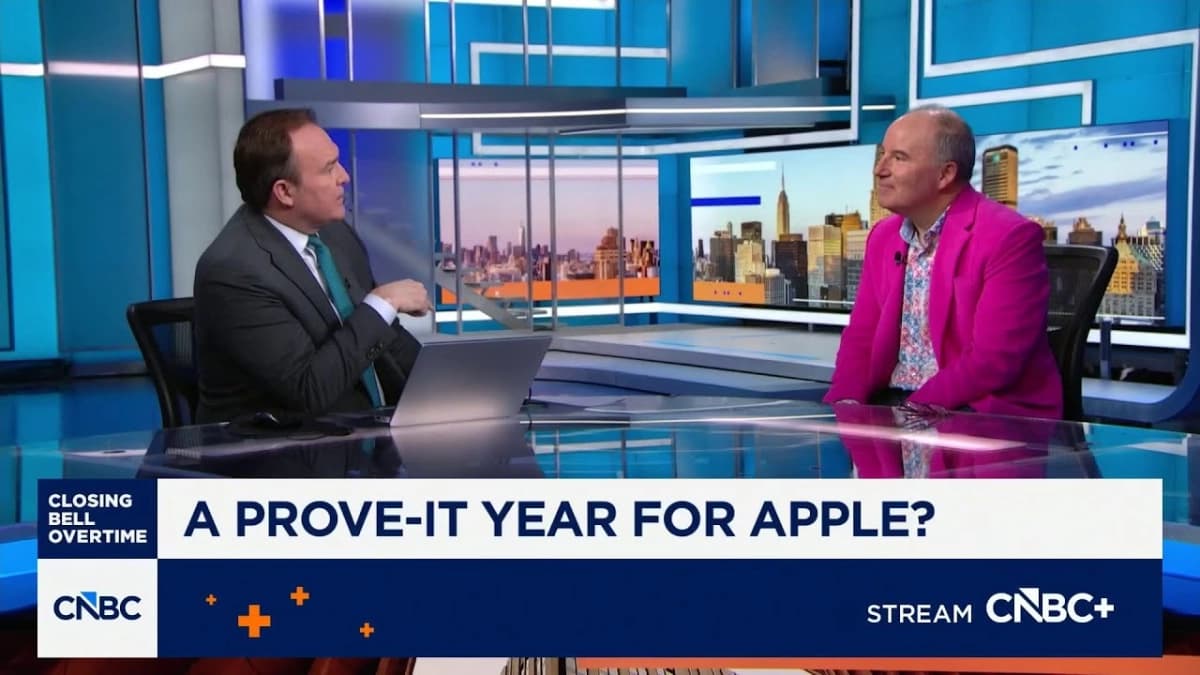
The clock has officially struck midnight for Apple’s internal AI strategy, forcing the company into a necessary, albeit complex, partnership with Google. Wedbush Securities Global Head of Technology Research, Dan Ives, articulated this stark reality on CNBC’s Closing Bell Overtime, framing 2024 as a crucial “prove it” year for the Cupertino giant. Ives spoke with CNBC’s Brian Sullivan about the shifting dynamics of the AI arms race, the surprising resilience of Google’s search business, and the antitrust implications of a massive consumer-facing collaboration between the two tech titans. The core message was clear: Apple cannot afford to build its generative AI foundation alone, and the path to next-generation AI features on the iPhone runs directly through Google’s Gemini.
Ives first addressed the monumental reversal of fortune for Google (Alphabet) over the past year. Twelve months ago, market sentiment suggested that the rise of generative AI would fundamentally “ruin search,” leading to a massive disruption of Google’s primary revenue engine. This narrative proved dramatically incorrect. Instead, Google leveraged its decades of research and infrastructure, pushing its AI capabilities—culminating in the Gemini model—to the forefront of the industry. Ives noted that the widespread fear that search would be replaced by AI queries was misplaced. “The exact opposite has happened,” Ives stated, noting that Google is now firmly “in the driver’s seat” of the AI transition, demonstrating that the initial panic surrounding its core business was premature. This success positions Google not merely as a competitor, but as the indispensable partner Apple now desperately requires.
Apple’s position, despite its trillion-dollar valuation and vast cash reserves, is considerably more tenuous in the context of consumer-facing generative AI. The company, known for its preference for building technology internally and maintaining tight control over its ecosystem, has fallen behind in the large language model (LLM) race. Ives characterized Apple’s efforts as being “on a treadmill at 2.0 speed,” suggesting a dangerous lack of velocity compared to rivals like Google and Microsoft. This deficit is particularly critical because the next wave of consumer technology—driven by predictive, personalized AI—will be delivered directly through the smartphone interface, an area where Apple dominates hardware but lags in intelligence.
The solution, according to Ives, is an urgent strategic alliance between Tim Cook and Sundar Pichai, potentially leveraging Google’s Gemini model to power a massively upgraded, AI-infused Siri. The integration of advanced generative AI into the iOS operating system would instantly revitalize the core user experience and provide the necessary intelligence layer Apple currently lacks. This partnership is viewed by Ives as a necessary pivot to ensure Apple remains competitive in the evolving mobile landscape. Ives believes that this strategic alignment is the defining necessity for Apple’s growth trajectory: “The only way Apple’s, in my opinion, the watershed moment, is ultimately Google next Siri.”
The imperative for Google to engage in such a deal is equally compelling, driven by the sheer scale of Apple’s device footprint. While Google controls the Android operating system, Apple’s user base remains highly valuable, particularly in affluent markets. Ives highlighted the financial motivation for Google: “There is about 2.4 billion reasons… on the iPhone why they want to do this. Because for them, this is going to give them the opportunity to monetize within that installed base.” By integrating Gemini into iOS, Google gains an immediate, massive distribution channel and the ability to monetize AI services, potentially through subscription models, across the most valuable consumer ecosystem globally.
However, such a powerful collaboration between two of the world’s most influential tech companies immediately raises significant regulatory and antitrust alarms. This tension was underscored by comments from Elon Musk, who recently slammed the potential Apple-Google deal, tweeting that it seems like an “unreasonable concentration of power for Google, given that they also have Android and Chrome.” The concern is that by consolidating the two major mobile operating systems (iOS and Android) under Google’s AI umbrella, they create an insurmountable duopoly, stifling innovation and competition.
Ives, however, appeared largely unconcerned by the regulatory threat, noting that Google’s recent victory in the DOJ antitrust suit regarding its search engine dominance provides a significant buffer. The outcome of that case, which affirmed Google’s ability to maintain its search default status, emboldens the company to pursue massive strategic partnerships. Ives views the current moment as one where the need for speed and technological advancement overrides regulatory scrutiny, asserting that the reality is simply that "stronger is going to get stronger.” For Apple, the risk of falling permanently behind in the AI revolution is a greater danger than the potential headache of antitrust review. The partnership is framed not as an anticompetitive maneuver, but as a survival mechanism necessary to inject state-of-the-art AI into the iPhone experience. The financial upside of executing this deal is substantial, according to Ives, estimating that successful AI integration via Google could unlock $75 to $100 per share upside for Apple, repositioning the stock for a major re-rating relative to the other AI leaders.