The strategic importance of Anthropic’s Claude Agent SDK lies not merely in its capacity to generate code, but in its ability to autonomously inhabit and operate within a live development environment. This marks a profound inflection point in AI architecture, shifting the paradigm from the large language model as a passive suggestion engine to a stateful, goal-driven software contributor. For founders and engineering leaders, the Agent SDK represents a significant step toward achieving true engineering leverage, minimizing the tedious, multi-step iteration cycles that define modern software development.
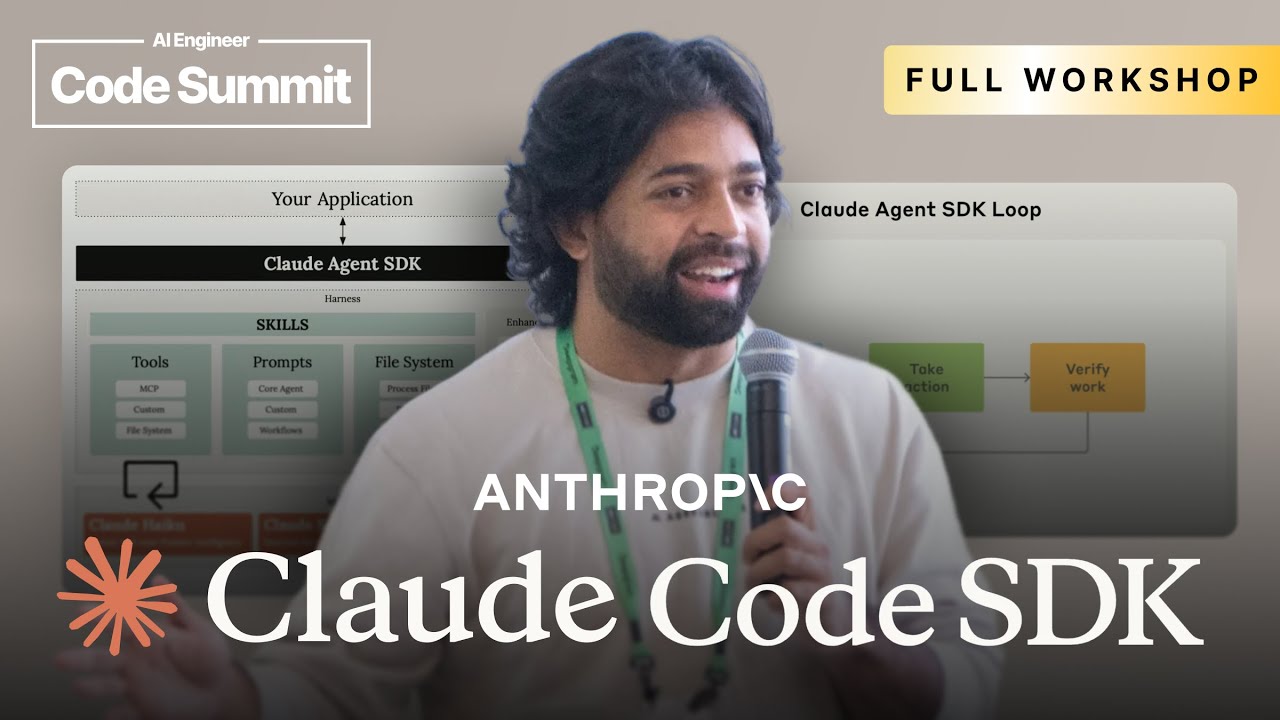
Thariq Shihipar, a key contributor at Anthropic, presented a comprehensive workshop detailing the mechanics and implications of the Claude Agent SDK, demonstrating how the system enables Claude to define goals, utilize external tools, execute code, and reflect on outcomes in a persistent session. The SDK provides the foundational scaffolding necessary for Claude to function as a genuine agent, capable of executing complex tasks like debugging, feature implementation, and dependency management without requiring continuous human prompting between steps. The core objective is to allow the AI to tackle tasks that previously required a human to manage context across multiple files, terminal commands, and tool interactions.
The technical architecture underpinning the Agent SDK is built around robust environment management. When a user defines a high-level task, such as "Refactor this module to improve latency", the SDK provides Claude with a structured API to interact with the environment, most critically, access to a sandboxed shell. Shihipar emphasized that this is not merely a simulation; the agent is interacting with the actual file system and running real shell commands. This capability is what separates the Agent SDK from standard function calling. Function calling is reactive; the Agent SDK is proactive, managing the entire execution loop.
This access to the terminal is the most potent and potentially dangerous feature of the SDK, and Anthropic has clearly prioritized mechanisms to manage the "blast radius" of an autonomous entity executing code. The design mandate is to provide powerful access while maintaining stringent safety boundaries. The Agent SDK ensures that every command executed by Claude is explicitly logged and, in many deployments, subject to human review or constrained within pre-approved scopes.
The Agent SDK’s power is derived from its inherent ability to engage in complex tool use, a concept far broader than simple API wrappers. The agent can read files, write files, install packages, and execute tests. "The agent is deciding what tools it needs to use," Shihipar explained, underscoring the agent’s autonomy in planning its next action based on the current state of the environment and the defined goal. This level of self-directed tool selection allows Claude to navigate ambiguity and errors gracefully, a capability crucial for real-world development tasks where clean paths are rare.