

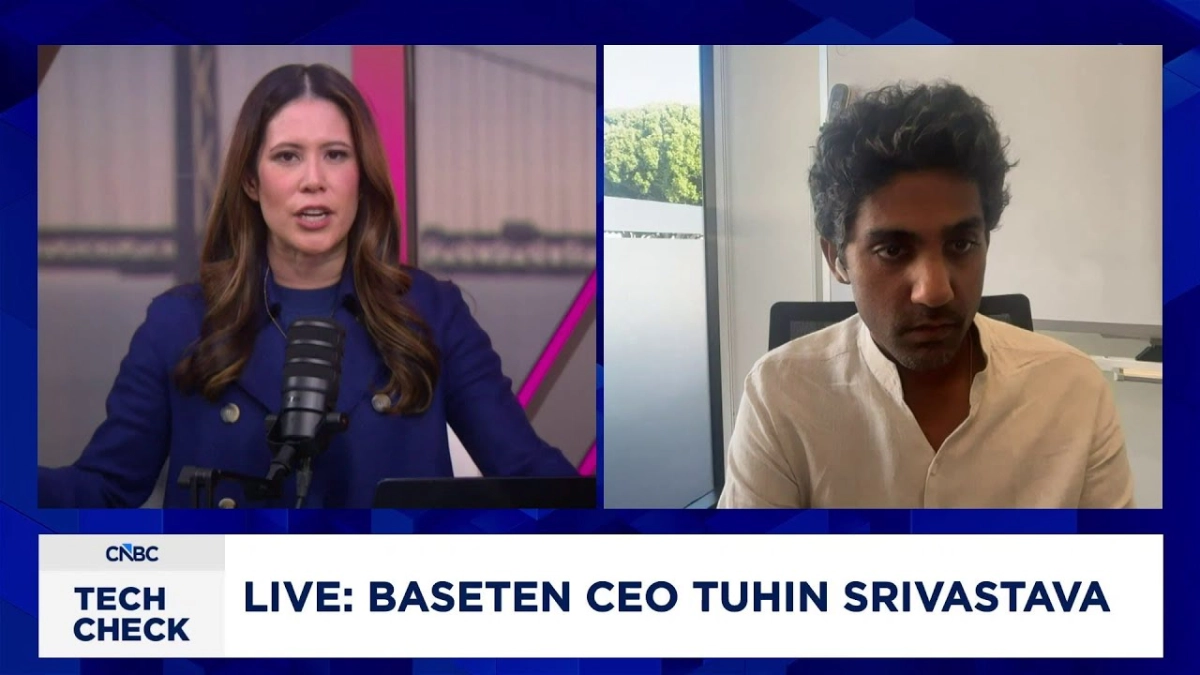
"The most surprising part? The demand isn't just coming from China… it's coming from American developers." This assertion, made by Tuhin Srivastava, Co-Founder & CEO of Baseten, during an interview with CNBC’s Deirdre Bosa, cuts straight to the heart of the current global AI competition. Srivastava spoke with Bosa on CNBC's TechCheck about the rapid proliferation of advanced AI coding tools originating from China and the implications for the established American technological moats.
The context of this discussion centers on the recent surge in popularity of Zhipu AI’s coding agent, a tool so in-demand that the company has already had to implement access limitations. This phenomenon is significant because it suggests that the quality and utility of Chinese AI models are now resonating directly with Western developers, challenging the perceived superiority of US-based AI offerings.
Srivastava highlighted a key metric indicating this shift: the comparison between the Chinese models and their US counterparts. He noted that models like Zhipu AI’s GLM-4.7 are not just keeping pace but are sometimes outpacing US benchmarks, especially when considering accessibility and cost-effectiveness. This competitive edge is particularly pronounced in the realm of open-source accessibility. Srivastava observed that Chinese firms are increasingly releasing models that are "as good as, close source options," which is critical for rapid adoption and iteration in the developer community.
One of the core insights emerging from Srivastava’s commentary is the concept of "vibe-coding" and its relationship to compute costs. He explained that the current AI landscape is witnessing exponential growth in the need for computational power, specifically for inference, the process of running trained models in production. This inference demand is driven by two primary factors: the sheer volume of users engaging with AI applications, and the increasing size of the models themselves.
Srivastava pointed out that while US giants like OpenAI, Anthropic, and Google are pouring billions into building massive foundational models, the Chinese ecosystem appears to be focusing on efficiency and deployability. He noted that Chinese models are often "very, very cost-efficient" and that their developers are spending significant time optimizing these models for inference. This efficiency translates directly into cost savings for enterprises, which is a compelling value proposition in a market where compute costs are ballooning. As Srivastava stated, "The models might be more efficient... and that goes beyond just the big tech players."