


• StartupHub.ai
    StartupHub.aiAI Intelligence
Discover
  • Home
  • Search
  • Trending
  • News
Intelligence
  • Market Analysis
  • Comparison
  • Market Map
Workspace
  • Email Validator
  • Pricing
Company
  • About
  • Editorial
  • Terms
  • Privacy
  • v1.0.0
  1. Home
  2. News
  3. Ais Hardest Year Yet The Honeymoon Is Over For Standalone Model Makers
Back to News
Ai video

AI’s Hardest Year Yet: The Honeymoon is Over for Standalone Model Makers

S
StartupHub Team
Jan 23 at 9:23 PM4 min read
AI’s Hardest Year Yet: The Honeymoon is Over for Standalone Model Makers

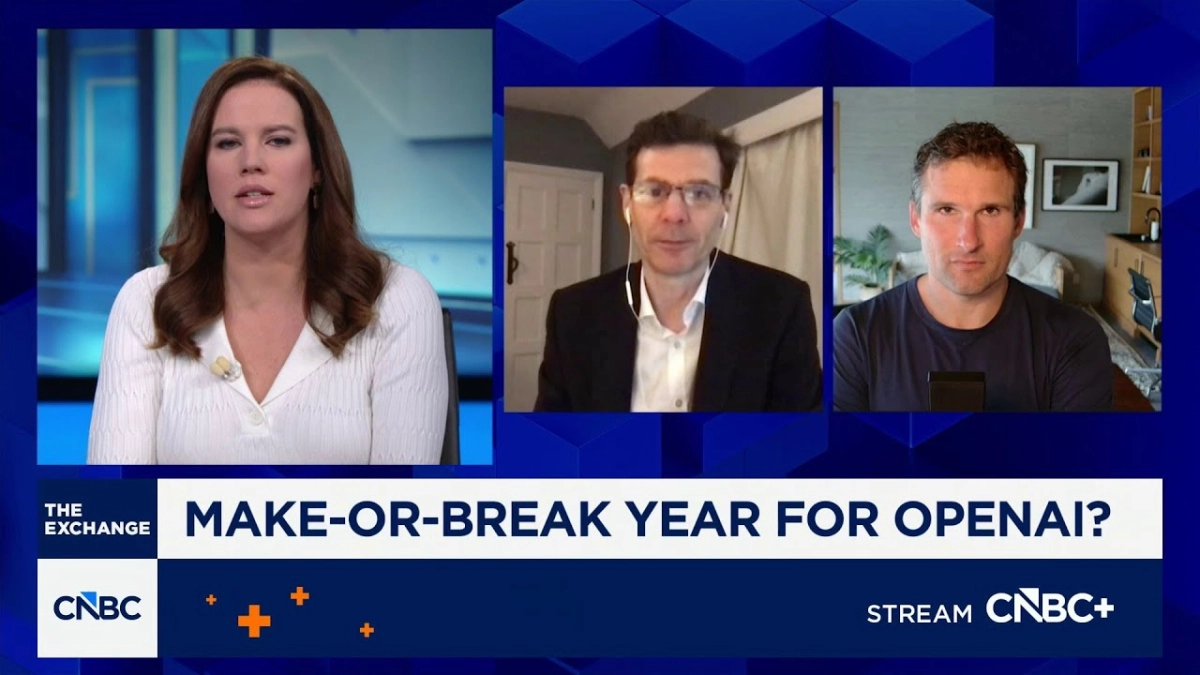
“The honeymoon is now over,” according to Adrian Cox, Thematic Strategist at Deutsche Bank Research Institute, speaking on CNBC’s The Exchange alongside Slow Ventures General Partner Sam Lessin. The sentiment across the technology sector is shifting from the initial exuberance surrounding generative AI to a cold, hard look at the business fundamentals, particularly the massive costs and the looming threat of hyperscaler competition. The conversation centered on the precarious position of standalone AI leaders like OpenAI, which, despite massive funding and hype, faces a critical make-or-break year defined by three converging themes: disillusionment, dislocation, and distrust.

The core tension highlighted by Cox is the stark difference between companies like OpenAI, which must constantly raise capital to fuel their expensive training and inference operations, and established tech giants like Google and Microsoft, which already possess immense distribution, proprietary data, and massive data center infrastructure. Cox emphasized that for OpenAI, the challenge is existential: it has not yet found a workable business model to cover its significant cash burn. He noted that unlike the hyperscalers, OpenAI must continually seek funding for its data center and training needs, which “presents it with the real challenge.” Deutsche Bank’s internal data, Cox revealed, suggests that the growth in consumer subscriptions for OpenAI’s products in Europe has “more or less flatlined since the middle of last year.” This revenue stagnation, coupled with the astronomical costs of maintaining state-of-the-art models, forces the company to aggressively seek new monetization avenues.

Sam Lessin framed the current situation by describing OpenAI as a "narrative asset." He argued that the company’s vision has far outpaced reality, having benefited immensely from the initial narrative that the first company to achieve Artificial General Intelligence (AGI) would be the ultimate, unassailable winner. However, this narrative is crumbling under the weight of market reality. Lessin contends that AI is actually “great for all the incumbents,” including Google and Meta, because they do not need to compete long-term on the model itself; they have distinct business models—search and advertising, respectively—that are perfectly leveraged by AI. The incumbents are not just playing catch-up; they are leveraging existing, unassailable moats.

The debate pivots on where the true moat in the AI ecosystem resides. For years, the thesis favored the model makers—those building the most powerful large language models (LLMs). But as models rapidly commoditize and the performance gap narrows, the advantage shifts to the companies that control distribution and the underlying infrastructure. Lessin pointed out that the established tech giants already control the customer touchpoints: "Apple had the handset, and Google had search, and you know, Meta was Meta." These companies are now integrating AI as an extending innovation, not a disruptive one that requires an entirely new business model. This dynamic fundamentally undermines the valuation thesis for standalone model makers, which were priced for total disruption.

The financial implications of this shift are already visible. The interviewer noted that companies heavily invested in the initial OpenAI/Microsoft narrative, such as Oracle and Microsoft itself, have seen significant market cap erosion since late last year, while Google, which was initially perceived as slow, has seen its stock soar. This reversal suggests that the market is now rewarding the integrated approach. Cox underscored the incumbents’ structural advantages, pointing to Google’s “massive distribution already,” its daily gathering of “enormous data,” and its “enormous capacity of data centers” built through tens of billions of dollars in annual investment. OpenAI simply lacks this foundational, revenue-generating infrastructure.

For founders and VCs in the AI space, the analysis serves as a sobering reminder: the era of simply building a better model and expecting hyper-growth is ending. The focus must now shift to defensible distribution and viable monetization strategies that can withstand the intense, costly competition from the hyperscalers. The market is demanding returns, and the cash burn required to stay competitive in the foundational model race is unsustainable without deep pockets or a clear path to profitability. The challenge for OpenAI and its peers is to transition from a narrative asset, valued on future AGI potential, to a fundamentally sound business capable of surviving the year of disillusionment.

Lessin succinctly summarized the pivot point for OpenAI: “This is the year where OpenAI has to ‘pay the piper’ on business fundamentals and outcomes.” The market is no longer content with the promise of AGI; it is focused on the viability of the current business structure. The ultimate winners in the next phase of AI will likely be those who successfully harness AI to enhance existing, proven business models, rather than those relying solely on the technical superiority of a generalized model.

#AI
#AI honeymoon is
#Artificial Intelligence
#Technology

AI Daily Digest

Get the most important AI news daily.

GoogleSequoiaOpenAIa16z
+40k readers