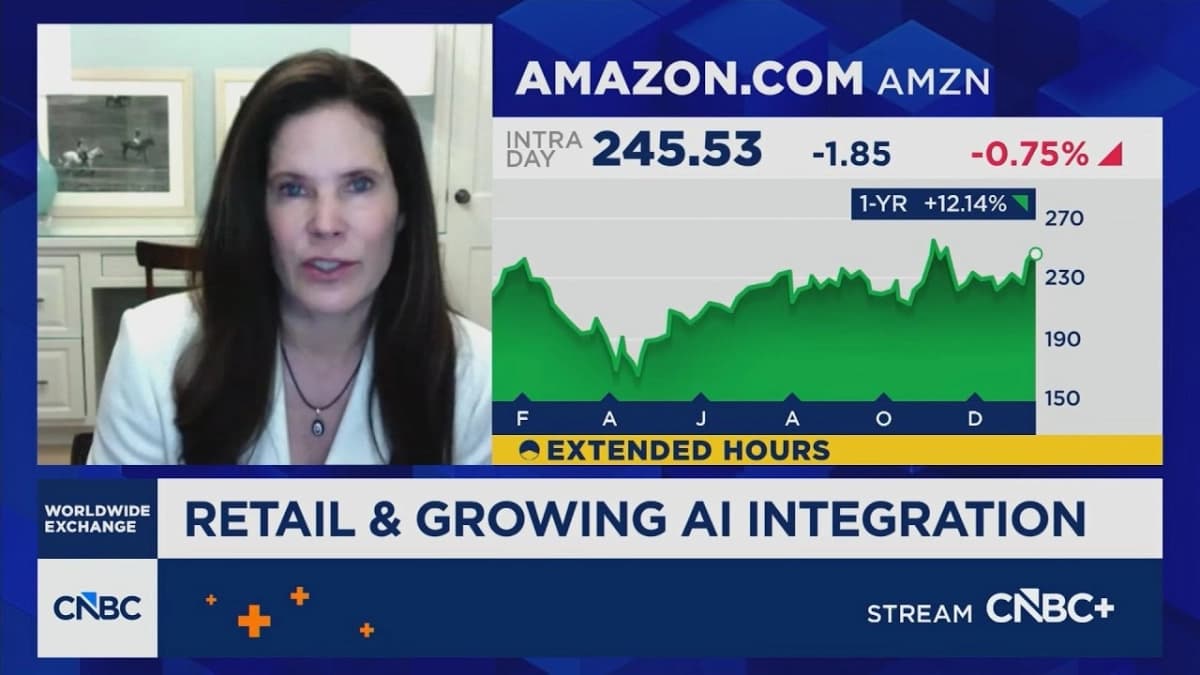
The era of impulse buying and brand discovery as we know it is facing imminent obsolescence, threatened not by a shift in consumer taste, but by the relentless efficiency of artificial intelligence. This was the stark assessment delivered by Stacey Widlitz, President at SW Retail Advisors, who recently spoke with a CNBC host regarding the dominant themes emerging from the National Retail Federation (NRF) Big Show. While the conference was ostensibly about retail, the conversation quickly centered on AI, its immediate applications, and the profound strategic challenges it poses to the entire ecosystem, from supply chain negotiation to the customer journey itself.
Widlitz’s analysis began with a necessary reality check for founders and tech leaders: the retail sector is still in the nascent stages of productive AI implementation. She noted that a massive percentage of current projects are failing to scale, stating, “95% of the experiments or AI tests that retailers implement don’t go to adoption. They fail.” The current challenge, therefore, is not merely experimenting with the technology, but figuring out what is truly usable and capable of delivering demonstrable returns. This focus on practical application is where industry giants like Walmart are already establishing an insurmountable lead. Walmart, for instance, is not just using AI for consumer recommendations; they are deploying it deep within their operational core, going so far as to negotiate vendor contracts through AI. This application illustrates a fundamental shift: AI is first targeting high-volume, repetitive, cost-intensive tasks, thereby freeing up human capital for customer-facing roles—a clear signal of how the largest players are leveraging automation to optimize their massive logistical footprints.
The most disruptive implication discussed, however, involves the inevitable rise of the AI shopping agent, a concept that fundamentally changes the relationship between consumer, brand, and retailer. When a consumer delegates purchasing decisions to an AI assistant—say, asking it to buy detergent—that agent is programmed to optimize for price, reviews, and algorithm ranking. This cuts out the messy, human element of discovery and impulse. Widlitz observed that companies are “really scared because if you think about it, if I tell my shopping agent, I need detergent... it’s going to go out, it’s going to find the best price, the highest algorithm, the best reviews.”
This automated efficiency directly undermines the traditional marketing models that have sustained consumer brands for decades. The marketing dollars spent on "traditional push marketing" and "inspiration shopping" become nearly worthless when the purchase decision is outsourced to an objective, cost-minimizing algorithm. This dynamic is set to solidify the dominance of already scaled entities. The shopping agent, by default, will likely gravitate toward the market leaders—Amazon and Walmart—because they consistently offer the most competitive pricing, robust supply chains, and sufficient data volume to satisfy algorithmic criteria. This means the AI agent will make “the bigger and the stronger retails even more impactful and rise to the top,” creating a winner-take-all scenario at the top of the digital shelf.
For smaller brands and mid-tier retailers, the challenge is twofold. First, they lack the massive data sets required to train competitive, proprietary AI models that can optimize their operations or effectively influence shopping agents. Second, they face significant budget constraints. As Widlitz pointed out, “the smaller brands have limited budgets, so it’s harder for them to implement and test a lot of this technology.” This technological disparity is widening the gap between those who can afford to integrate AI across their supply chain and those who cannot.
The inability to leverage AI for core functions is already manifest in operational failures among competitors. While Walmart pushes forward with AI-driven vendor negotiation and task automation, other major retailers have struggled with basic inventory control. Widlitz highlighted this pain point, noting that brands still haven't figured out how to use AI to "really manage their inventory," citing examples like Target pulling back on some tech areas and American Eagle having big inventory missteps. For the startup ecosystem, this signals a critical market opportunity: building highly focused, usable AI solutions that can plug these operational gaps for mid-sized retailers who lack the capital and infrastructure of the market leaders. The competitive differentiation in retail is rapidly moving away from slick marketing and toward supply chain efficiency and algorithmic supremacy.