

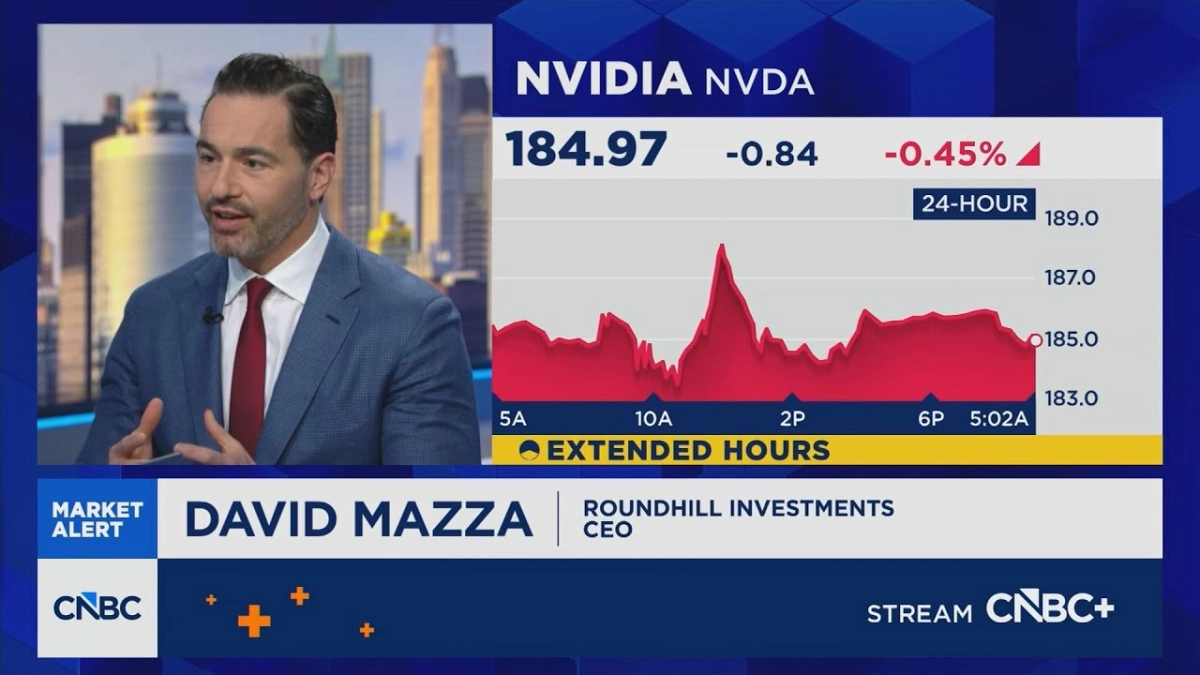
When examining the current market dynamics surrounding artificial intelligence, the prevailing narrative that the leadership rests solely on the shoulders of a handful of GPU giants is beginning to fray. As David Mazza, CEO of Roundhill Investments, noted in a recent discussion with a CNBC anchor, the market is signaling a significant rotation, driven by the realization that AI infrastructure requires an entire ecosystem, not just compute power. Mazza’s commentary focused on the increasing importance of quality balance sheets, earnings, and market breadth, suggesting that while 2026 may remain bullish, it will be characterized by greater volatility and a search for value deeper within the technology stack.
The immediate market action, particularly regarding Nvidia, provided a sharp entry point for the conversation. Despite robust underlying demand, the stock has recently stalled. This deceleration, Mazza suggests, is largely due to the fact that “so much of its future earnings growth has been baked into its valuation.” The market has already priced in the near-perfect execution and dominance of the current AI leaders. Furthermore, the persistent geopolitical risk concerning China exports—a market that once represented about 15% of Nvidia’s global sales—adds a layer of uncertainty, even if the company has proven its ability to thrive without that revenue stream for multiple quarters. Investors, however, are now looking years ahead, demanding clarity on sustained growth trajectories beyond the initial infrastructure buildout phase.
This demand for clarity is catalyzing a broader rotation, a crucial insight for founders and venture capitalists assessing where the next wave of capital deployment will occur. The AI trade, Mazza argues, “is most certainly evolving.” The focus is shifting from the scarcity of the top-tier GPUs to the foundational components required to make large-scale AI deployment functional and efficient. This includes crucial, often overlooked components that reside lower in the technological stack.
The conversation highlighted memory and storage providers, such as Micron and SanDisk, as key beneficiaries of this rotation. The buildout of powerful data centers necessitates far more than just processing power; it requires massive amounts of high-speed memory and storage capacity. Mazza emphasized this fundamental requirement: “You can’t have these powerful data centers without both the AI chips themselves and then the memory and storage to make it all happen.” This signals a substantial opportunity for companies specializing in high-bandwidth memory (HBM) and advanced storage solutions, which are now seeing renewed investor interest after being largely neglected during the initial megacap-driven rally. For founders, this rotation validates the strategic importance of specializing in adjacent infrastructure segments that support, rather than compete directly with, the GPU leaders.
Beyond the specific technical rotation, Mazza offered a cautious but constructive outlook on the macroeconomic environment heading into 2026. While the VIX has not signaled major panic, underlying risks—including Federal Reserve policy uncertainty and a looming election year—mean that volatility is likely to increase. The market has seen a resurgence in high-beta stocks, meme stocks, and small caps, indicating a broader appetite for risk that often precedes choppier waters. Therefore, selectivity is paramount.
For sophisticated investors navigating this complex landscape, the strategy must be bifurcated. It requires a balanced portfolio that still leverages the growth potential of the Magnificent Seven (Mag 7) megacaps for "offense," while simultaneously building "defense" through highly selective exposure to companies that offer new or underestimated earnings growth potential. This includes those infrastructure enablers benefiting from the broadening AI adoption. The key takeaway for the coming quarters is that simply holding the dominant AI leaders will likely not be sufficient to outperform the benchmark. As Mazza concluded, “Investors should expect for greater volatility,” necessitating a refined, selective approach that captures growth wherever it emerges across the increasingly complex AI ecosystem.



