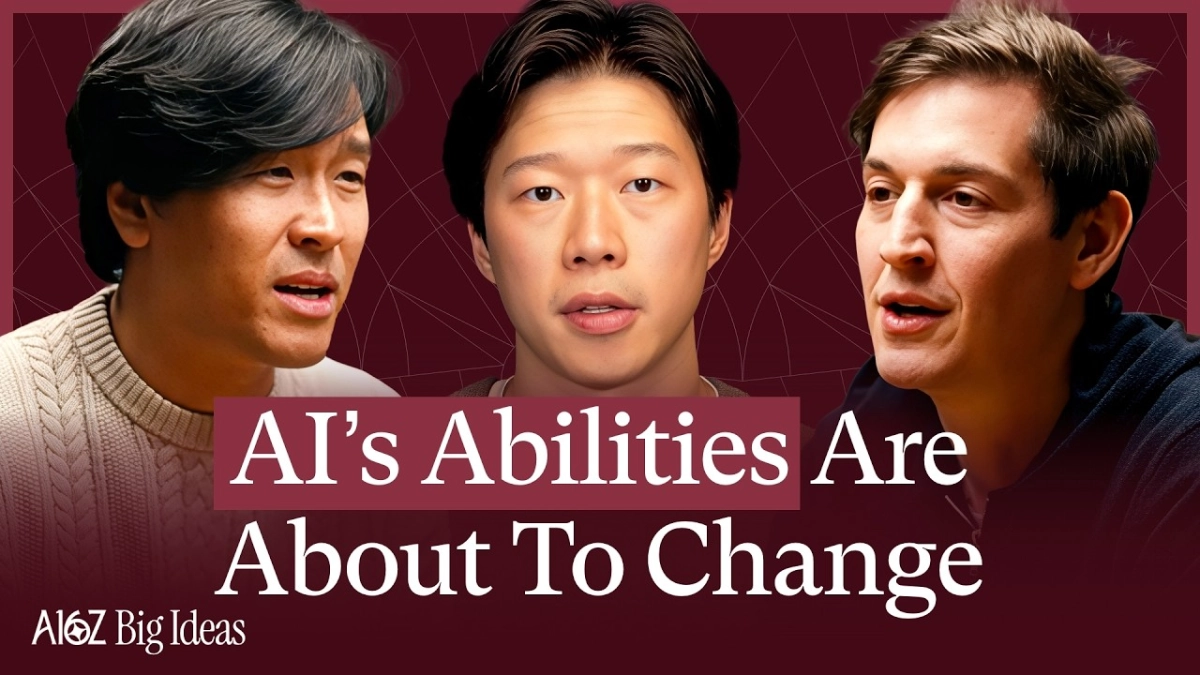
The future of artificial intelligence applications hinges not merely on automating existing tasks but on fundamentally reinforcing business models and accelerating human discovery. This was the central theme articulated by Andreessen Horowitz partners Oliver Hsu, Bryan Kim, and David Haber in their recent "Big Ideas for 2026" discussion, where they outlined three critical vectors defining AI’s next phase: autonomous science, connectivity in consumer products, and durable economic defensibility. Their analysis suggests that the true value of AI will be unlocked when it moves beyond basic productivity gains to drive net-new revenue and smarter outcomes.
Oliver Hsu, a partner focused on American Dynamism, introduced the concept of autonomous labs, arguing that advances in AI reasoning and robotic manipulation are pushing scientific discovery toward a closed-loop system. Laboratory automation itself is not novel; pre-programmed robots have long handled repetitive tasks. The shift, Hsu explained, is the combination of physical automation with advanced AI reasoning capabilities that enable complex experiment planning and iteration. "As model capabilities progress across modalities and robotic manipulation capabilities continue to improve, teams will accelerate their pursuit of autonomous scientific discovery," Hsu noted, painting a picture of an AI scientist that can design, execute, and learn from experiments without constant human input.
In the near term, this means collaboration: a human scientist working directly with an AI system that handles the experimental workflow. Critical to this transition is interpretability. Since AI systems act as non-deterministic computers, researchers must understand why the system is planning experiments in a specific way to ensure scientific rigor and replicability. This focus on verifiable process recording is essential for trust and eventual full autonomy.
I think these areas, particularly life sciences and chemicals, are ripe for initial adoption because they feature a mature demand side market willing to pay for successful research outcomes. The increasing speed and capability offered by AI-driven labs, coupled with public-private initiatives like the Genesis Mission, are setting the foundation for this self-driving science to become a reality.
Shifting focus to the consumer landscape, Bryan Kim, a partner in AI Applications, argued that major AI products will pivot from mere productivity enhancement toward genuine connectivity and identity. While the initial wave of large language models focused on helping users "do work better," the next generation will focus on helping people feel "seen" and building stronger relationships. This involves leveraging AI to understand the user deeply—ingesting their digital footprint, communications, and history—to facilitate meaningful human interaction.
Kim contended that startups are uniquely positioned to challenge incumbent platforms in this shift. Incumbents possess existing network effects and data moats, but AI provides a "net new user interaction" that may not natively fit within established platforms. This disruption provides an opening for nimble companies to build creative outlets and new atomic units of interaction that foster connection. Kim expressed excitement for the coming wave of products, stating, "Instead of helping you just do work, AI will allow you to see yourself more clearly and help you build stronger relationships." This personalization, driven by deep self-knowledge shared with the AI, is the key to unlocking the next massive consumer market.
Finally, David Haber, also a General Partner in AI Applications, presented the most stringent economic insight: the most durable AI companies are those where AI strengthens the business model itself, driving revenue rather than just reducing costs. He highlighted that while cost reduction is a clear initial benefit, the market pull is far stronger when AI enables companies to generate more money or deliver superior client outcomes. If AI is merely a cost-cutting tool, the adoption ceiling is low; if it’s a revenue multiplier, adoption is limitless.
Haber provided compelling examples from the A16Z portfolio. In plaintiff law, the company Eve uses legal AI to automate drafting and discovery. Because plaintiff attorneys work on contingency (they only get paid if they win), AI’s ability to automate high-volume tasks enables them to take on more cases and triage their labor toward high-value cases, directly reinforcing the revenue model. Similarly, in consumer lending, Salient’s AI voice agents handle collections and compliance. While efficiency is a factor, the crucial finding is that the AI agents actually drive better collection rates than human agents. This directly improves the lender’s core financial outcome, creating a compounding advantage. Haber emphasized that the source of defensibility in these models is often proprietary outcome data: "The more cases that Eve processes, the smarter and more powerful the platform becomes." By owning the end-to-end workflow and capturing proprietary outcome data—whether it’s the success rate of a legal case or the collection rate of a loan—these AI applications create compounding advantages that legacy software, which only tracked inputs, cannot touch. This strategic alignment of AI with core financial incentives is what separates fleeting AI features from enduring, defensible platforms.