


"I don't think it's going to be the show me the money year," stated Jake Loosararian, CEO of Gecko Robotics, addressing the question of whether 2026 will be the inflection point where corporate investments in artificial intelligence finally yield widespread, quantifiable returns. This sentiment, expressed during a recent CNBC panel discussion at Davos, cuts directly against the prevailing market euphoria surrounding generative AI. Loosararian argued that while momentum is undeniable, the current environment still features "too much hype in the market" and significant "froth."
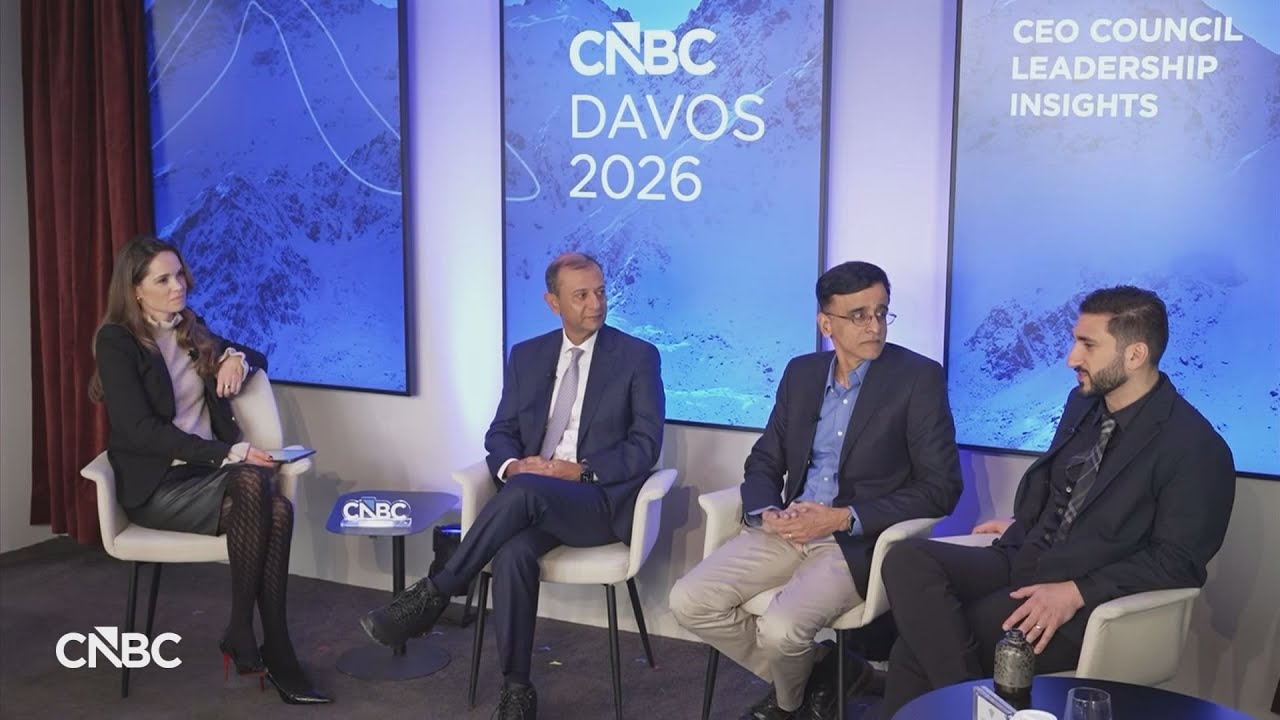
Loosararian, alongside Snowflake CEO Sridhar Ramaswamy and EXL CEO Rohit Kapoor, spoke with CNBC anchor Carolin Roth during the CEO Council Leadership Insights panel in Davos, focusing on the critical timeline for AI ROI in the enterprise. The core tension of the discussion revolved around whether the massive capital expenditure currently flooding into AI infrastructure, specifically GPUs and data centers, is being matched by demonstrable, bottom-line business outcomes across diverse industries. Loosararian highlighted a crucial disconnect: the majority of current AI conversations focus on executive-level white-collar applications, neglecting the physical, blue-collar industries that form the bedrock of the global economy. "We don't really talk about like how artificial intelligence is actually helping and improving the condition of the folks on the ground that are running the companies and the GDP drivers... in these like physical jobs," he observed, suggesting that true, organic ROI will emerge only when AI addresses these fundamental challenges.
This skepticism about the immediate, macro-level financial returns was quickly tempered by those seeing tangible, micro-level benefits today. Sridhar Ramaswamy of Snowflake offered a counter-narrative, stressing that the efficacy of AI is already proven within specific operational silos, even if the systemic financial impact hasn't fully materialized in enterprise profit and loss statements. Ramaswamy noted that for Snowflake itself, AI coding agents are having a profound effect on efficiency. "Our ability to deploy new products, like the ones that create agents, and have them deliver value ten times faster, not ten percent faster, has been truly, truly remarkable." He argued that this concrete, dramatic acceleration in productivity, whether in software development or in data product creation, is proof that AI is generating measurable ROI today, pushing back against the tendency to view the technology through an "all or nothing" lens.
Ramaswamy provided further examples of practical, immediate value, citing a customer like Siemens, which utilized AI to build a chatbot based on the PDF manuals for 150,000 devices. This simple application provides immediate, crucial information to field workers, solving the "impossible" problem of sifting through thousands of pages of documentation. This directly reinforces Loosararian’s point about aiding the blue-collar workforce, demonstrating that real-world applications are indeed emerging outside of purely digital domains. These examples suggest that while the market may be frothy, the underlying technology is robust and already driving efficiency gains where properly applied.
Rohit Kapoor of EXL sought to bridge the gap between the immediate technical success and the delayed enterprise financial impact. He agreed that the effectiveness of AI is proven, but noted that the widespread ROI that large organizations seek remains elusive. Kapoor attributed this lag to a critical adoption challenge: most companies are currently implementing "bolt-on AI." He elaborated: "AI gets applied to be able to automate or apply intelligence into a part of a process, and only that part gets improved upon." This incremental approach means that while individual tasks or functions might see massive efficiency boosts, the overall P&L benefit does not fully "fall through" because the underlying, end-to-end business process has not been fundamentally redesigned.