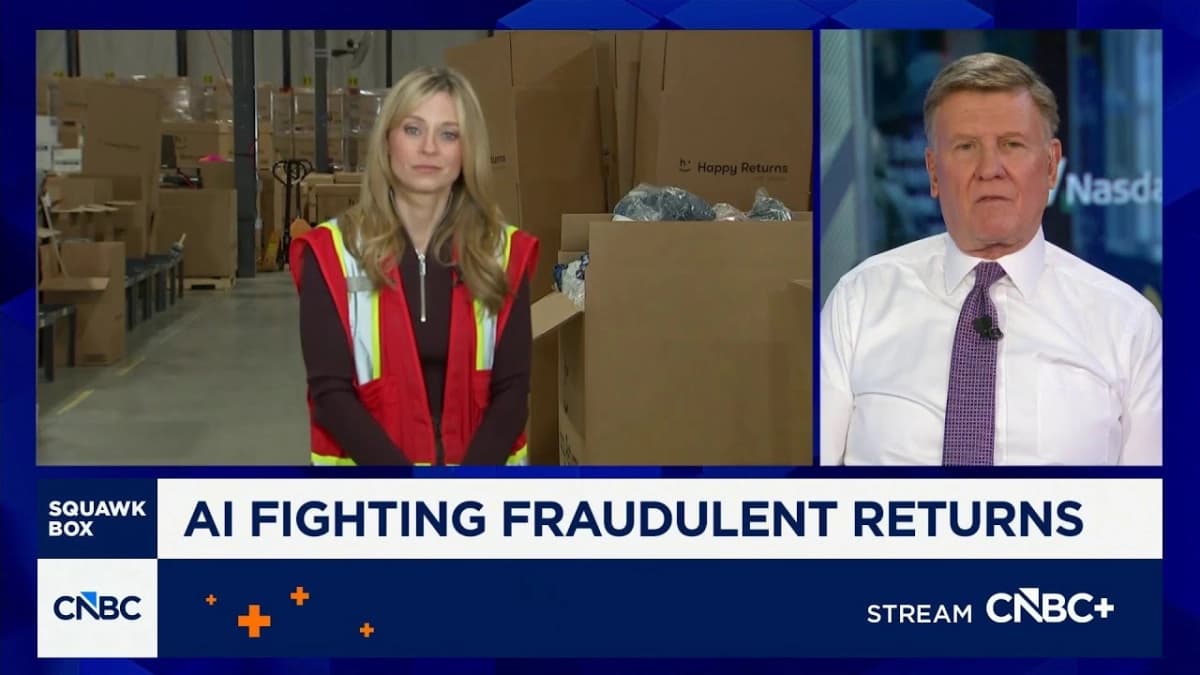
Retailers are hemorrhaging $75 billion annually due to return fraud, a staggering figure representing 9% of all returned goods. This enormous cost, often absorbed by honest consumers in the form of higher prices, has created a critical imperative for technological intervention in the often-overlooked segment of reverse logistics. The CNBC Squawk Box segment, featuring CNBC Senior Retail Reporter Courtney Reagan reporting from a Happy Returns hub in Valencia, California, detailed how providers are rapidly deploying artificial intelligence and machine learning to staunch this massive financial bleed.
Reagan spoke with Joe Kernen about the complex operations underpinning modern e-commerce returns, highlighting that the traditional linear supply chain is now burdened by a massive, high-risk reverse flow. Happy Returns, a UPS company, manages box-free returns for major retailers like Gap, Shein, and Under Armour across 8,000 drop-off locations. The sheer volume of this process—millions of items processed monthly—necessitates automation, but also introduces immense opportunity for sophisticated fraud that human employees often cannot detect in real-time.
The core technological insight here is the shift from relying solely on human judgment to leveraging AI for granular inspection at the point of return. When a shopper drops off an item, an employee conducts a first-line inspection, scoring the return for potential fraud risk. Items flagged as medium or high risk are then subjected to a detailed AI analysis. This system is designed to catch the subtle deceptions that constitute a significant portion of return fraud—namely, “wardrobing” (wearing an item once and returning it) or swapping the purchased item for a cheap, similar decoy.
The AI utilizes computer vision to compare the returned item against the retailer’s original product image, scrutinizing minute details like logos, knit patterns, and unique design features. Reagan demonstrated the system identifying a "suspected mismatch" in a returned cardigan, noting that the AI could detect discrepancies in the knit pattern and neckline that the human eye might easily miss during a quick scan. This level of forensic inspection is impossible to scale manually across thousands of retail locations.
David Sobie, Co-Founder and CEO of Happy Returns, emphasized the significant financial reward derived from catching even a small percentage of these high-value fraudulent returns. He explained that "about 15% of the items that we flag as high-risk returns that are audited here end up actually having fraud." Crucially, these aren’t low-value transactions; Sobie noted that on average, those fraudulent attempts involve items "worth about $240," meaning the retail price the shopper was attempting to defraud the merchant on. For retailers operating on thin margins, recovering even a fraction of this leakage translates directly to material profit protection.
The problem extends beyond physical returns and into digital fraud claims. Reagan pointed out that Happy Returns is not the only firm innovating in this space; Navar, for instance, focuses on delivery fraud—cases where shoppers falsely claim an item was never delivered to secure a refund. Navar’s AI solutions have proven highly effective, reducing "the payouts of fraud cases by 25% for 1500 retailers including Lululemon and DSW.” This highlights that AI's utility in reverse logistics spans the entire spectrum of the return process, from the physical inspection of goods to the verification of digital claims.
For founders and VCs focused on supply chain optimization, the clear takeaway is that the reverse logistics pipeline is now a ripe target for sophisticated AI application. The high volume of returns in e-commerce—where 25% to 30% of online items are returned, and categories like women's dresses can see rates as high as 90%—creates an enormous data set for machine learning models to train on. The cost of labor and manual inspection, combined with the escalating sophistication of fraudsters, makes automated, intelligent fraud detection an economic necessity rather than a luxury. Implementing AI in this highly complex environment is the only viable path for retailers to protect their margins against pervasive and costly shrinkage.