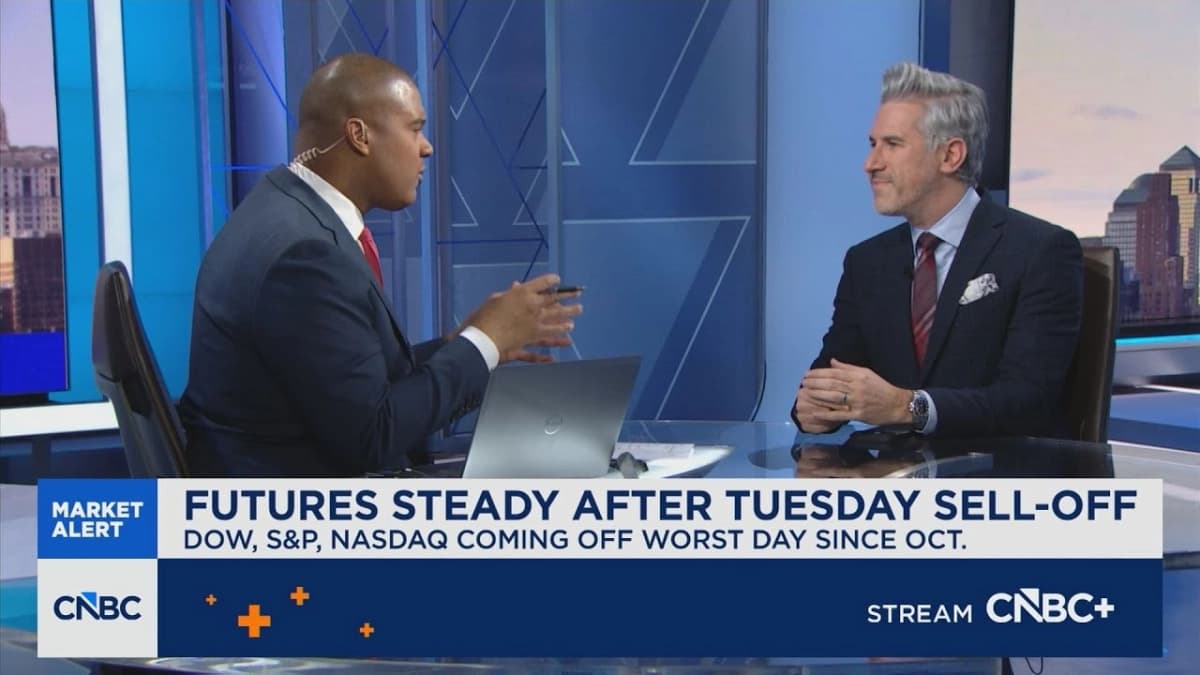
"I think we’re earlier in this AI than people realize," stated Gene Munster, Managing Partner at Deepwater Asset Management, during a recent discussion on market dynamics. This sentiment, emphasizing the profound yet nascent stage of artificial intelligence, framed a broader conversation about how immediate macroeconomic volatility—driven by tighter liquidity and geopolitical stress—is colliding with long-term technological disruption, forcing strategic reevaluation among founders and capital allocators.
Munster, alongside Douglas Boneparth, President of Bone Fide Wealth, spoke with a CNBC anchor about the complex pressures currently reshaping investment strategies, particularly within the tech ecosystem. Their analysis highlighted the necessity of defensive positioning in the face of macro uncertainty while maintaining a clear focus on the exponential growth curves being carved out by leading AI innovators.
The immediate turbulence in global markets, according to Boneparth, stems partly from shifts in Asian bond markets, specifically Japan. The repatriation of capital prompted by rising yields in Japanese bonds is often seen as pulling liquidity out of high-risk trades, including US technology stocks, creating a "compound fracture" when combined with other global geopolitical tensions. Boneparth noted, "They are creating a compound fracture here. Look at what the U.S. Treasuries have done yesterday. Good luck refinancing your mortgage with that." This confluence of events forces investors to grapple with a dual reality: immediate risk driven by global financial plumbing, and long-term opportunity driven by technological leaps.
This macro tightening provides a stark backdrop against which Big Tech companies must deliver exceptional growth. The recent earnings trajectory of streaming giant Netflix served as a case study for the law of large numbers finally asserting itself, even among market leaders. Munster pointed out that Netflix’s projected growth rate has significantly decelerated compared to its recent performance, stating, "The growth outlook for calendar ’26, they said 12 to 14%. That compares to 18% in what they just reported." This slowing growth, combined with reduced subscriber additions, highlights the crucial need for companies to either find new, massive revenue levers or risk falling victim to market skepticism regarding their future trajectory. For VCs and founders, this underscores that incremental growth is no longer sufficient to justify premium valuations; true disruption is required.
In this volatile environment, Boneparth advised investors to embrace a defensive, tactical stance. He recommended rebalancing portfolios to align with target allocations and, critically, maintaining "cash and dry powder." While a 2% market dip might not warrant aggressive buying, larger drawdowns—like the 20% pullback seen in April of the previous year—create critical moments for strategic deployment. The key, he argued, is to identify high-conviction assets that can be acquired at a discount during these periodic market panics. This disciplined approach separates those who panic from those who capitalize on volatility, allowing long-term focused investors to aggressively add to positions in companies that possess durable competitive advantages and exponential growth potential.
This brings the focus back squarely onto the realm of AI, where the exponential improvements are redefining the definition of "durable advantage." While headlines often focus on OpenAI, Munster directed attention toward Anthropic and its Claude Code, viewing this development as a major step function in utility. Claude Code, designed to simplify application building, democratizes access to powerful generative models, allowing non-technical users to build sophisticated tools. Munster explained the profound implication: "Essentially what this does, it allows non-technical people... to build applications. Why that's important is because the utility of the underlying model from Anthropic is having exponential improvements." This accessibility dramatically accelerates the pace of innovation and adoption across all industries, confirming the belief that the AI revolution is still in its earliest, most explosive phase.
For the startup ecosystem and tech professionals, the message is clear: the current market volatility, driven by factors like Japan's monetary policy shifts and geopolitical tensions, is not a reason to retreat entirely, but rather a necessary condition for creating future buying opportunities. The sustained, compounding growth will emerge not from incremental improvements in legacy sectors, but from the exponential utility being unlocked by foundational AI models. Investing successfully in this era requires patience, dry powder, and a precise focus on the companies building the infrastructure and applications that will define the next wave of disruptive growth, regardless of short-term macro noise.