


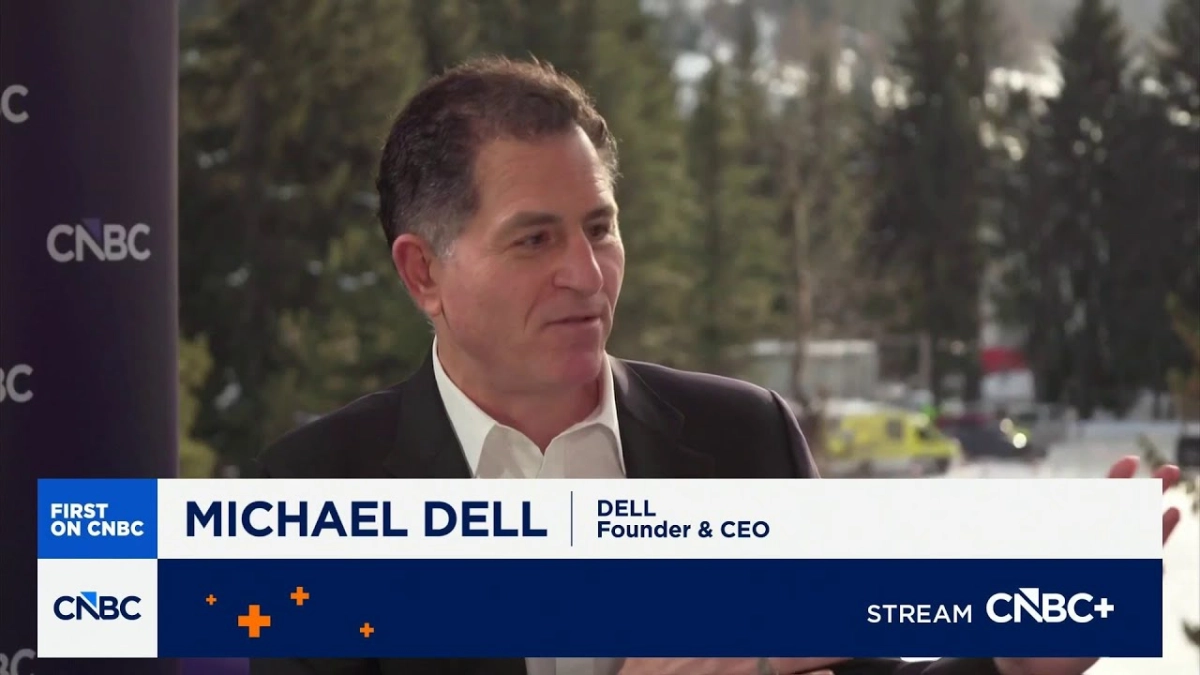
"I think we’re on the way to the stadium," Michael Dell stated, offering a surprisingly reserved assessment of the current artificial intelligence boom, despite acknowledging the overwhelming infrastructure requirements. "The game hasn't even started really yet." Speaking on CNBC’s Squawk on the Street, the founder and CEO of Dell Technologies provided a sharp analysis of the tectonic shift occurring in enterprise technology, emphasizing that while demand for the foundational hardware is historic, the true revolution—the re-imagining of business—is only just beginning. Dell spoke with CNBC’s Sara Eisen at the World Economic Forum in Davos, addressing the impacts of AI on supply chains, profitability, and global competition.
The most immediate and pressing constraint facing the AI industry is not innovation, but simple capacity. Dell confirmed what many analysts and investors have suspected: "The demand is in excess of the supply by quite a lot." This bottleneck stems directly from the rapid acceleration of foundational AI models. Dell pointed out the inherent timeline mismatch: ChatGPT, which triggered the current gold rush, emerged just over three years ago. Building a semiconductor fabrication plant, however, requires approximately four years. This temporal lag means that the infrastructure required to meet today’s explosive demand simply hasn't been manufactured yet, leading to severe shortages in key components like memory silicon and advanced semiconductor nodes.
This shortage is a direct result of a fundamental transformation in how enterprises utilize computational power. Dell characterized this as a definitive shift away from the legacy paradigm of processing. For decades, computing was about calculation. Now, it is about cognition. "We’re shifting from calculating and computing, which is what we sort of did for 60 years, to thinking and helping people think," Dell explained. This qualitative change requires entirely new architectures, primarily centered around GPUs and high-bandwidth memory, which are the components currently under the most severe strain. The current generation of AI models, while revolutionary, are still the "worst they’ll ever be," destined to be surpassed by models that are "way better in a year or two." This relentless advancement ensures that the demand for increasingly powerful, specialized infrastructure will continue to accelerate, keeping pressure on the supply chain for the foreseeable future.
For Dell Technologies, this infrastructure frenzy translates into clear profitability. When asked about the return on investment for companies pouring billions into AI hardware, Dell noted that the opportunity is dual-layered. First, AI is helping Dell itself become a more competitive and efficient company. Second, and more immediately impactful on the balance sheet, Dell is positioned as a key provider of the enabling technology. "We’re making the picks and shovels and selling them to all the great companies out there and the firms that are building these big models," he said, invoking the classic gold rush analogy. This strategic position in the supply chain ensures that profitability metrics, such as earnings per share, are consistently growing in double digits, a trend Dell anticipates will continue over the next five years.
However, the CEO’s perspective transcends mere hardware sales. The real, long-term opportunity lies in how companies fundamentally restructure their operations around AI capabilities. While early gains are visible in productivity and efficiency within the tech giants and a few forward-thinking firms, the broader enterprise landscape is lagging. Dell emphasized that the biggest rewards will go to those who "reimagine these companies" using AI as the core operating system, rather than just an added tool. He noted that the newest cohort of companies, those born into the AI era, are growing significantly faster than their predecessors, indicating that a ground-up integration of AI yields superior results.
The current geopolitical climate further complicates the supply/demand equation. While Dell acknowledged the general difficulty of doing business in a complex global environment, he maintained that the primary driver of friction in the AI space remains the sheer, unanticipated velocity of technological change outrunning manufacturing lead times. The investment cycle required to build capacity in semiconductors and advanced packaging is simply too long to react instantly to the sudden, voracious appetite for AI compute power seen since 2022. This structural imbalance ensures that access to high-end AI infrastructure remains a competitive moat, favoring those who secured early access and those who can navigate the lengthy procurement cycles. This is not a fleeting trend, but a foundational shift that will define the next decade of enterprise spending.


