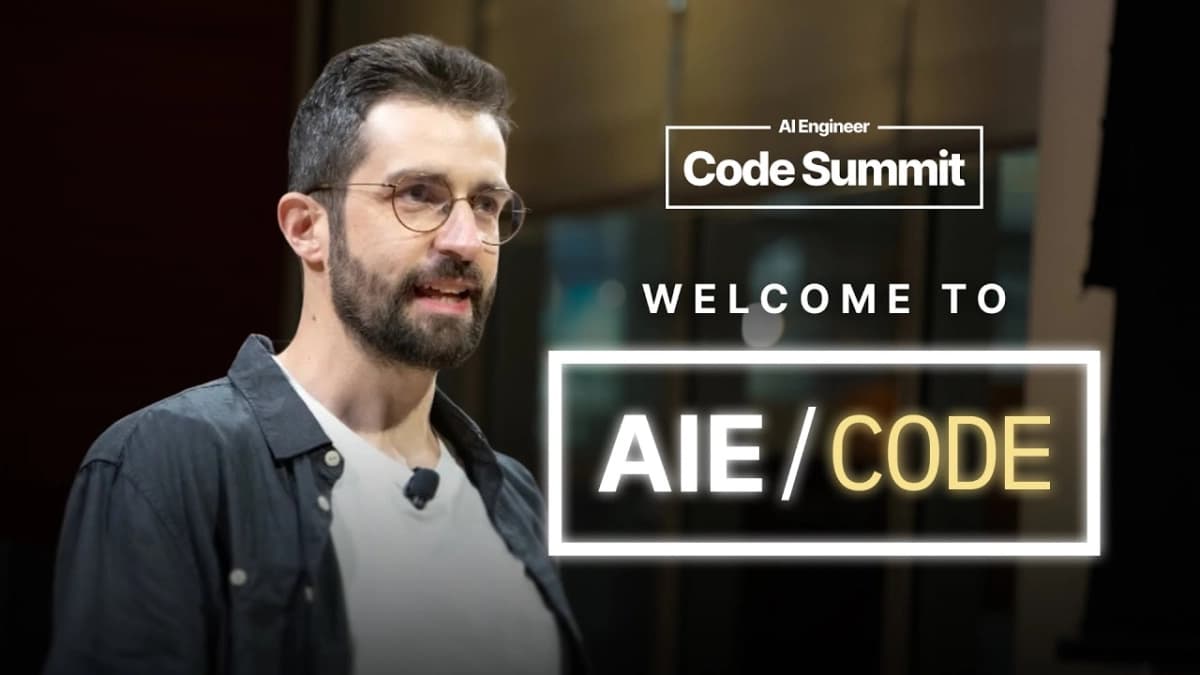
Richard Hamming famously challenged his colleagues with a blunt query: "What’s the most important problem in your field? So why aren’t you working on that?" This foundational challenge, aimed at pushing researchers toward high-leverage work, served as the ideological bedrock for the AI Engineer Code Summit, as articulated by Jed Borovik, Senior Staff Engineer at Google DeepMind. Borovik, acting as the Day 2 MC, framed the entire conference around the premise that for those operating at the frontier of applied artificial intelligence, the answer to Hamming’s question is unequivocally, code.
Jed Borovik, who also humorously introduced himself as “Gemini’s assistant at Google,” spoke at the AI Engineer Code Summit (AIE/CODE) held in New York about the critical shift from theoretical AI research to practical, scalable deployment. The event, held in late 2025 according to the presentation slides, was segmented into a "Leadership Track" focusing on organizational transformation and a "Code Summit" track dedicated to the engineering systems, patterns, and products making autonomous coding agents possible. This distinction underscores a maturing industry recognition that the bottleneck for AI value creation is shifting away from pure model capability toward reliable, robust execution systems capable of writing, debugging, and deploying production-grade software.
The strategic importance of AI coding agents—the tools and models designed to autonomously execute complex engineering tasks—cannot be overstated for founders and venture capital investors currently assessing the market. Borovik’s assertion acts as a mandate for the current technological cycle, clarifying where technical resources and investment capital should be directed. The transition from large language models being mere copilots to becoming fully autonomous agents requires solving intricate problems related to context window management, tool integration, persistent memory, and verifiable output. This is where the engineering challenge resides.
The necessity of focusing intensely on this specific technical domain drives the event’s design. Borovik emphasized that this Code Summit was distinct from the broader "World’s Fair" track. "This being a summit event is intentionally smaller than the World’s Fair. It’s intentionally single track."
This focused, single-track approach is a deliberate move to accelerate industry-wide progress. It mandates a technical depth that avoids the broad, often generalized discussions common at larger tech gatherings, ensuring that the participants—primarily AI engineers and product leaders—are deeply engaged in the shared, difficult work of building reliable AI agents. For companies like DeepMind, which Borovik represents, the focus on coding agents is central to leveraging their advanced foundational models, such as the recently announced Gemini 3 and Nano Banana Pro, turning immense computational power into tangible, repeatable engineering output. The goal is to move beyond mere proofs-of-concept into reliable, production-ready AI systems that can fundamentally alter the economics of software development.
The previous day's leadership track focused on "how AI is transforming software organizations." This transformation is not merely about increasing developer velocity; it is about redefining the organizational structure and the operational cadence of engineering teams. When AI can reliably handle iterative coding, debugging, and testing, the human engineer's role elevates entirely, shifting focus toward high-level architecture, system design, and complex problem specification. This shift demands new tooling, new deployment pipelines, and ultimately, new cultural norms within technology firms.
The consensus emerging from such focused industry events is clear: the future of software development hinges on the successful application of AI to the coding process itself. It is the crucial step in transforming large language models from powerful, abstract intelligence engines into pragmatic, economic tools. Without robust, engineered solutions for autonomous code generation and maintenance, the monumental investments in foundational models risk remaining trapped in the lab, unable to fully realize their potential for broad industry disruption. The challenge is no longer if AI can write code, but how to build the engineering infrastructure that makes AI-written code the default, trustworthy standard.