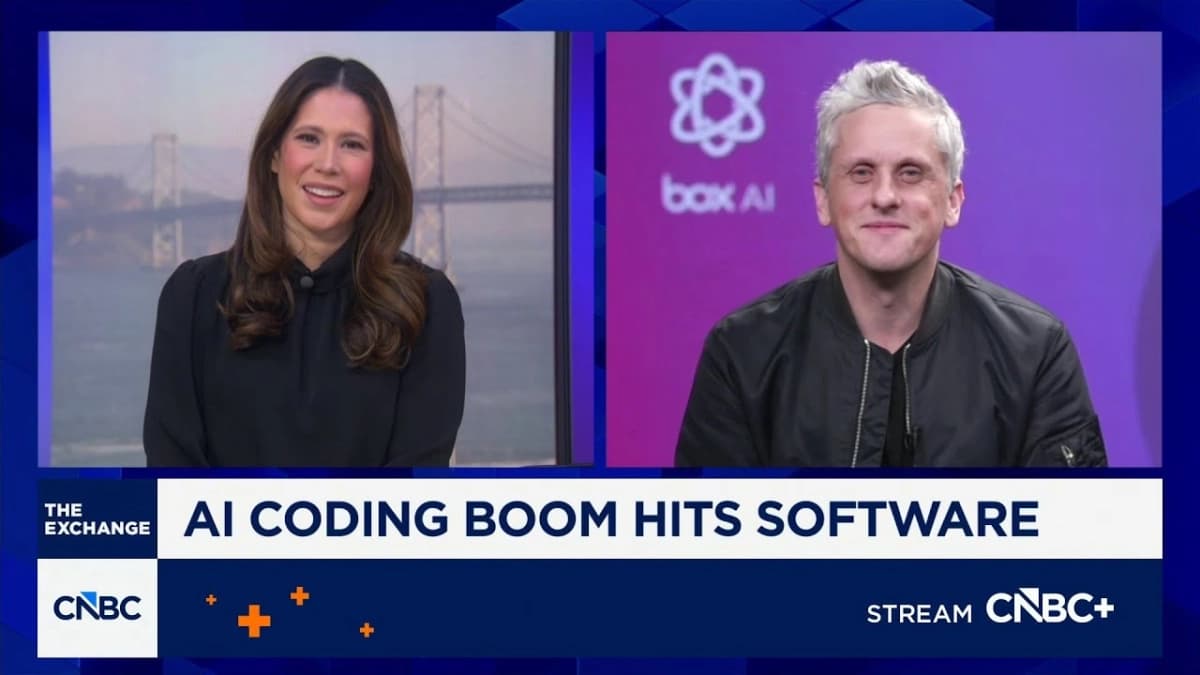
“Why does anyone need a software provider when their own engineers can spin up their own tools using something like Claude Code?” This existential question, posed by CNBC’s Deirdre Bosa, encapsulates the anxiety currently gripping the enterprise software sector. With generative AI democratizing coding and automating complex workflows, legacy SaaS companies are facing intense market skepticism, reflected in the lackluster performance of software stocks compared to the chipmakers fueling the AI revolution. Yet, according to Box CEO Aaron Levie, this anxiety is misplaced. Levie argues that far from destroying traditional platforms, AI agents will dramatically increase their strategic value, particularly for those systems that hold the true ‘context’ of the enterprise.
Levie spoke with Bosa and Kelly Evans on CNBC’s The Exchange about the start to the year for software stocks and the transformative power of AI agents. The conversation quickly shifted from market malaise—noting that the iShares Expanded Tech-Software Sector ETF (IGV) has lagged significantly behind indices like the S&P 500—to an architectural debate about where AI value will accrue. Levie acknowledged the immediate threat posed by engineers quickly building internal tools, but drew a crucial line between these bespoke applications and the bedrock systems that govern business operations.
For mission-critical operations, the notion that companies will abandon established, secure systems to stitch together custom AI workflows is fraught with risk. Levie pointed to the resilience of core systems of record: CRM, ERP, and document management platforms. These systems are not merely applications; they are the deterministic backbones that ensure regulatory compliance, data integrity, and precise workflow execution. While generative AI excels at non-deterministic tasks—analyzing unstructured data, making judgments, or drafting content—it requires strict guardrails when integrated into processes that cannot afford errors.
This is where the incumbent platforms gain leverage. Levie posits that AI agents will become ubiquitous, running around inside organizations to automate processes, extract intelligence, and manage information. However, these agents cannot operate in a vacuum; they must be tethered to trusted data and reliable workflows. “If you imagine a world where there's 10 or 100 times more AI agents that are using technology in the future because they can run around and use our tools, then actually the platforms where those agents are operating in and the data that they have access to, we believe will become even more valuable,” Levie explained. The data, and the platform’s inherent security and governance layers, become the high-value asset.
The core of Levie’s architectural insight rests on the separation of duties. He recommends that enterprise leaders “sort of separate the non-deterministic work... from the deterministic parts of a workflow.” Non-deterministic work involves human-like judgment—reviewing a document, deciding on a path forward. Deterministic work involves the rigid, predictable steps that ensure a process executes correctly every single time, such as workflow triggers or access controls. Having an AI agent try to predict who should have access to sensitive information, and occasionally giving them the wrong data, is, as Levie bluntly put it, “obviously a non-starter for any mission-critical workflow or process.” The robust, deterministic framework provided by existing enterprise software is essential for harnessing AI safely at scale.
This structural necessity places companies like Box in a privileged position. As a content cloud provider, Box houses massive quantities of unstructured corporate data. Levie noted that they store “hundreds of billions of documents in Box, and every single one of those pieces of information contain incredible intelligence for our customers.” By integrating AI agents directly into the platform, Box can allow the AI to operate on the data while maintaining the security, governance, and compliance boundaries already established by the platform. This centralized control over context and workflow is difficult, if not impossible, for internal engineering teams or external third-party AI startups to replicate quickly or securely.
The debate for the next few years, therefore, centers on monetization and execution. Will existing software providers successfully integrate and commercialize these new AI agent capabilities within their existing platforms, or will the value be captured by external AI models operating off-stack? Levie believes that platforms that house the workflow and data are in the "pole position" to power these future workflows. While new startups will inevitably emerge to fill gaps, the entrenched position of incumbents—holding the data, the security frameworks, and the established customer relationships—provides a formidable competitive moat in the age of AI agents. The crisis facing software stocks is less about obsolescence and more about the urgency of transformation: platforms must evolve from mere repositories to intelligent, agent-ready operating environments.