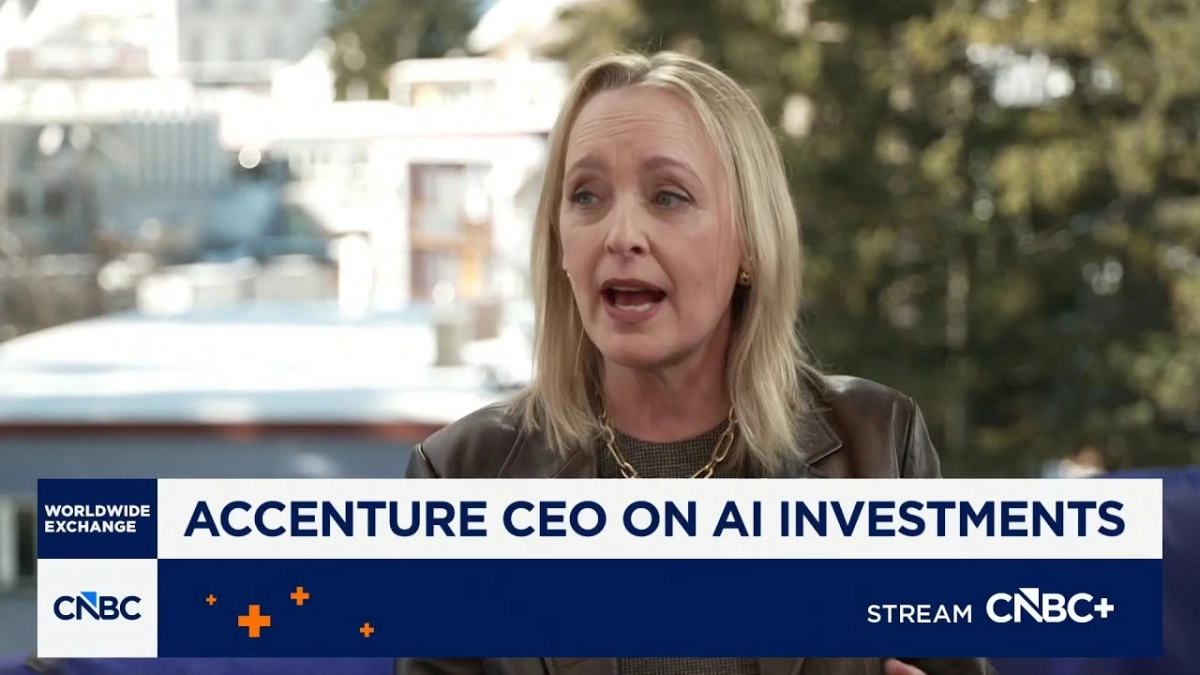
“It’s going to change how we all live day to day,” stated Accenture CEO Julie Sweet, cutting through the usual tech hype to deliver a stark assessment of generative artificial intelligence’s real-world impact. This statement, delivered during an interview on CNBC's Worldwide Exchange, underscored the central theme of her discussion: AI is a fundamental, generational shift that necessitates immediate, large-scale action from global enterprises. Sweet’s commentary provided a pragmatic, operations-focused view of AI deployment, moving the conversation past theoretical potential toward the critical challenges of implementation, investment, and workforce readiness.
Julie Sweet spoke with CNBC’s Sara Eisen at the World Economic Forum (WEF) in Davos, Switzerland, addressing AI strategy, its implications for the global workforce, and Accenture’s massive commitment to navigating this seismic technological shift for its clients. Her perspective, rooted in the consulting giant’s broad exposure to nearly every major industry, is crucial for founders and venture capitalists seeking to understand where enterprise budgets are truly flowing and what operational friction points must be solved for mass adoption.

The scale of the company’s internal and client-facing commitment to AI is perhaps the most tangible evidence of the current enterprise urgency. Accenture has pledged a staggering $3 billion investment over three years specifically to enhance its data and AI practice, double its AI talent, and accelerate client transformations. This capital allocation is not merely for R&D; it is targeted at building the industrial capacity necessary to deploy AI across complex, legacy systems. Sweet emphasized that after a year dominated by exploratory pilots and proofs of concept, the mandate for 2024 is clear: moving AI from the experimental lab into scalable production environments.
This transition from pilot to production represents the next great hurdle for the AI ecosystem. Many startups are adept at building novel models, but few have mastered the integration layer—the messy work of connecting LLMs to proprietary, often siloed enterprise data at scale, securely and reliably. Sweet highlighted this exact operational gap, noting that for companies to realize actual productivity gains, they must move beyond isolated experiments. "The biggest opportunity and challenge is moving from pilot to production," she observed, explaining that this requires a foundational layer of clean data, modern cloud architecture, and appropriate security protocols. For VCs backing B2B SaaS and infrastructure plays, this insight confirms that the immediate value creation is less about raw model superiority and more about enterprise readiness and deployment tooling. The market needs builders who can industrialize AI solutions, not just demonstrate them.
Furthermore, Sweet’s analysis strongly pivoted away from the narrative of job destruction toward one of augmentation and transformation. For an organization like Accenture, which employs hundreds of thousands globally, understanding the workforce implications is not an academic exercise, but a strategic imperative. The CEO pointed out that generative AI will fundamentally change how knowledge workers operate, impacting every role from entry-level analysts to senior executives. The core insight here is that companies must invest equally in human capital transformation as they do in technology. This necessitates a massive, accelerated retraining effort to equip employees with the new skills required to partner with AI systems.
This focus on talent is directly tied to the concept of responsible deployment. In the rush to adopt generative AI, many enterprises risk overlooking governance, security, and ethical guardrails—issues that become exponentially more complex when AI is scaled across critical business functions. Sweet made it clear that technological capability cannot outpace ethical responsibility. She stressed, "We have to build the responsible foundation," referring to the necessity of establishing robust data governance and security frameworks before large-scale deployment can be safely achieved. For enterprise leaders, this translates into immediate demand for AI governance software, specialized legal and compliance consulting, and sophisticated data lineage tools—all areas ripe for innovation and investment.
Ultimately, Accenture’s perspective, as articulated by Sweet, serves as a grounded compass for the tech industry. AI is not a cyclical upgrade but a structural change that demands strategic commitment, not just curiosity. The capital flows will follow the path of scalable integration, responsible governance, and human workforce transformation. The winners in the coming decade will be those enterprises and solution providers who successfully bridge the gap between AI’s vast potential and the practical, secure requirements of global operations.