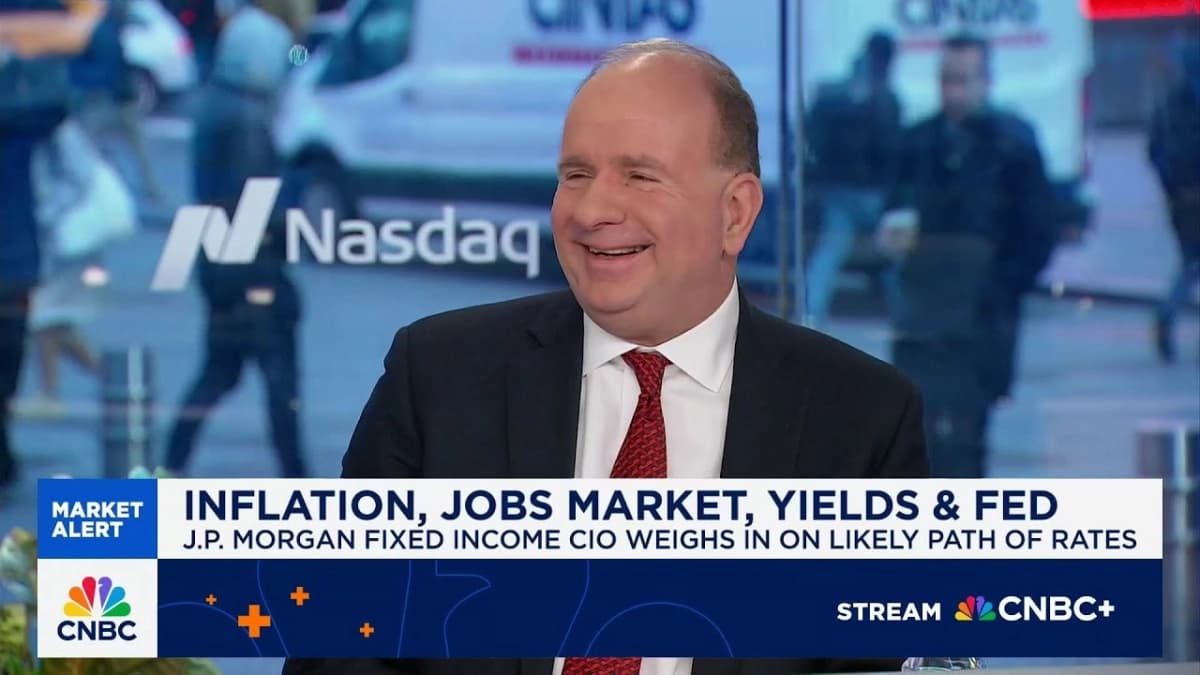
JPMorgan's Bob Michele dismisses the notion of an AI bubble, asserting that the current market environment is far from overheated, despite significant investment in artificial intelligence.
Bob Michele, Chief Investment Officer at JPMorgan Asset Management, spoke with CNBC's "Squawk Box" to discuss market valuations and the broader economic landscape. Michele expressed an optimistic outlook, stating, "I'm going to be the professional optimist today. We're in a pretty good place." He elaborated on the resilience of the US economy, noting its ability to absorb recent economic shocks. "The US economy is gliding into year-end in a pretty good environment right now. Corporate America's seems to have absorbed the tariffs pretty well, consumers are doing pretty well."
A key insight from Michele's analysis is the expectation of a Federal Reserve rate cut in December. He believes this move would be beneficial as the economy transitions into the new year, potentially providing a positive catalyst. "We do expect the Fed to come in and cut rates in December. That would be a nice tailwind as we head into 2025," Michele commented. This projection suggests a belief that inflation, while a concern, is manageable and that the central bank has room to maneuver.
The discussion also touched upon the significant capital expenditure companies are undertaking, particularly in the realm of AI. Michele observed that companies are actively investing in AI capabilities, anticipating future growth and efficiency gains. "Everyone's gearing up for CapEx next year. They're looking to ramp up some hiring, they're looking to build out whatever they're doing in AI. They see the effectiveness of it." This widespread investment indicates a strategic shift towards AI integration across various sectors.
However, Michele also cautioned against viewing the current AI landscape through the lens of past speculative bubbles. He drew a distinction between the current situation and historical instances of irrational exuberance. "You know, we've had bubbles in the past. The dot-com bubble burst. We don't think we're in one now for AI. Companies didn't stop spending on the internet and technology." He emphasized that the fundamental utility and transformative potential of AI differentiate it from previous speculative manias.
Michele highlighted that companies are not simply engaging in speculative investment but are strategically allocating capital to technologies that promise tangible returns. "Look at stock valuations, they're down. I'm not going to invest in this; it's a hoax, ridiculous," he stated, referring to a sentiment of market pessimism that he believes is unfounded. His perspective is that while valuations may appear high to some, the underlying growth and adoption of AI justify the current investment levels.
Furthermore, Michele pointed to the historical context of technological adoption. He referenced the .com era, suggesting that while some speculative excesses occurred, the underlying technology continued to drive growth. "We have to appreciate that there are some secular changes underway. Technology, of course, is a big one. You have to look at demographics, the 1970s boom, the 1980s boom, the 1990s boom, the 2000s boom. You've got a lot of people that are 34 years old, they're dominating earnings, spending and saving." This demographic trend, coupled with technological advancement, underpins his optimistic outlook.
When questioned about the potential for over-investment in AI and its associated costs, Michele remained sanguine. He suggested that while significant capital is being deployed, it is being directed towards areas with demonstrated or anticipated high returns. "I think you have to look at where the money's going. And right now, every company we talk to, and we extend a lot of credit into the system, everyone's gearing up for CapEx next year. They're looking to ramp up some hiring, they're looking to build out whatever they're doing in AI. They see the effectiveness of it."
The core argument presented by Michele is that the current market is not experiencing an AI bubble because the underlying fundamentals of AI adoption and its impact on productivity are robust. He believes that the significant investments being made are strategic and will yield substantial long-term benefits, contrasting this with past speculative manias that lacked a solid foundation. His view is that the market is experiencing a period of fundamental technological transformation rather than irrational exuberance.