
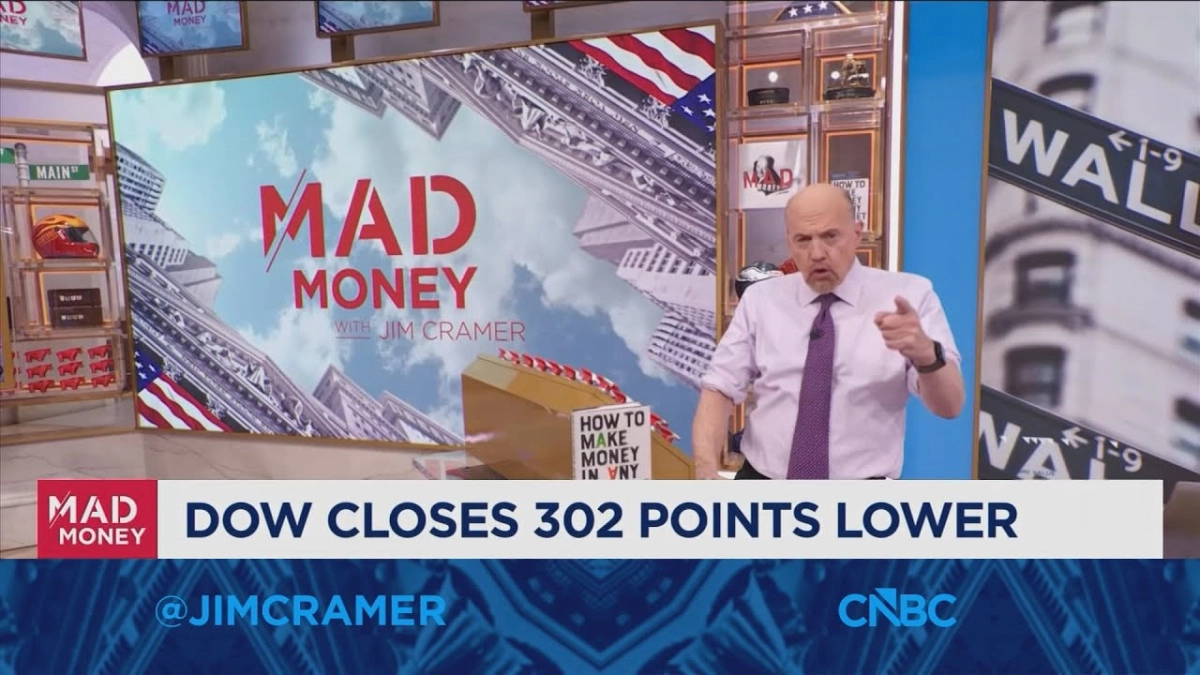
Wall Street has reached a stark conclusion regarding the massive buildout of AI data centers: companies are "paying too much money to build out the data centers." This pronouncement, delivered with characteristic fervor by Jim Cramer on CNBC's Mad Money, signals a critical shift in investor sentiment, moving away from the unbridled enthusiasm that has characterized the AI infrastructure boom. His commentary dissects the complexities of investing in the AI space, highlighting a growing skepticism among money managers concerning the sustainability and profitability of current capital expenditure trends.
Jim Cramer spoke on Mad Money about the AI data center buildout and the intricate challenges of investing in this rapidly evolving sector, emphasizing the market's current assessment of these significant infrastructure investments. His analysis suggests that the sheer scale of investment—hundreds of billions of dollars—is now perceived as a liability rather than an asset by a segment of the investment community. This perspective is particularly salient for founders, VCs, and AI professionals, who must navigate the capital-intensive demands of AI development against a backdrop of potentially shifting market priorities.
One core insight from Cramer’s commentary is the emerging "scarlet letter" status of the data center in the eyes of Wall Street. The immense capital outlay required for these facilities, while essential for AI's computational needs, is now deterring some investors. Instead of pouring capital into companies directly involved in this infrastructure expansion, money managers are reportedly "turned off" and diverting funds towards other sectors entirely, including industrials and pharmaceuticals, or even other, less infrastructure-heavy tech plays. This indicates a flight from perceived overvaluation and an anticipation of a potential correction in the AI infrastructure segment, suggesting that the market is seeking more immediate and less capital-intensive avenues for growth.
The market's discernment is further illustrated by its preference for "plain old-fashioned data storage companies" over the hyper-scalers and proprietary semiconductor firms that have previously dominated the AI narrative. Cramer points to companies like SanDisk, Western Digital, Seagate, and Micron as examples of entities currently thriving. Their success stems from a fundamental imbalance: an "immense amount of demand and not nearly enough supply" for memory and storage components. This scarcity allows these companies to implement "endless price increases," driving robust earnings and attracting investors who are wary of the higher-risk, longer-term returns associated with massive data center investments.
This situation, however, is inherently cyclical, forming a second critical insight into the market dynamics Cramer outlines. The memory and storage sector has a historical pattern of boom and bust, driven by supply and demand fluctuations. While current demand, significantly fueled by AI, allows for strong pricing power, this equilibrium is fragile. Cramer warns that "the moment there are enough machines to manufacture these products, their stocks will indeed plummet." This predictable cycle, he argues, will see analysts "calling a top" even on companies delivering strong reports, such as Micron. For those building AI products and services, this cyclicality means that the cost of foundational components, currently high, could eventually decrease, but the volatility presents a challenge for long-term planning and cost projections.
The divergence in tech investment is striking. Wall Street is now drawing a clear line between the foundational, tangible components of the AI revolution—like memory and storage—and the broader, more abstract investments in data centers and proprietary AI chips. This isn't to say that the latter are without value, but rather that their current valuation and capital expenditure are under intense scrutiny. Investors are seeking more immediate returns and a clearer path to profitability, shying away from what they perceive as speculative overspending in the race to build AI infrastructure.
This recalibration of investor priorities compels a strategic re-evaluation for founders and VCs. The pursuit of AI innovation must now contend with a market that is increasingly sensitive to capital efficiency and tangible returns on investment. The days of simply announcing large AI investments and expecting market applause may be waning, replaced by a demand for clear business models, disciplined spending, and a demonstrated path to profitability. The market is signaling that while AI is undeniably transformative, the infrastructure supporting it must also adhere to sound economic principles, or risk being relegated to the "House of Pain." The focus is shifting from simply building to building smartly and sustainably.