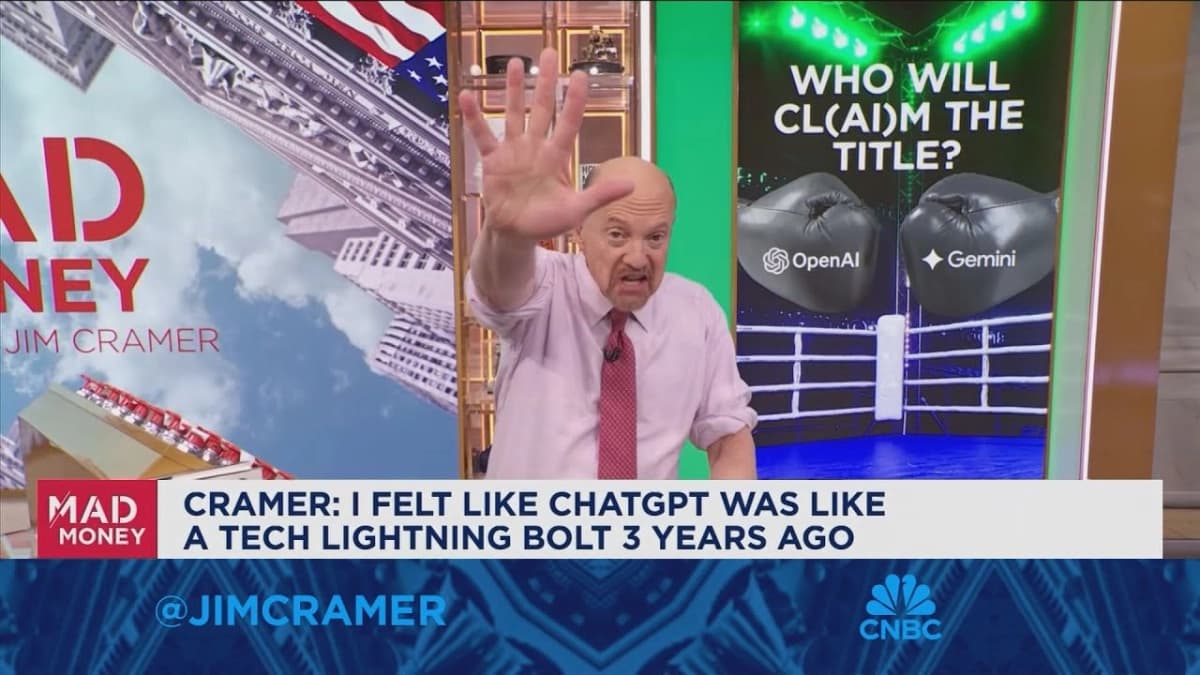
"The leap is insane — reasoning, speed, images, video... everything is sharper and faster. It feels like the world just changed, again." This emphatic declaration from Salesforce CEO Marc Benioff, shared by Jim Cramer on CNBC's *Mad Money*, encapsulates the electrifying pace and competitive intensity defining the current artificial intelligence landscape. Cramer, known for his fervent market commentary, dedicated a segment to dissecting the evolving AI race, specifically highlighting the monumental impact of OpenAI's ChatGPT and the recent, formidable challenge posed by Google's Gemini 3.
In his analysis, Jim Cramer reflected on the initial shockwave that ChatGPT sent through the tech world a little over three years ago. Launched on November 30, 2022, the generative AI chatbot achieved an astonishing one million users in just five days, a testament to its unprecedented capabilities and broad appeal. Cramer described this moment as a "tech lightning bolt," recalling his own amazement at its ability to perform diverse tasks, from composing haikus to simulating interviews with historical figures. This rapid adoption propelled OpenAI, a company that has yet to go public, into a valuation stratosphere typically reserved for established tech giants.
Fast forward to the present, and the AI narrative has gained another critical chapter. Google, through its parent company Alphabet, recently unveiled a new version of its own generative AI platform, Gemini 3. This release marked another pivotal "moment" in the industry, one that Cramer suggests is already reshaping perceptions of AI leadership. The immediate and profound reaction from industry leaders, particularly Benioff's public endorsement, underscores the qualitative leap Gemini 3 represents. Benioff, a long-time user of ChatGPT, stated he had spent two hours on Gemini 3 and was "not going back," signaling a significant shift in his preference.
The implication of such a statement from a prominent tech CEO is not merely anecdotal; it speaks to a fundamental re-evaluation of the competitive landscape. For an incumbent like ChatGPT, which has enjoyed a virtually unchallenged reign in public consciousness, the emergence of a demonstrably superior or at least highly competitive alternative poses an existential threat. "The idea that [ChatGPT] could be dethroned so quickly is inconceivable," Cramer remarked, yet he immediately followed this with a personal admission: he, too, a regular and heavy user of ChatGPT, found himself "migrating to Gemini." This personal experience from a seasoned market observer illustrates the tangible impact of Gemini 3's advancements.
The speed at which these AI models are evolving and the intensity of the competition are core insights for any professional in the startup ecosystem or tech investment space. This is not a gradual innovation curve but a series of disruptive, almost instantaneous, advancements. The market is constantly being reshaped by new iterations that redefine the possible, demanding agility and foresight from founders and VCs alike. The "insane" leaps in reasoning, speed, image, and video processing that Benioff cited indicate a multimodality and performance benchmark that could set a new industry standard.
Related Reading
- New York Assemblyman Alex Bores on AI Regulation: A Battle Against Unbridled Power
- Alphabet's Vertical AI Dominance Threatens Nvidia-OpenAI Ecosystem
- No AI Bubble, Just an Altitude Adjustment: Doug Clinton on Market Realities and Google's Gemini Leap
The financial ramifications of this AI arms race are, as Cramer articulated, "gigantic." Alphabet, the parent of Gemini, has already witnessed its stock rally furiously, climbing 68% year-to-date, with a substantial portion of that growth occurring in recent weeks. This surge reflects growing investor confidence in Google's renewed competitive edge in AI, suggesting that the market views Gemini 3 not just as an incremental improvement but as a potential game-changer. The stock's previous undervaluation relative to other "Magnificent Seven" tech stocks now appears to be correcting, driven by the palpable excitement around Gemini's capabilities.
This intense rivalry between OpenAI and Google exemplifies the high-stakes nature of the AI frontier. Companies are not just competing for market share; they are vying for the very definition of future digital interaction and enterprise efficiency. The rapid succession of groundbreaking releases creates an environment where leadership can be fleeting, and yesterday's "lightning bolt" can quickly be overshadowed by tomorrow's "insane leap." For founders and investors, understanding these shifts is paramount, as the trajectory of entire industries, and indeed the global economy, hinges on who can consistently deliver the most powerful, user-friendly, and integrated AI solutions.