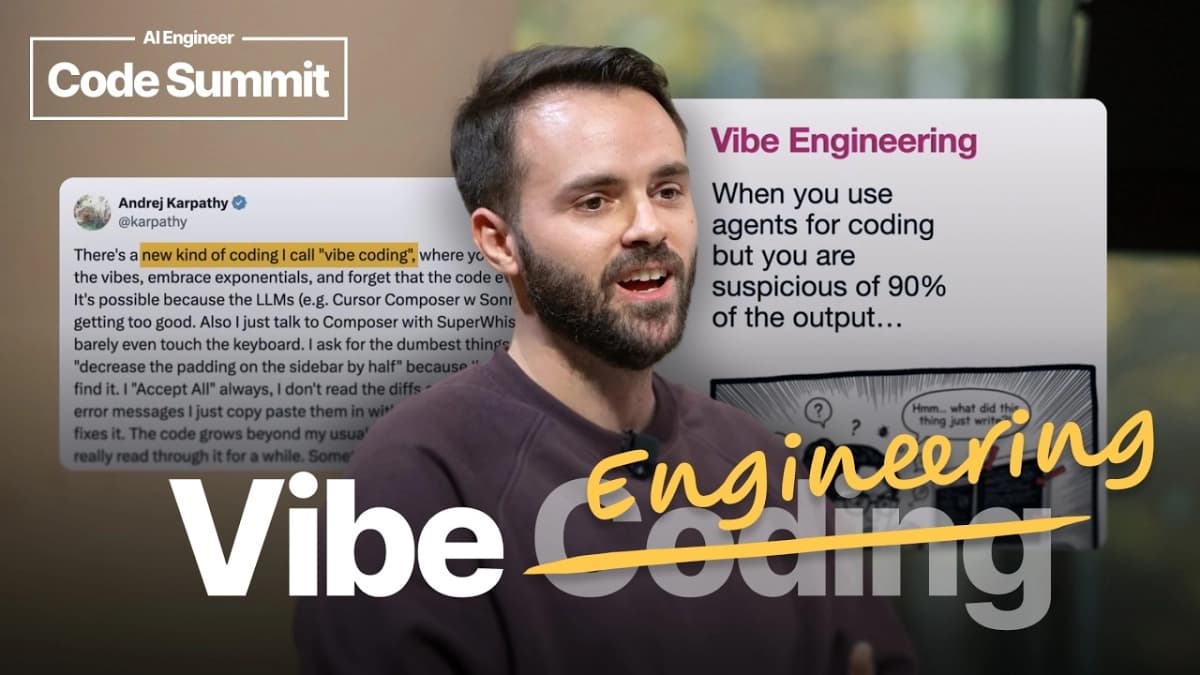
The advent of large language models is fundamentally reshaping the very act of software creation, moving developers from the meticulous crafting of syntax to a more abstract, intent-driven collaboration with artificial intelligence. This profound shift was the central thesis of Kitze, founder of Sizzy, in his recent discourse on the evolution from "vibe coding" to "vibe engineering." He posits that the developer's role is transforming, echoing past technological revolutions while setting a new trajectory for how we conceive and build digital experiences.
Kitze, a prominent voice in developer tooling and frontend innovation, articulated this vision in a recent presentation, exploring what the rise of AI means for the future of coding, particularly within frontend development. His insights challenge traditional notions of programming, suggesting that the most valuable skills are shifting from execution to conceptualization and critical evaluation.
At its core, "vibe coding" describes an emergent paradigm where developers communicate their desired outcomes, or "vibe," to an AI, rather than writing explicit lines of code. It's a departure from the imperative, step-by-step instructions of traditional programming. As Kitze explains, "It's like you're giving it a vibe, a feeling, and it understands what you want to achieve." This analogy suggests a relationship more akin to a director guiding actors or a chef providing a culinary vision than a programmer meticulously typing out instructions. The AI becomes the executor, translating abstract intent into functional code.
This initial phase of "vibe coding" naturally evolves into "vibe engineering," a more refined and strategic approach. Vibe engineering demands a deeper understanding of AI's capabilities, limitations, and the nuances of effective prompt design. It moves beyond simply stating a desire to skillfully orchestrating AI models to produce complex, high-quality software. This transition implies that developers will need to cultivate a sophisticated intuition for interacting with AI, learning how to articulate requirements with precision and clarity, and how to iteratively refine AI-generated outputs.
The implications for the developer workforce are significant. Kitze argues that developers will transition from being "syntax monkeys" to "vibe managers" or "AI orchestrators." The emphasis shifts from memorizing APIs and debugging semicolons to problem-solving at a higher level of abstraction, understanding user needs, and critically evaluating the AI's output. This requires a strong sense of aesthetic and functional judgment. "You need to be able to tell what's good and what's bad," Kitze emphasized, highlighting the enduring importance of human discernment in a world of AI-generated code.
Frontend development stands at a particularly interesting juncture in this evolution. As Kitze notes, "The frontend is the most human-centric part of the application." Its direct interaction with users means that conveying a precise "vibe"—the look, feel, and user experience—is paramount. AI, with its capacity to rapidly generate UI components and design variations, can accelerate this process, but the human developer remains crucial for defining the ultimate user experience and ensuring the "vibe" aligns with strategic goals. This domain, more than others, will likely see an accelerated adoption of vibe engineering principles, as visual and interactive elements lend themselves well to conceptual, intent-based prompting.
This isn't an entirely unprecedented shift. Kitze draws compelling parallels to historical advancements in computing, from the introduction of compilers abstracting away assembly language to the rise of powerful frameworks like jQuery and React, which simplified complex DOM manipulations. Each wave of technological abstraction has, rather than replacing developers, elevated their roles. "Every time there's a new abstraction, it feels like it's going to replace developers, but it just elevates them," he stated, reassuring that this evolution is a natural progression, not an existential threat.
For founders, VCs, and AI professionals, this vision underscores a critical investment area: tools and platforms that facilitate effective vibe engineering. The next generation of development environments will likely focus on intuitive interfaces for AI interaction, robust feedback loops for refining AI outputs, and powerful visualization tools that allow developers to quickly assess and iterate on AI-generated codebases. The ability to abstract away boilerplate and focus on the unique, value-adding aspects of a project will become a significant competitive advantage. This transformation promises to unlock unprecedented levels of productivity and innovation, allowing smaller teams to achieve what once required vast engineering resources.