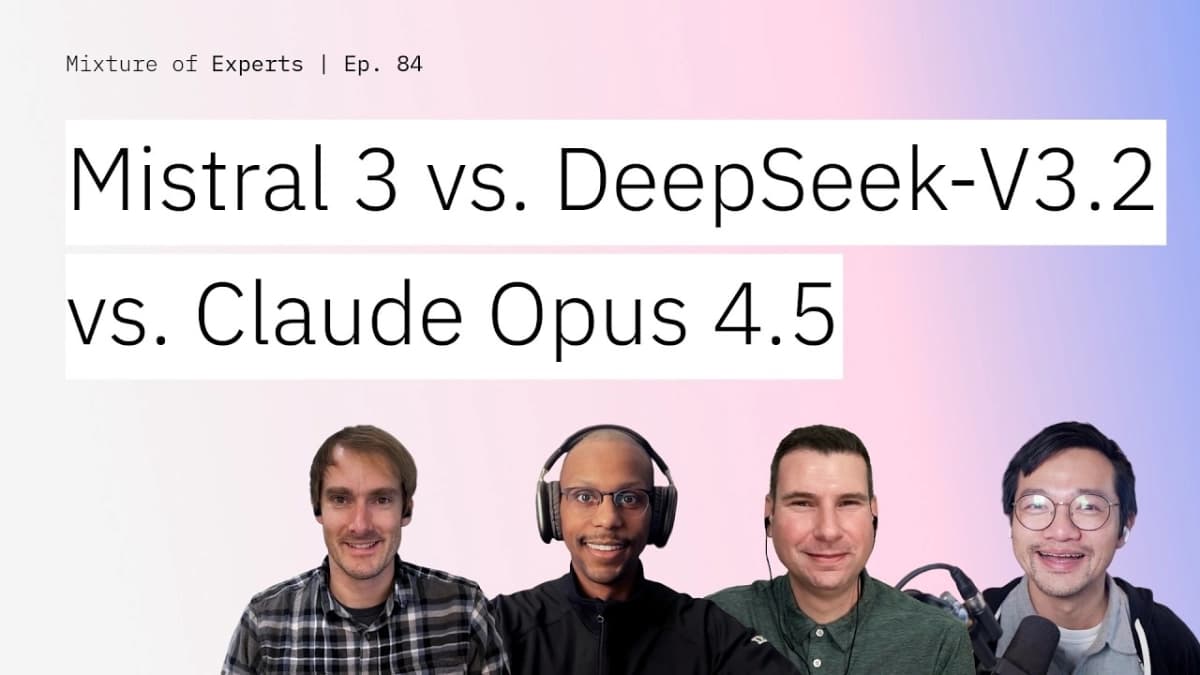
The AI landscape is not merely evolving; it is exploding with innovation, a phenomenon acutely dissected by host Tim Hwang and panelists Aaron Baughman, Abraham Daniels, and Gabe Goodhart on a recent 'Mixture of Experts' podcast. Their conversation delved into a flurry of new model releases, the enduring debate around AI scaling laws, and the burgeoning "turf wars" threatening the dream of universal AI agents. This rapid progression, marked by both collaborative open-source efforts and competitive closed-source strategies, underscores a pivotal moment for founders, VCs, and tech professionals navigating this dynamic ecosystem.
On this episode of 'Mixture of Experts,' Tim Hwang spoke with IBM Fellow and Master Inventor Aaron Baughman, Senior Technical Product Manager Abraham Daniels from Granite, and Chief Architect for AI Open Innovation Gabe Goodhart. Their discussion centered on three recent major model releases—Mistral 3, DeepSeek-V3.2, and Claude Opus 4.5—along with the implications of AI scaling laws, particularly in light of Gemini 3, and the business incentives behind Amazon's decision to block ChatGPT's shopping research agent. The panelists offered sharp analysis on these developments, revealing a market increasingly defined by specialization and strategic positioning.
The sheer volume and quality of recent AI model releases have created what Gabe Goodhart aptly dubbed "Fun-cember," a period where developers eagerly unpack new models to "play with over the holidays." This celebratory sentiment underscores a crucial insight: the AI field is currently experiencing an unprecedented "wealth of riches in the model space," with "so many good models out there" that distinguishing a clear winner becomes increasingly challenging. Mistral 3, for instance, has impressed with its multimodal capabilities across its entire model line, making vision a "bread and butter" feature rather than an extra. DeepSeek-V3.2, conversely, leans into a "reasoning-first" approach, optimizing for agentic workflows and tool-calling. These distinct strategies highlight a growing trend among open-source labs to "lean into their strengths," cultivating specialized niches in an otherwise crowded market.
The conversation then pivoted to the ongoing debate surrounding AI scaling laws, sparked by a provocative blog post from Theory Ventures suggesting Gemini 3 validates the "throw more compute at the problem" approach. While Google's massive computational resources and integrated hardware/software stack (TPUs) offer an unparalleled advantage, Abraham Daniels highlighted that this doesn't necessarily invalidate algorithmic innovation. Aaron Baughman underscored this, noting that Gemini 3 achieved its advancements while keeping roughly the same number of parameters as its predecessor, suggesting that "algorithmic improvements" played a significant role. Gabe Goodhart reframed scaling laws as "quality improvement laws," arguing that true progress lies in faster experimentation and more efficient training methods, rather than simply increasing model size. The high cost of training large models, often running into millions of dollars and months of development, incentivizes a shift towards smarter, rather than just bigger, approaches.
This strategic recalibration is further evidenced by the emerging "turf wars" in the AI agent space. Amazon’s recent decision to block ChatGPT’s shopping research agent from accessing its product data is a stark reminder of the business incentives at play. Aaron Baughman explicitly labeled this conflict as "open shopping AI versus closed retail empires," highlighting Amazon's efforts to protect its e-commerce data and direct users to its proprietary AI-driven shopping services like Alexa Plus and Rufus. This move, while understandable from a business perspective, could stifle the broader dream of universal AI agents capable of seamless interaction across various platforms. Gabe Goodhart drew parallels to the historical "browser wars" and antitrust lawsuits, speculating that similar legal battles will likely arise as platforms erect digital walls around their content.
The implication is clear: the era of unrestricted data access for AI agents may be drawing to a close. The future will likely see a complex interplay of specialized models, hybrid architectures that combine different AI strengths, and platform-specific agents operating within carefully guarded ecosystems. The pursuit of "what is good enough" will increasingly be defined by specific business cases and domain expertise, rather than a singular race for general intelligence.