
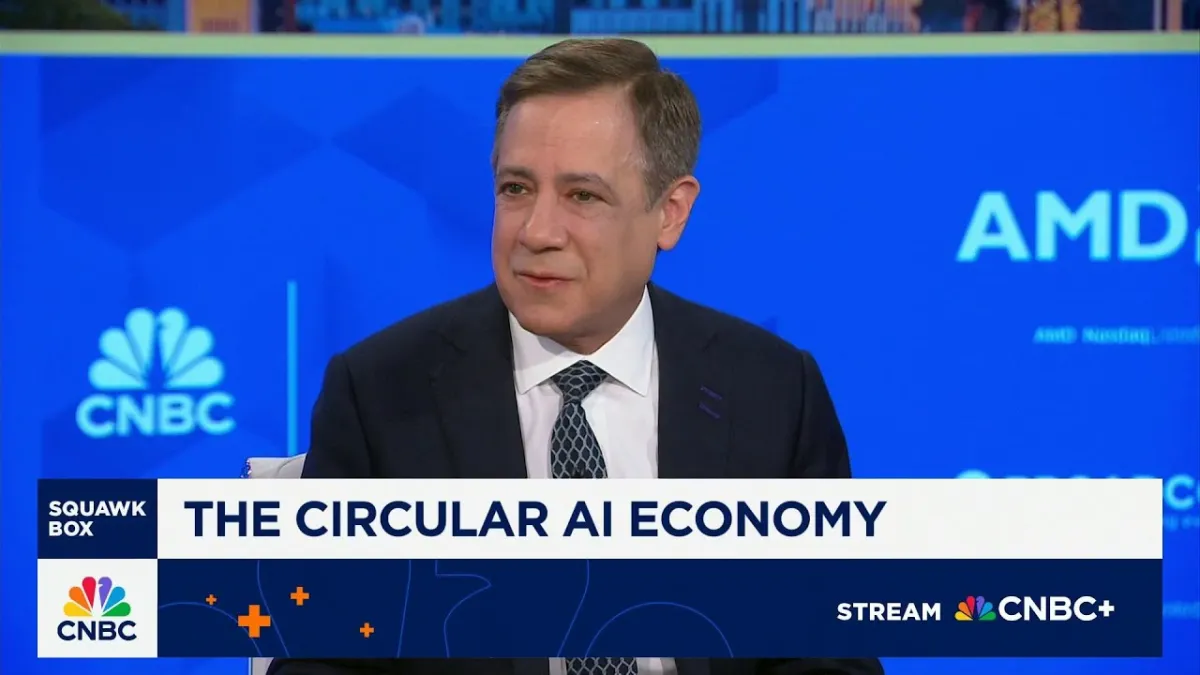
The burgeoning AI economy, characterized by colossal investments and strategic partnerships, has ignited a fervent debate: is this a sustainable growth engine fueled by genuine demand, or a speculative bubble reminiscent of past tech frenzies? This critical question formed the core of a recent CNBC "Squawk Box" discussion, featuring Activate co-founder and CEO Michael Wolf alongside interviewers Andrew Ross Sorkin, Joe Kernen, and Becky Quick. The conversation dissected the intricate financial relationships underpinning the AI surge, particularly the "circular spending" model where leading players invest in and procure from each other.
Michael Wolf, speaking with the CNBC panel, addressed the nature of these unprecedented capital flows, pushing back against the notion that current AI investments are merely "vendor financing." He asserted, "This is you've got all of these companies, they're all investing, making huge investments in infrastructure. And this level of investment, of course, they're all going to partner up to do it. But they're investing really because there's going to be real demand." Wolf posited that the sheer scale and strategic imperative of developing foundational AI infrastructure necessitate such collaborative investment, driven by an undeniable market need rather than artificial inflation.
Andrew Ross Sorkin, however, voiced a more skeptical perspective, drawing parallels to historical market excesses. He highlighted the apparent paradox where companies "can't afford to make the commitments that they're making... They don't have the cash." Sorkin pointed to instances, like Nvidia's investment in OpenAI, followed by OpenAI's commitment to purchase Nvidia chips, as evidence of a "circular money loop." He argued that firms are effectively getting funding from those they are committing to buy from, creating a potentially precarious financial ecosystem. This structure raises questions about the true independence and solvency of these AI entities, suggesting a self-reinforcing cycle of investment and procurement that could be vulnerable to shifts in market sentiment.
Wolf countered by differentiating the current AI landscape from the dot-com bust of the late 1990s. He recalled, "In the late 90s what we saw was the equipment companies, Nortel and others, making huge investments, Lucent and others, they were they were they were giving credit to WorldCom, Sprint, AT&T to buy equipment. But the demand wasn't there." The crucial distinction, according to Wolf, lies in the presence of tangible, rapidly expanding consumer and enterprise demand for AI services today. Unlike the telecom bubble where infrastructure was built on anticipated, but ultimately unrealized, demand, AI is already demonstrating massive user engagement and utility.
A key point of contention revolved around the economics of delivering AI. Sorkin raised concerns about the higher marginal cost of AI-powered answers compared to traditional search. While acknowledging this, Wolf emphasized the transformative nature of AI, citing ChatGPT's evolution into a "super platform." He elaborated, "ChatGPT is no longer an app. It is it is now a super platform because you can go on to it today, DoorDash, Expedia, all of those, you can go there. So suddenly it's creating it's creating demand that that was wasn't going to be there in the past." This shift from a standalone application to an integrated ecosystem suggests AI is not merely substituting existing services but generating entirely new categories of interaction and demand.
The competitive dynamics within the AI chip market also underscore the investment rationale. Nvidia has, for the moment, enjoyed a near-monopoly on the high-performance chips critical for AI development. However, AMD's recent deal with OpenAI, involving a substantial stake and commitment to deploy AMD chips, signals a nascent competitive landscape. This move, which saw AMD's stock jump, reflects investor confidence that competition will spur innovation and provide alternatives to Nvidia's dominance.
The market’s willingness to reward spending in AI is unusual but indicative of a belief in future returns. This is not merely a speculative bet but an acknowledgment of the foundational role AI will play across industries. The current investment frenzy is seen by proponents as a necessary precursor to a broader, more productive economy, rather than a fleeting speculative wave.
The debate between a sustainable "circular AI economy" and a potential bubble hinges on whether the underlying demand for AI services can ultimately justify the enormous capital expenditures. While the financial mechanisms bear some resemblance to past speculative periods, the tangible utility and rapid integration of AI into daily life suggest a more robust foundation. The market is betting heavily on AI's capacity to drive unprecedented productivity and create new economic value, a gamble that remains the central narrative for founders, VCs, and tech insiders navigating this transformative era.



