
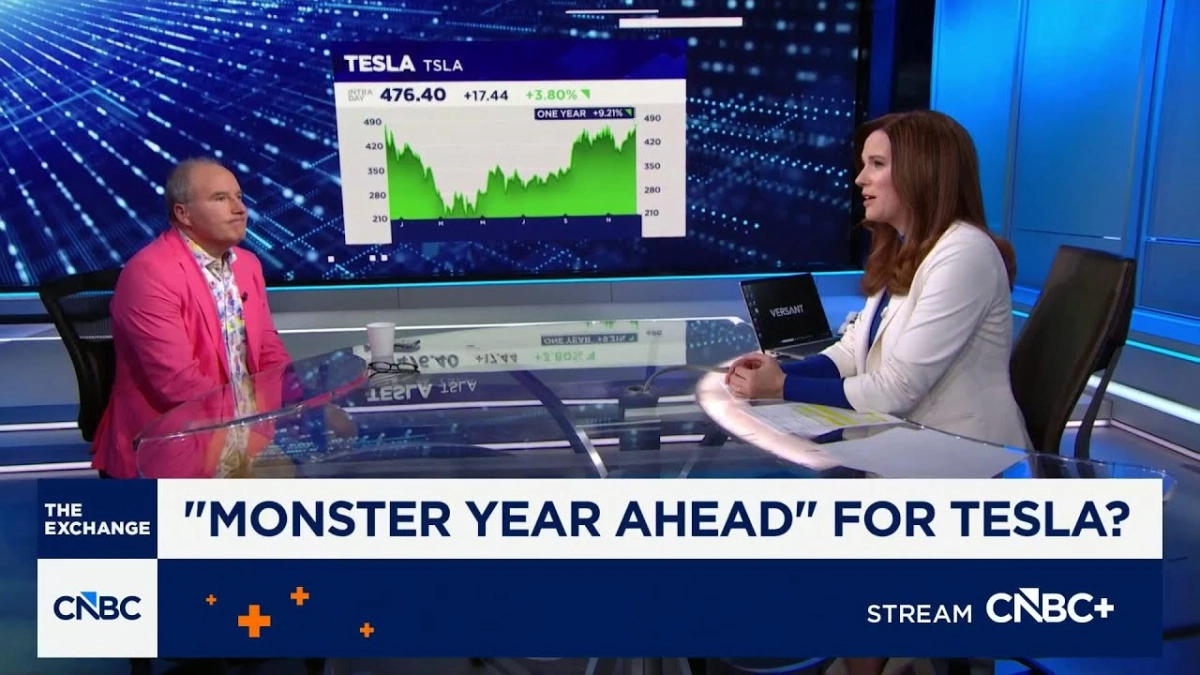
Wedbush Securities’ Dan Ives recently offered a compelling vision of Tesla's future, asserting that the company, alongside Nvidia, stands at the forefront of the "physical AI revolution." This isn't merely about electric vehicles; it's about the profound convergence of hardware and artificial intelligence to create tangible, real-world autonomous capabilities. Ives’s commentary underscores a pivotal shift in how market leaders and tech insiders perceive Tesla, moving beyond its automotive manufacturing prowess to its foundational role in a broader AI ecosystem.
In a recent appearance on CNBC's "The Exchange," Ives, Global Head of Technology Research at Wedbush, articulated his bullish outlook on Tesla, particularly forecasting 2026 as a "golden chapter" for the company. He engaged with interviewer Kelly Evans on the drivers behind his optimistic projections, delving into the nuances of Tesla's technological advancements and their potential financial implications. His analysis presented a future where Tesla's AI innovations redefine its market position and valuation.
Central to Ives's thesis is the transformative power of physical AI, encompassing everything from autonomous driving to advanced robotics. He posits that the opportunity presented by AI and autonomous technology for Tesla alone is valued at "at least $1 trillion." This staggering figure isn't just speculative; it's rooted in the anticipated rollout of robotaxis, the Cybertruck's potential for volume production, and the humanoid robot Optimus. These initiatives, according to Ives, will fundamentally alter Tesla's growth trajectory and margin profile.
The analyst anticipates that Full Self-Driving (FSD) penetration could skyrocket from its current levels to over 50%. Such widespread adoption would dramatically change the company's financial model, ushering in unprecedented margins. This shift moves Tesla from a traditional automotive manufacturer to a high-margin software and services provider.
Ives also pointed to an evolving regulatory landscape, suggesting that a potential easing of regulations, possibly under a new administration, could fast-track key autonomous initiatives within the next three to six months. This regulatory tailwind would further accelerate Tesla's ambitious plans, solidifying its market leadership. The shift from state-level to federal oversight in autonomous driving regulations would create a more unified and predictable environment for deployment.
Addressing concerns about the potential distraction or dilution of investor interest should SpaceX go public, Ives offered a counter-narrative. He believes a SpaceX IPO would not detract from Tesla but rather "expands the ecosystem" around Elon Musk's ventures. This perspective suggests that the collective innovation across Musk's companies reinforces a broader, interconnected vision, attracting a larger pool of visionary investors rather than fragmenting capital. He notes that we are only in "year three of an eight-to-ten-year buildout in terms of the AI revolution," implying significant runway for growth across the Musk empire.
Comparing Tesla's autonomous ambitions to competitors like Waymo, Ives dismissed the latter as a "rounding error" in the grand scheme. He asserts that Tesla's ability to scale its technology globally, coupled with its aggressive pursuit of robotics, positions it to capture an overwhelming majority—70% to 80%—of the global autonomous market over the next decade. This global reach and technological breadth distinguish Tesla from rivals focused on more localized or niche applications.
Ultimately, Ives paints a picture of Tesla reaching a $2 trillion market cap in the near term, with a bull case scenario pushing it to $3 trillion by late 2026 or early 2027. This valuation hinges on the company's successful execution of its physical AI roadmap, transforming it into a dominant force in autonomous transportation and advanced robotics. The market's perception of Tesla, he argues, is shifting from an EV company to an AI and robotics powerhouse.