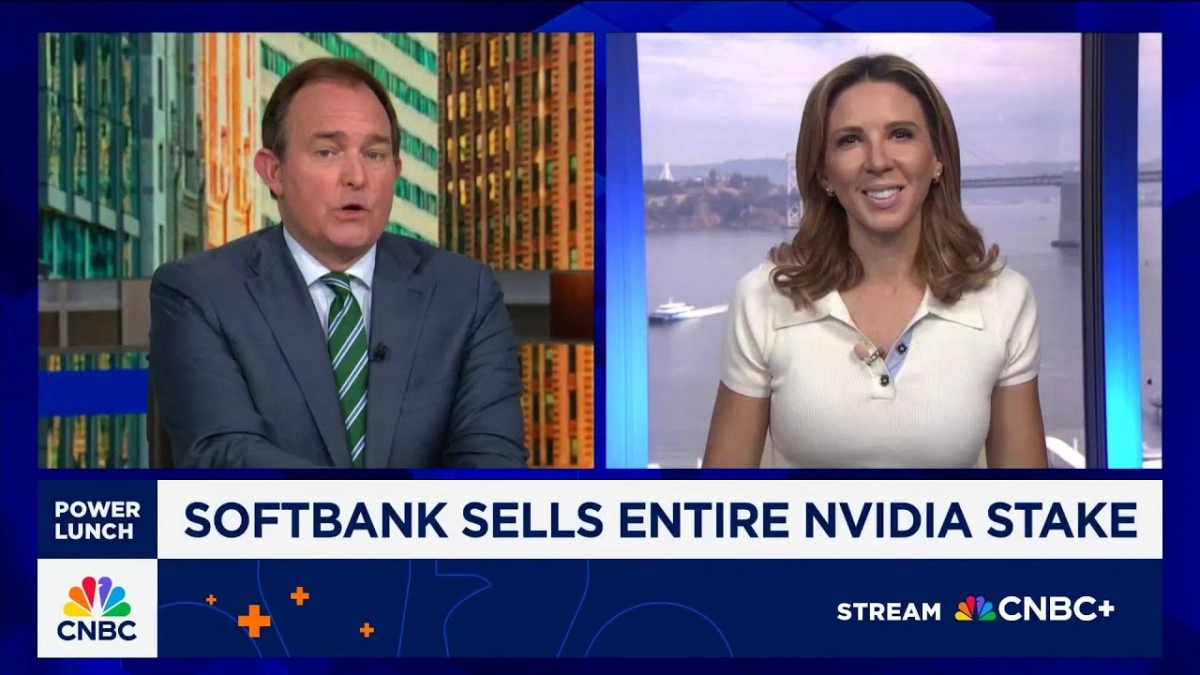
SoftBank has executed one of the most significant strategic pivots in the current artificial intelligence cycle, selling its entire stake in chip-making behemoth Nvidia to funnel capital into OpenAI. This move, totaling nearly $6 billion from the Nvidia divestment alone, signals a profound shift in investment philosophy, moving away from the foundational infrastructure of AI to the application layer where direct user and business interaction occurs. The decision by SoftBank, led by Masayoshi Son, is not merely a divestment but a complete reorientation of capital toward what they perceive as the next frontier of value creation in AI.
This dramatic repositioning was discussed on CNBC's Power Lunch, where Brian Sullivan spoke with CNBC Business News reporter MacKenzie Sigalos about the implications of SoftBank's actions. Sigalos detailed SoftBank’s aggressive cash-raising efforts, which included selling over $9 billion in T-Mobile stock and leveraging its Arm stake, all to finance its deepening involvement with OpenAI. The firm is not only participating in OpenAI’s recent secondary share sale but is also reportedly leading a substantial $40 billion primary funding round.
MacKenzie Sigalos highlighted the rationale behind this pivot: "It is not a call against Nvidia's future... it is about where they see that next wave of value creation and it's not in the infrastructure layer, but it's in the interface, the platforms, agents, those tools that consumers and businesses are actually using." This perspective underscores a belief that while Nvidia's hardware underpins the AI revolution, the true economic leverage will ultimately reside in the user-facing applications and platforms that directly deliver AI capabilities. It’s a classic venture capital thesis: move up the stack to capture more value as the underlying technology commoditizes or matures.
However, SoftBank’s enthusiastic embrace of OpenAI comes with a stark financial reality, particularly when contrasted with its competitor, Anthropic. Recent financial documents reviewed by The Wall Street Journal reveal a significant divergence in profitability timelines and business models. Anthropic has maintained a sharp focus on enterprise clients, a strategy that is demonstrably paying dividends.
"Anthropic has always been focused on enterprise, and it's paying off. Roughly 85% of its revenue comes from business customers compared to OpenAI's 70/30 consumer-heavy split," Sigalos reported. This enterprise-centric approach has positioned Anthropic for a much faster path to profitability. Its revenue stream is more predictable and less reliant on the high-volume, often lower-margin, consumer-facing products that characterize much of OpenAI's current offerings.
OpenAI, despite its groundbreaking innovations like ChatGPT and the popular new video tool Sora, faces substantial financial hurdles. These consumer-facing products, while driving widespread adoption and brand recognition, are "deeply unprofitable" and contribute significantly to OpenAI's massive infrastructure costs. The company has reportedly committed over $1.4 trillion to power its consumer-facing products, a staggering figure that translates directly into a colossal cash burn.
The financial projections are sobering for OpenAI. "OpenAI expects to lose $74 billion in 2028 alone, burning through 14 times more cash than Anthropic before it turns a profit in 2030," Sigalos conveyed, citing the Wall Street Journal's findings. This forecast suggests that despite the rapid growth in revenue, the operational costs associated with developing and deploying cutting-edge AI models on a consumer scale are immense, pushing profitability further into the future than many might expect. The sheer scale of these projected losses underscores the long and capital-intensive road ahead for companies operating at the frontier of AI development, particularly those targeting broad consumer markets.
In response to such figures, OpenAI CEO Sam Altman maintains an optimistic outlook, asserting that the company is on track to generate "hundreds of billions of dollars" in revenue by 2030. This projection represents a "sharp revision upward" and is rooted in the belief that the current heavy investment in research and development, coupled with infrastructure build-out, is a necessary precursor to future profitability. It’s a "spending to make money" philosophy, common in high-growth tech, but the scale of the investment and projected losses is unprecedented for a private company.
SoftBank’s history with Nvidia provides a cautionary tale. The Japanese conglomerate previously exited its Nvidia stake in 2019, missing out on a surge that would have made that holding worth $210 billion today, a 5,722% increase. This time, the exit is explicitly not about Nvidia’s valuation, but about a strategic repositioning. Masayoshi Son, known for his audacious bets, is once again placing a significant wager on a transformative technology, albeit with a different focus. The question remains how patient SoftBank and other investors will be as OpenAI navigates a path of multi-billion-dollar losses over the next several years before potentially reaching profitability. The current landscape highlights a bifurcated AI market: one path prioritizing rapid, enterprise-driven monetization, and another pursuing a grander, more capital-intensive vision of consumer-facing general AI, with SoftBank now firmly entrenched in the latter.