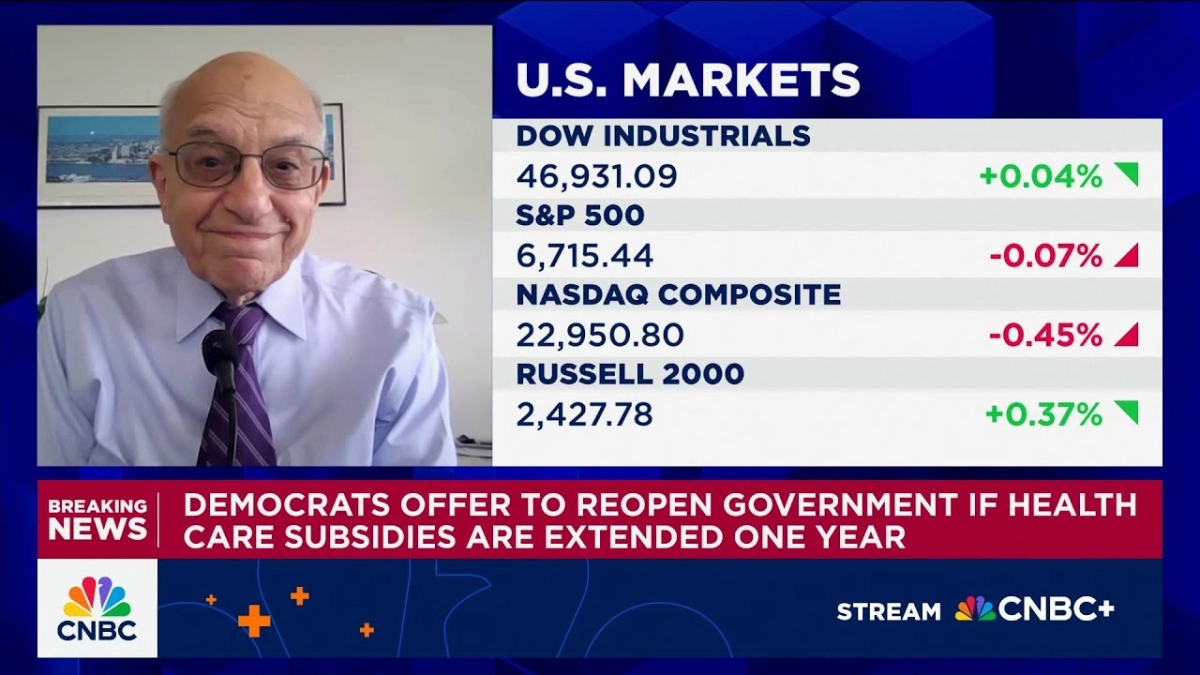
Despite a week marked by pronounced volatility in the tech sector and a looming government shutdown, the underlying strength of the artificial intelligence trade remains robust, according to veteran economist Jeremy Siegel. Speaking with Scott Wapner on CNBC's "Closing Bell," the Wharton School professor and WisdomTree Chief Economist offered a steadfast perspective on the market, distinguishing between temporary political anxieties and enduring technological shifts. The conversation, occurring as markets reacted to an offer to potentially resolve the government shutdown, pivoted from immediate fiscal concerns to the longer-term trajectory of AI-related investments, a topic generating considerable "anxiety" among investors.
Siegel initially addressed the breaking news of a potential breakthrough in the government shutdown, noting the swift market reaction. He observed a rapid ascent in the Dow Industrials, remarking, "about 20 minutes ago, I saw the Dow go up 150 points in about 30 seconds and I said something’s afoot here." This immediate upward swing underscored the market’s sensitivity to political stability, with Siegel advising Republicans to accept the offer, asserting that the shutdown has not worked to their advantage. He further posited that a prolonged shutdown could significantly impede economic growth, stating, "I think this shutdown could shave one and a half, maybe two points off of GDP this quarter." This candid assessment highlights the tangible economic costs of political impasse, a critical consideration for founders and VCs navigating broader market conditions.

The core of the discussion, however, revolved around the perceived fragility of the AI trade. Wapner highlighted the Nasdaq's week-long dip, down more than three percent, and the extraordinary volatility experienced by major AI stocks. Yet, Siegel remained unfazed, reiterating his conviction: "I still think the AI trade is on." He acknowledged the recent dips, noting that while tech stocks had shot up and subsequently retreated, they were now "right back at the trend line." This observation suggests that the recent downturn might be a natural correction rather than a fundamental flaw in the AI narrative.
Siegel articulated a valuable insight for those operating in the startup ecosystem: market sentiment often acts as a contrarian indicator. He pointed out, "Whenever anyone says it’s the beginning of the end, and when everyone starts saying it’s the beginning of the end, I begin to say, 'Hey, that’s not the way it works.'" This perspective challenges the herd mentality, suggesting that widespread pessimism can signal a buying opportunity, just as universal optimism often precedes a correction. For VCs evaluating nascent AI ventures, this philosophy encourages a deeper look beyond immediate market reactions to fundamental value and long-term potential.
His analysis of the broader trend for AI stocks further solidified his bullish stance. Siegel noted that "the trend line is still that these stocks over the last six months, over the last year, after two years, are still moving up relative to the rest of the market." This consistent outperformance, even amidst short-term fluctuations, indicates a powerful, sustained growth trajectory. While acknowledging Meta Platforms' challenges with capital expenditures, Siegel clarified that most other AI companies are successfully "generating those profits with that expenditures," differentiating between specific company-level issues and the overall health of the AI sector.
Related Reading
- Tech Valuations Under Scrutiny as Market Correction Looms
- AI Stock Repricing Signals Market Caution
- AI Hyperscalers Fuel Debt Surge, Offering Unique Investor Opportunity
The economist believes that once the "cloud" of the government shutdown clears, a clearer picture of the real economy will emerge. This resolution, he argues, will allow stock prices to be based more accurately on economic fundamentals rather than political uncertainty. For AI professionals, this implies that while macro headwinds can create short-term noise, the intrinsic value and transformative power of AI will ultimately dictate long-term market performance. The current anxiety, therefore, might be less about AI's potential and more about the broader economic and political environment.
Siegel’s commentary serves as a critical reminder to tech insiders and investors that the foundational shift driven by artificial intelligence is a long-term phenomenon, less susceptible to transient market anxieties or political squabbles. The current market movements, though dramatic, are viewed as temporary deviations from a robust upward trend. The true test, he suggests, will come when external distractions subside, allowing the market to properly evaluate the economic realities and the sustained, profit-generating power of the AI revolution.