

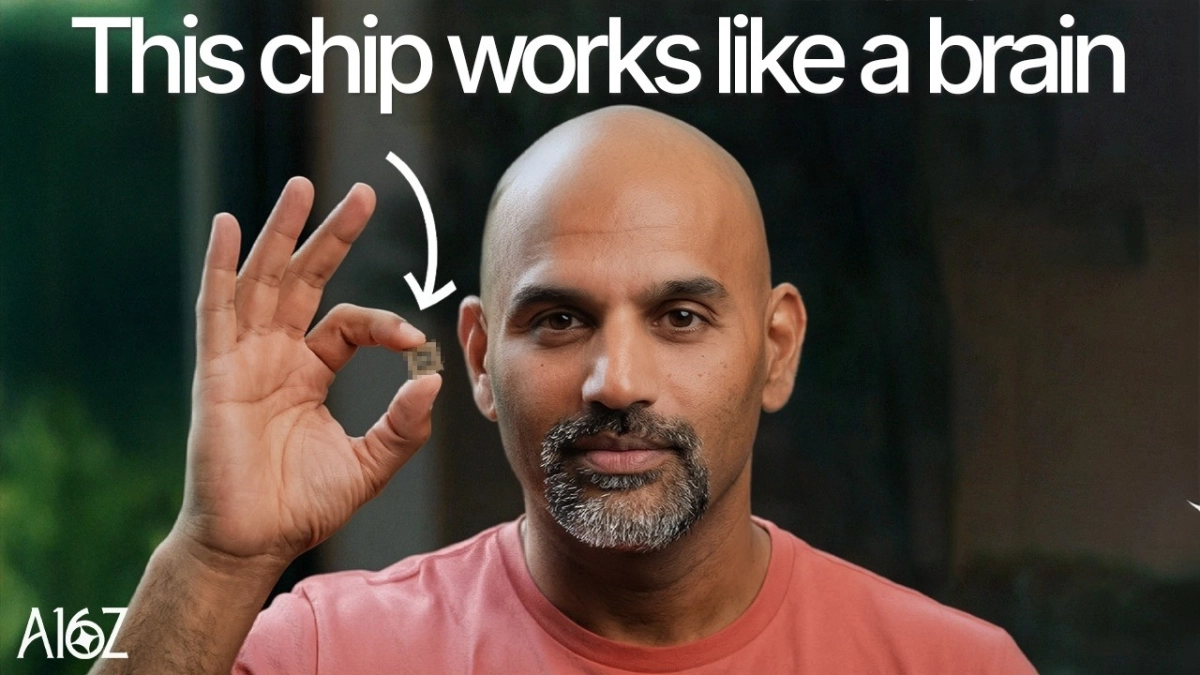
The escalating energy demands of artificial intelligence models, poised to consume an unsustainable percentage of the global power grid, underscore a critical juncture in computing history. This profound challenge, and a potential "unconventional" solution, formed the crux of the recent discussion between Naveen Rao, cofounder and CEO of Unconventional AI, and a16z’s Matt Bornstein at NeurIPS. Their conversation delved into why the eighty-year reign of digital computing might be the wrong substrate for achieving true artificial general intelligence (AGI), advocating instead for a return to analog systems that mirror the brain’s astounding efficiency.
For decades, the digital computer has been the hammer, making every computational problem look like a nail. Naveen Rao, with a career spanning hardware, software, and neuroscience, explained how his early work focused on optimizing algorithms and shrinking capabilities into faster, smaller form factors for applications like real-time video compression. This pursuit of efficiency within the digital paradigm, however, eventually hit fundamental limits. Digital computers, by their very nature, represent numbers with a fixed number of bits, introducing inherent precision errors and requiring immense energy for deterministic, arithmetic operations. "We’ve been building largely the same kind of computer for 80 years," Rao observed, highlighting that the shift to digital in the 1940s was primarily for scalability, not inherent efficiency for intelligence.
Analog computing, in stark contrast, offers a paradigm shift.
The human brain operates on a mere 20 watts of energy, a staggering feat when compared to data centers that currently consume about 4% of the US energy grid. This biological efficiency is not just impressive; it serves as an existence proof that intelligence does not necessitate the prodigious power consumption of today's digital architectures. Rao passionately articulated how biology is "exquisitely efficient," dynamically adjusting energy usage to the task at hand, a far cry from the static, power-hungry operations of current AI systems. This energy-bound reality, leading to concerns like "brownouts in the Southwest during the summer," necessitates a radical rethinking of how we build intelligent machines.
Rao contends that current AI, while powerful, falls short of genuine intelligence, often making "stupid errors" because it lacks a true understanding of causality. Digital systems simulate physical processes through numerical approximations, inherently losing the dynamic, probabilistic, and time-evolving nature of real-world interactions. Analog computers, however, can leverage the physics of the underlying medium directly to perform computations, offering a more natural isomorphism to how neural networks in biological brains function. This ability to inherently understand and model causality, rather than merely simulate it, is, in Rao's "hand-wavy" but deeply intuitive view, a critical step towards AGI.