
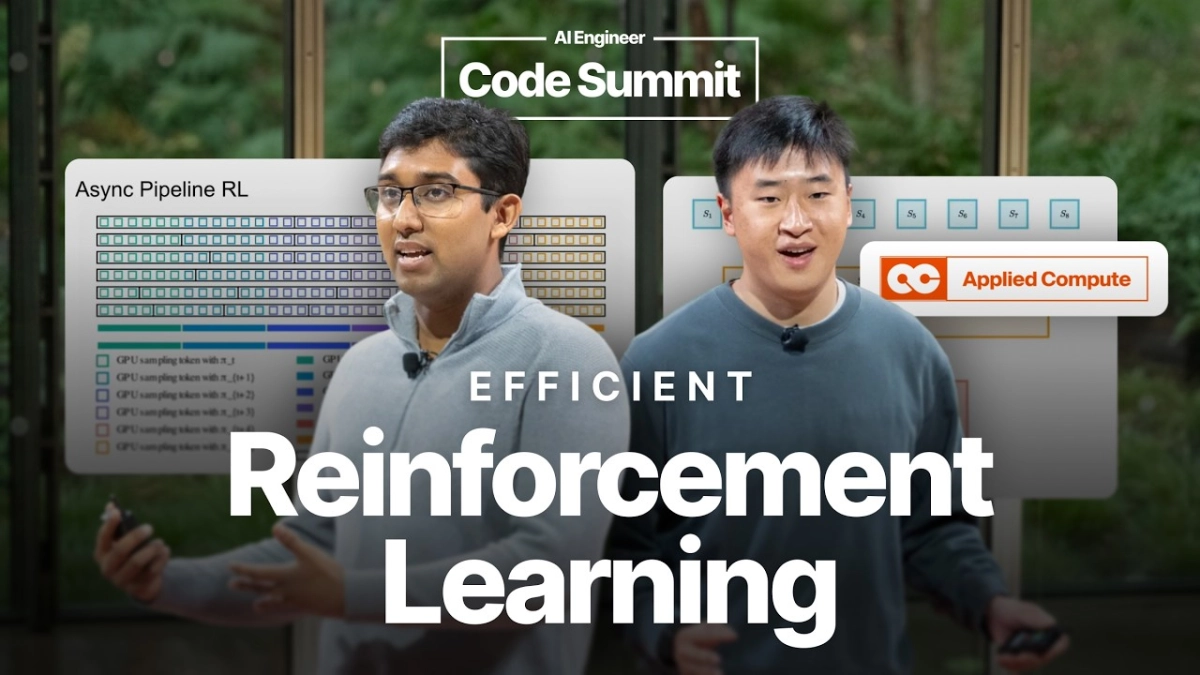
The promise of superhuman AI agents for specialized tasks often collides with the gritty reality of enterprise implementation: the prohibitive cost and unpredictable timelines of training. This fundamental challenge formed the crux of the discussion by Applied Compute co-founders Rhythm Garg and Linden Li at the AI Engineer Code Summit. Their presentation, “Efficient Reinforcement Learning,” illuminated how their proprietary RL stack aims to bridge the gap between cutting-edge AI capabilities and tangible business value.
Rhythm Garg, Co-Founder and CTO, alongside Linden Li, Co-Founder and Chief Architect of Applied Compute—both former researchers at OpenAI—spoke at the AI Engineer Code Summit about their company's mission to empower enterprises with internal AI workforces. Their focus is on building tailored, continuously learning automation solutions that deliver quantifiable return on investment, moving beyond mere productivity enhancements. Reinforcement Learning (RL) is a core component of this strategy, enabling the customization necessary for enterprise-specific challenges.
A primary hurdle in deploying robust RL models for enterprises stems from the inherent inefficiencies of traditional synchronous training methods. Garg highlighted this, explaining that "effective RL training often involves several iterative derisking runs to better understand learning dynamics... If done naively, this can be very time-consuming and expensive." In a synchronous setup, sampling new data and training the model occur in lockstep. This means that the entire training batch must wait for the slowest sample to complete before any learning can proceed. This long-tail latency leads to significant GPU idle time, a problem humorously dubbed "GPUs slackin'" by Garg, directly contributing to inflated costs and unpredictable project timelines crucial for enterprise adoption.
Applied Compute's solution lies in its asynchronous RL stack, designed to maximize hardware utilization and accelerate the training process. Instead of sequential sampling and training, their approach dedicates separate GPU pools to each function. Sampling workers continuously generate data at high batch sizes, feeding it into a queue. Concurrently, training GPUs pull batches from this queue, ensuring a more fluid and continuous workflow. A key innovation is "in-flight weight updates," where new model weights are propagated to sampling workers even as they are in the midst of generating samples. This dynamic updating mechanism allows for continuous learning, forming a data flywheel that enables models to improve over time as they are used.
However, this asynchronous architecture introduces a critical trade-off: staleness. When sampling workers receive updated model weights mid-generation, their current samples might be based on slightly older policy versions. While higher staleness can reduce GPU idle time and accelerate throughput, it can also destabilize RL training, leading to divergence if not carefully managed. This delicate balance between efficiency and stability necessitates sophisticated algorithmic innovations and "science interventions," as Garg described, to ensure robust and reliable learning outcomes.
To navigate these complexities, Linden Li detailed their use of first-principles systems modeling to simulate and optimize RL workloads. By defining key variables such as the number of GPUs allocated for training and inference, the training batch size, and the sampling throughput, they can predict system behavior. Li presented a "latency curve" that illustrates how inference throughput is influenced by batch size, moving from a memory-bound regime to a compute-bound one. This analytical framework allows Applied Compute to understand the intricate interplay of compute resources and model performance without resorting to costly, real-world GPU runs.
The strategic advantage of this simulation capability is profound. As Li emphasized, "Sweeping layouts within these constraints allows us to limit staleness at maximal throughput, while also giving insight to simulate different workloads." This predictive modeling enables Applied Compute to answer critical questions such as identifying optimal configurations for scenarios with very long response lengths or determining the empirical throughput targets required for specific performance optimizations. By modeling the workload in a steady state, where batch size remains relatively consistent, they can ensure that their custom RL solutions are not only efficient but also predictable, a non-negotiable requirement for enterprise clients seeking reliable automation and measurable business impact. This proactive approach to system design ensures that the deployment of sophisticated RL models translates directly into tangible, quantifiable benefits, solidifying AI's role as a driver of real-world enterprise value.