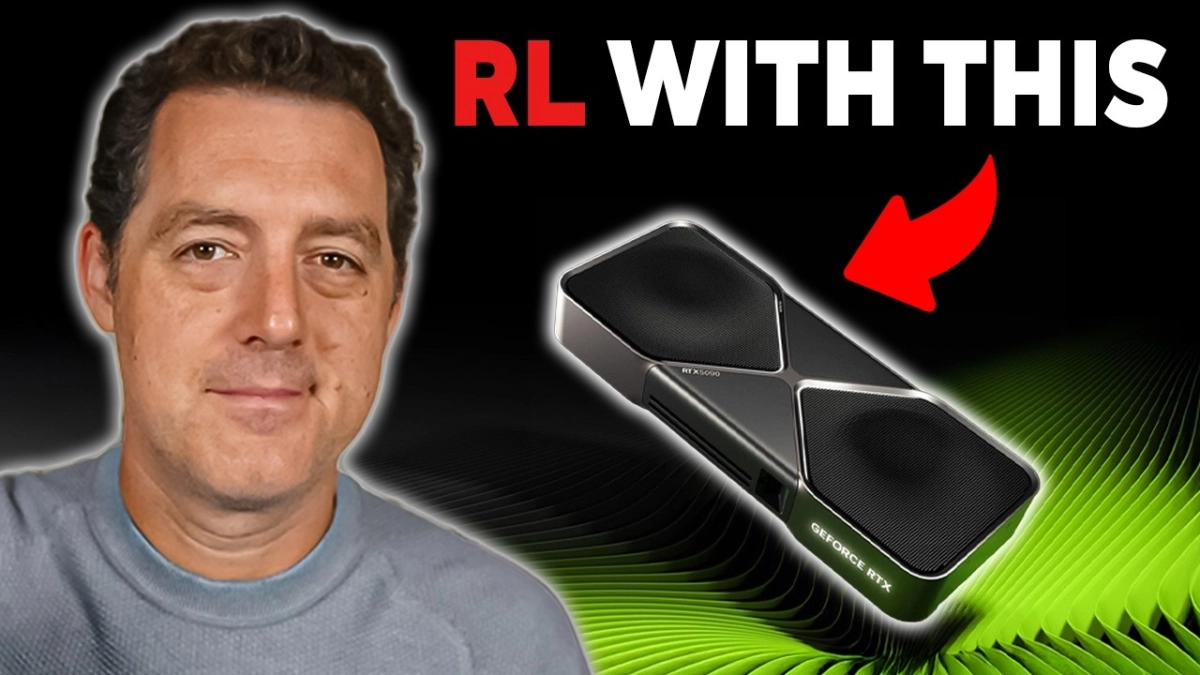
Reinforcement Learning, once the exclusive domain of supercomputers and multi-million dollar data centers, has decisively stepped into the realm of local computing. This shift, highlighted in a recent tutorial by Matthew Berman, demonstrates how powerful AI models can now be trained on consumer-grade NVIDIA RTX GPUs using open-source tools like Unsloth, fundamentally democratizing access to cutting-edge AI development. The tutorial provides a practical guide to setting up Reinforcement Learning with Verifiable Rewards (RLVR) on a home PC, showcasing its prowess by teaching an AI model to master the complex 2048 game.

Matthew Berman, in collaboration with NVIDIA and Unsloth, meticulously walked viewers through the process of establishing a local environment capable of running sophisticated reinforcement learning. This tutorial wasn't merely theoretical; it was a hands-on demonstration of how the latest advancements are making once-unthinkable AI capabilities accessible to individual developers and smaller teams, effectively bypassing the exorbitant costs and complexities of cloud-based training. The core insight here is the profound impact of this decentralization on innovation.
At the heart of this tutorial is Reinforcement Learning with Verifiable Rewards (RLVR), a methodology that elevates AI training by removing human intervention from the feedback loop. As Berman explained, "We are able to tell the AI when it does something right or when it does something wrong, but without us actually telling it. Humans are removed from the loop." This automated reward function is critical; it allows the AI agent to continuously test, learn, and refine its strategies within an environment, efficiently identifying optimal approaches without requiring constant human supervision or subjective judgment. This self-improving mechanism is what enabled AI to surpass human capabilities in intricate games like chess and Go.
The significant barrier to entry for such advanced AI techniques has historically been the immense computational resources required. Berman explicitly stated, "Previously, Reinforcement Learning took massive machines. Sometimes millions of dollars to do." However, the landscape has dramatically changed. "Now thanks to RTX and your regular gaming PC, you can do this at home," he affirmed, pointing to the transformative power of modern NVIDIA GPUs. This capability is further amplified by Unsloth, an open-source library that optimizes the fine-tuning and reinforcement learning process for large language models (LLMs), boasting up to 2x faster training with 70% less VRAM, evidenced by its "nearly 50,000 stars on GitHub."
The tutorial concretely applied RLVR to the popular number puzzle game, 2048. The objective was to take an AI model with no prior knowledge of the game and, through reinforcement learning, transform it into a master player. This specific application perfectly illustrated the iterative nature of RL, where the model makes moves, receives feedback (rewards or penalties), and adjusts its internal strategy to maximize its score and achieve the 2048 tile. The process involved defining a clear reward function that automatically evaluated the AI's performance, guiding its learning trajectory.