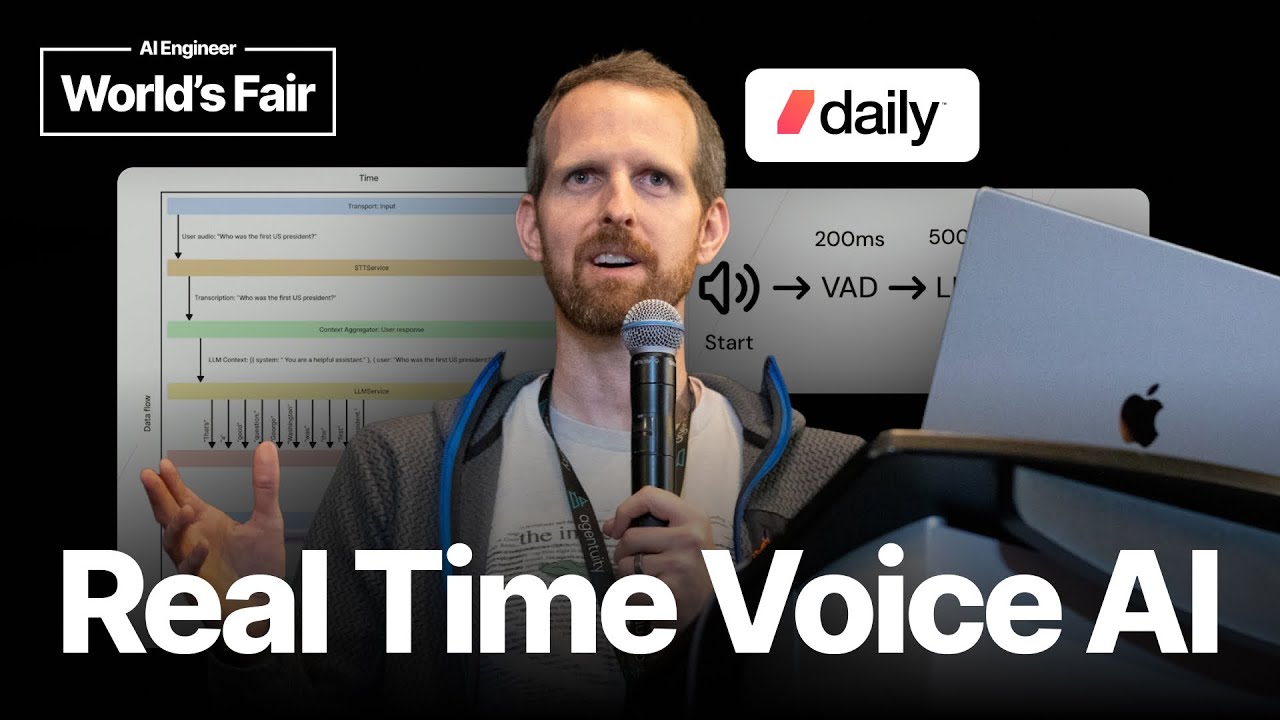
"Voice AI agents today can conduct natural, human-like conversations and perform a wide variety of tasks," stated Mark Backman from Daily, highlighting the burgeoning potential of this technology. However, achieving truly seamless, real-time voice interaction presents significant engineering challenges. This dynamic workshop at the AI Engineer World's Fair, led by Backman and Alesh from Google DeepMind, delved into the intricacies of building state-of-the-art voice AI agents, emphasizing the critical role of Pipecat’s open-source framework.
The session quickly established the "great expectations" users now have for voice AI: accurate listening, smart and conversational responses, internet/database connectivity, a natural-sounding voice, and crucially, speed. Backman emphasized that the entire end-to-end communication pipeline needs to complete "in roughly... around 800 milliseconds" to feel natural to a human user. This stringent latency requirement underscores the complexity inherent in orchestrating multiple AI services.
Pipecat, an open-source Python framework developed by the team at Daily, aims to simplify this orchestration. Alesh described Pipecat’s core concept: a "multimedia pipeline... basically just think about like boxes that receive input." This modular approach allows developers to chain together various services, from voice activity detection (VAD) and speech-to-text (STT) to large language models (LLMs) and text-to-speech (TTS), ensuring efficient data flow.
The inherent flexibility of Pipecat is a key differentiator. "All these boxes you can plug and play the service you want in Pipecat," Backman reiterated, noting the ability to swap out components like Google's Gemini Live, OpenAI, or other providers without altering the underlying application code. This vendor-neutrality provides significant agility for developers. Pipecat also handles essential utilities such as recording, transcription output, and context aggregation, streamlining development. While speech-to-speech models like Gemini Live simplify the pipeline by integrating STT, LLM, and TTS into a single service, the need for robust orchestration around transport, context management, and error handling remains paramount. Pipecat bridges this gap, enabling developers to build sophisticated, real-time voice agents, even supporting advanced features like dynamic failover between vendors within a single conversation.