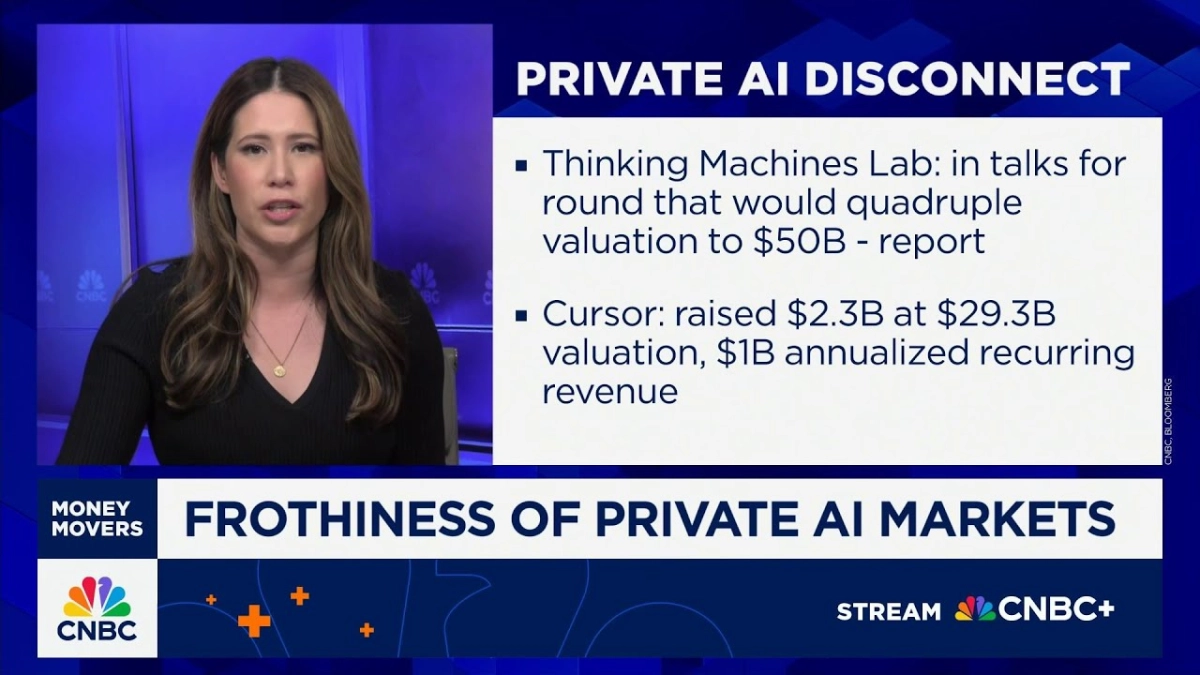
The current artificial intelligence boom presents a fascinating paradox: while public tech giants celebrate soaring profits and robust earnings driven by AI, a significant portion of this prosperity is being underwritten by a burgeoning cohort of often unprofitable, cash-burning private AI startups. This dynamic, a "private-public circular AI funding" mechanism, as CNBC’s Deirdre Bosa articulated on "Money Movers" during a recent Tech Check segment, raises pertinent questions for founders, venture capitalists, and seasoned tech investors about the sustainability and true value creation within this rapidly expanding ecosystem. Bosa, speaking with Karl, underscored how the very losses incurred by private AI ventures are directly fueling the revenue streams of their public market counterparts, creating an economy simultaneously buoyant and potentially precarious.
Deirdre Bosa’s commentary highlights a core insight: "Startup losses, they are the engine of this boom." This isn't merely a byproduct; it's a fundamental mechanism. These nascent AI companies, driven by intense competition and a race to build foundational models and innovative applications, are spending vast sums on computational resources, specialized chips, and data center infrastructure. This expenditure, often far exceeding their revenue, translates directly into revenue and profit for the established tech behemoths that supply these critical components and services.
"Every dollar they burn on compute turns into revenue for Microsoft, Amazon, Nvidia and others," Bosa emphasized, detailing how this cycle creates a symbiotic relationship where "private losses sustain public profits." Companies like OpenAI and Anthropic, two of the largest AI startups, are known to spend tens of billions on chips and data centers, all supplied by these megacap tech firms. This relentless demand for high-performance computing has been a significant tailwind for companies like Nvidia, whose stock performance has been closely tied to the AI surge.
Beyond the well-known players, a less discussed but equally critical facet of this phenomenon involves "unprofitable and in some cases product-less startups funding the boom." These ventures, often boasting sky-high valuations based on future potential rather than current revenue, are attracting billions in venture capital. Cursor, an AI startup, exemplifies this trend, having reportedly raised $2.3 billion at a near-$30 billion valuation, despite generating only $1 billion in annualized recurring revenue. Such figures suggest an optimism that far outstrips conventional financial metrics, reminiscent of past tech bubbles where valuations were detached from immediate profitability.
The financial flow is undeniably circular. Cursor, for instance, spends millions on large language models like Anthropic's Claude to power its AI-first coding tools for customers. This spending, in turn, funnels money back to the foundational model providers and, ultimately, to the large cloud and chip providers like Microsoft, Amazon, and Nvidia, which host and power these advanced AI models. This intricate web of expenditure and revenue creates a self-reinforcing loop where private market exuberance directly underpins public market strength.
A compelling illustration of this circular funding mechanism came with the news of SoftBank’s strategic move. The investment giant reportedly cashed out entirely of its significant stake in Nvidia, one of the biggest public market winners of the AI boom. This capital was then redirected into OpenAI, a prominent private AI entity that, despite its revolutionary technology, operates as a "private loss engine." SoftBank, known for its bold, often speculative, bets on startups and its tolerance for initial losses, is essentially shifting funds from a public beneficiary back into a private generator of the very demand that fuels the public market. This decision speaks volumes about the perceived long-term potential of the private AI sector, even if it comes with significant short-term burn.
This intricate interplay suggests that the public AI market's robust performance is inextricably linked to the private market's spending habits. If the flow of venture capital to these private AI startups were to diminish, the ripple effect on Big Tech's earnings could be substantial. The current AI economy, therefore, is "both bubbly and circular, inflated by optimism and sustained by its own losses," as Bosa concluded. It's a delicate balance, where the continued growth and perceived success of the public AI trade depend heavily on the sustained investment and high burn rates of the private market. This interconnectedness warrants careful consideration from all stakeholders, as any significant shift in private funding could recalibrate the entire AI economic landscape.