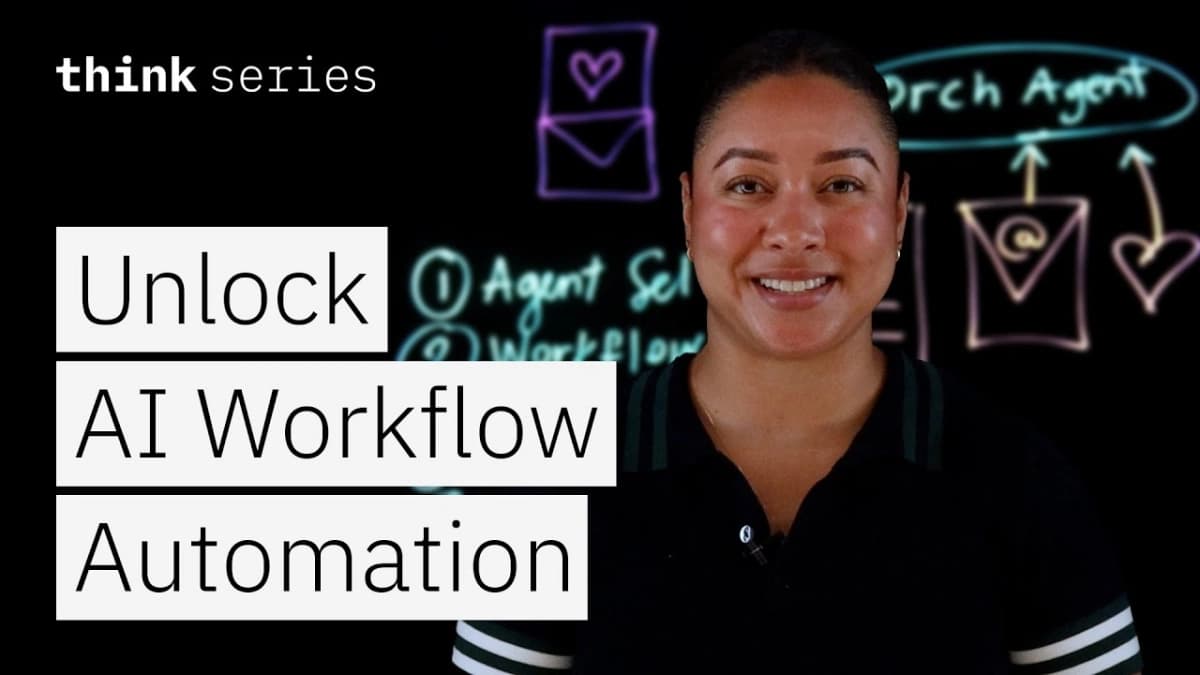
Melissa Hadley, Sr. watsonx AI Assistants SME at IBM, recently illuminated the intricate mechanics of orchestrator agents and their pivotal role in the burgeoning landscape of multi-agent AI systems. Her presentation, "Orchestrator Agents & MCP: How AI Agents Drive Automation," delved into how these advanced AI constructs not only manage but actively enhance the efficiency and performance of complex AI workflows. Hadley presented a clear, practical framework for understanding the underlying processes that allow disparate AI tools to collaborate seamlessly, fundamentally transforming how tasks are executed within enterprise environments.
The core concept revolves around orchestrator agents acting as a sophisticated "nervous system for AI tools," as Hadley aptly describes them. These agents are designed to supervise and coordinate work across a diverse array of AI tools and other specialized agents, particularly within multi-agent systems where numerous sub-agents must collaborate to achieve a larger objective. The challenge lies not just in assigning tasks, but in ensuring intelligent, real-time interaction and data exchange between components that may originate from different vendors or be built on varying technological stacks.
Hadley outlined a four-step process illustrating how an orchestrator agent functions, using the relatable example of generating customized thank-you notes for a project team. The initial step is Agent Selection. Here, the orchestrator agent intelligently sifts through a catalog of available agents and tools, identifying those best suited for the task. For the thank-you note scenario, this might involve selecting a project management system to retrieve team member details and project contributions, an email writing or generation agent to draft the personalized messages, and an employee appreciation application to facilitate their delivery. This initial selection demonstrates a fundamental level of AI reasoning, matching capabilities to requirements.
Following agent selection, the orchestrator proceeds to Workflow Coordination. This critical phase involves breaking down the overarching task—writing and sending thank-you notes—into smaller, manageable sub-tasks. The orchestrator then assigns these sub-tasks to the appropriate agents or tools, leveraging Application Programming Interfaces (APIs) to establish the necessary connections for data exchange. This orchestration ensures that each component contributes its specialized function in the correct sequence, forming a cohesive operational flow.
The third, and perhaps most technically significant, step is Data Sharing. As each agent or tool executes its assigned sub-task, it generates and processes information. This data must then be communicated back to the orchestrator agent and, often, shared among other sub-agents in real-time. This is where a significant challenge emerges: how do agents from different vendors, potentially coded in disparate languages, effectively communicate and share context?
This interoperability hurdle is precisely what the Model Context Protocol (MCP) aims to solve. Hadley posits MCP as "kind of like a USB-C port for AI applications," a universal standard facilitating seamless communication regardless of the underlying vendor or technology. MCP ensures that data and context can be exchanged effectively, allowing agents to ask for information without needing explicit knowledge of its storage location or retrieval method. This abstraction layer is vital for creating truly flexible and scalable multi-agent systems.
The "M" in MCP stands for Model, referring to the large language model that forms the intelligence core of the orchestrator agent. The "C" represents Context, encompassing all the supplementary information required for task execution, such as relevant documents, search results, or specific data pulled from integrated systems. Finally, the "P" signifies Protocol, establishing a standardized communication framework. This protocol dictates how the orchestrator's central model interacts with and directs various tools and data sources, ensuring coherent and effective collaboration across the entire AI ecosystem.
The final stage of the orchestration process is Continuous Learning. Orchestrator agents are not static entities; they are designed to be reflective and adaptive. They continuously monitor their performance, analyzing the outcomes of executed tasks and identifying areas for improvement. This iterative learning process allows the orchestrator to refine its agent selection, workflow coordination, and data sharing strategies over time, optimizing future task execution. This self-improvement capability is a hallmark of advanced AI agents, moving beyond mere automation to true intelligent autonomy.
The culmination of this process, the "artifact," represents the deliverable or result of the orchestrated task. In our example, this would be the beautifully crafted thank-you notes. The orchestrator agent then presents this artifact, potentially even offering to automate the final step, such as sending the notes through the employee appreciation tool. The user simply confirms, and the task is completed without ever leaving the chat interface, a testament to the seamless integration and efficiency orchestrator agents bring.
Orchestrator agents are fundamentally reshaping how enterprises approach automation. By providing a centralized intelligence to manage and coordinate diverse AI tools, they unlock unprecedented levels of efficiency and capability. The introduction of Model Context Protocol further solidifies this foundation, addressing critical interoperability challenges and paving the way for more robust, scalable, and intelligent multi-agent systems. The ability to select the right tools, coordinate complex workflows, share data across heterogeneous systems, and continuously learn makes orchestrator agents indispensable for organizations aiming to harness the full potential of AI.