
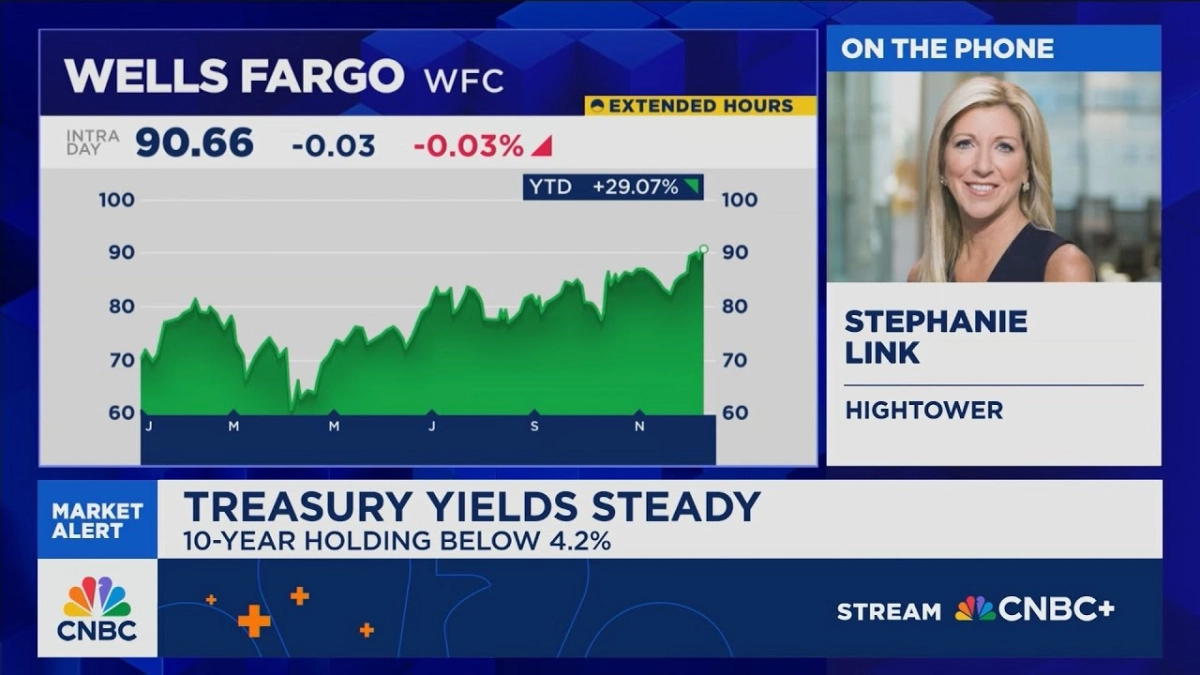
The market’s immediate reaction to Oracle’s latest earnings report, a sharp downturn, belies a deeper narrative about the artificial intelligence landscape and broader economic sentiment. Stephanie Link, Chief Investment Strategist and Portfolio Manager at Hightower, spoke with CNBC’s Frank Holland, offering a nuanced perspective that challenges the knee-jerk pessimism, suggesting that while the AI trade might be momentarily losing favor, underlying strength and future opportunities abound.
Link's commentary centered on the surprising market response to Oracle’s quarter, which she viewed as fundamentally robust. "I thought the quarter was actually quite good," she stated, highlighting how earnings were in line with expectations and, crucially, Remaining Performance Obligations (RPOs) surged. This key metric, representing future contracted revenue, was "up 438% year-over-year, up 15% sequentially," indicating substantial long-term demand for Oracle’s services. Furthermore, every segment of Oracle’s cloud business—total revenue, infrastructure, and applications—not only "beat expectations" but also "accelerated."
The disconnect, Link explained, stemmed not from operational underperformance but from a lack of transparency regarding the financing mechanisms for Oracle’s significant capital expenditure. Investors sought greater clarity on how these large-scale investments would be funded. This absence of detail triggered a sell-off, even as the core business showed undeniable vigor in the AI-driven cloud space. Such a reaction underscores the market's current sensitivity to financial specifics, especially in high-growth sectors where future commitments often outweigh present profitability in valuation models.
Despite the immediate market jitters, Link maintains a long-term bullish view on Oracle. She believes the current dip could represent a strategic entry point for investors. "At some point, Frank, this is going to be a buy," she remarked, emphasizing the need to let the "dust settle" before making moves. This perspective is vital for founders and VCs who understand that market volatility often obscures intrinsic value, especially when the underlying demand for critical infrastructure like cloud and AI services remains robust. The market’s current valuation of Oracle at 33 times earnings might not be "cheap," but the astounding RPO growth signals a powerful future trajectory.
This sentiment extends beyond Oracle to the broader AI ecosystem. Link observed, "I just think the AI trade right now is kind of getting out of favor." This shift in investor preference, she argues, is temporary, suggesting that once the initial speculative froth dissipates, genuine opportunities for growth and investment will emerge. For tech insiders, this period of re-evaluation is critical, separating companies with solid fundamentals and clear long-term roadmaps from those riding purely on hype.
Her macroeconomic outlook reinforces this patient optimism. Link expressed "relief that we got through the Fed," referring to the Federal Reserve's recent policy decisions. She interprets the Fed's commentary as signaling a healthy economy that is "growing better than expected" and likely to "accelerate into next year" due to increasing productivity. This positive economic backdrop provides a stable foundation for strategic investments, even as specific sectors like AI experience short-term recalibrations.
Beyond tech, Link identified the financial sector, particularly banks, as a compelling investment opportunity extending into 2026. This outlook is predicated on several factors: the potential for deregulation, the presence of "excess capital" within banks, and improving "net interest income and net interest margins." Furthermore, accelerating fee income contributes to a healthier financial landscape.
She specifically cited Wells Fargo as an example, noting its strong consumer franchise and company-specific catalysts like the potential lifting of the asset cap, which would "increase growth initiatives and lower costs." Her confidence in the financial sector also stems from a belief in the resilience of the economy's upper tier. "The upper end is doing fine," she asserted, acknowledging the long-standing "K-shaped" economic recovery where different segments perform unevenly. This sustained strength among higher-income consumers, coupled with favorable regulatory and financial conditions, positions banks well for future performance.
Ultimately, Link's analysis provides a pragmatic lens through which to view current market dynamics. While the AI trade may be experiencing a momentary cooling, the underlying technological revolution and economic growth remain intact. For sophisticated investors and industry leaders, the current period demands discernment—identifying true value in companies like Oracle, which continue to demonstrate strong operational metrics despite market skepticism, and recognizing the broader economic currents that favor sectors like financials. The message is clear: caution is warranted, but opportunities are ripening for those who look beyond the immediate headlines.