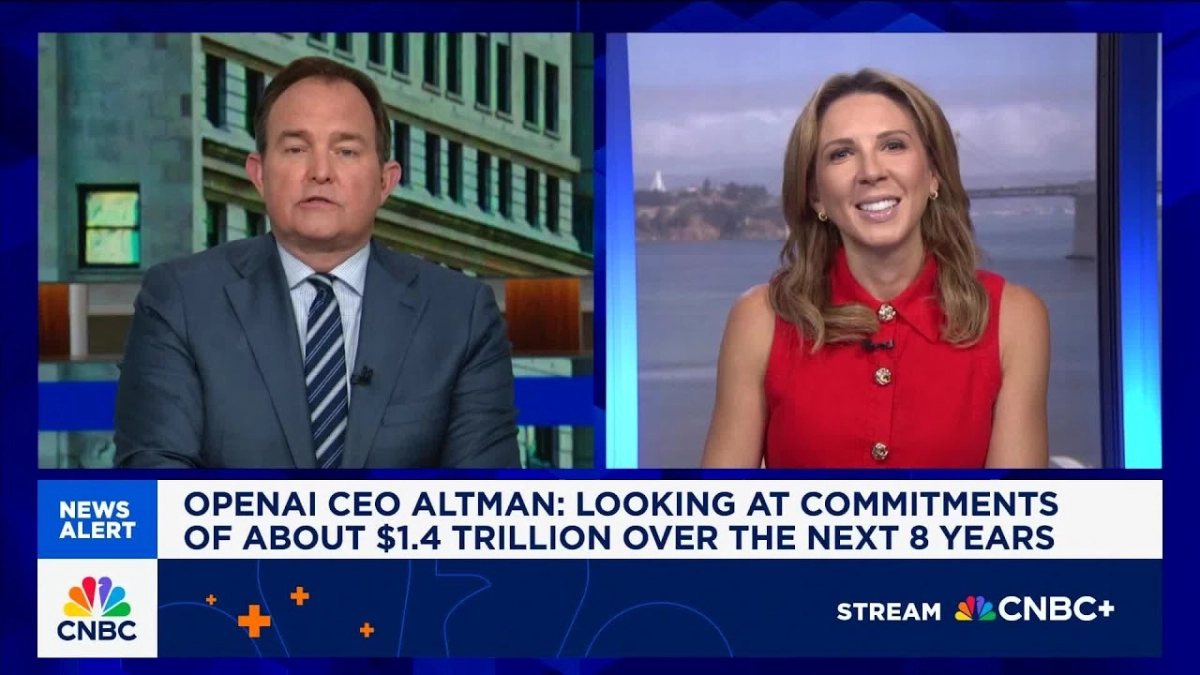
The audacious financial targets unveiled by OpenAI CEO Sam Altman paint a vivid picture of artificial intelligence's transformative economic power, positioning the company as a titan in a burgeoning industry. In recent remarks reported by CNBC's MacKenzie Sigalos, Altman offered a fresh look at OpenAI's financial trajectory and strategic posture. His comments, made in response to a discussion initiated by White House crypto and AI czar David Sacks regarding potential government backstops for AI firms, provided critical insights into the company's ambitious growth plans and its unequivocal stance on state intervention.
The headline figures are nothing short of staggering, underscoring the hyper-growth phase OpenAI is navigating. The company expects its "annualized revenue run rate to top $20 billion this year," a significant upward revision from a prior $13 billion estimate. This meteoric rise, particularly for an entity that only publicly launched ChatGPT in late 2022, serves as a powerful testament to the unprecedented demand for generative AI capabilities across enterprises and consumers alike. Such rapid financial acceleration is not merely a testament to OpenAI's product-market fit but also a clear indicator of the profound economic reorientation AI is catalyzing across global markets. The speed at which large language models have permeated various sectors, from software development to content creation and customer service, has created a new, high-value segment within the tech landscape, with OpenAI firmly at its vanguard. For founders and venture capitalists, this trajectory suggests a company not just growing, but fundamentally reshaping the contours of the digital economy, capturing substantial value as industries scramble to integrate AI into their core operations. The immediate implication is a robust validation of the AI thesis: the market is not just real, it's expanding at a pace few could have predicted, rewarding early movers with unparalleled growth and setting an exceptionally high bar for emerging competitors. This environment suggests a potential winner-take-most dynamic, where scale and early market capture are paramount.
Beyond the immediate revenue projections, Altman articulated a vision of long-term financial scale, forecasting growth to "hundreds of billions by 2030." This aggressive outlook is underpinned by an equally colossal commitment to infrastructure investment, highlighting the strategic imperative of compute power in the AI arms race. Altman stated that OpenAI is "personally... committed to spending $1.4 trillion on compute deals over the next 8 years." This figure, a sum that dwarfs the GDP of many nations, underscores the critical bottleneck and strategic importance of specialized hardware, primarily advanced GPUs, in achieving AI dominance. It signifies that the future of AI advancement is inextricably linked to the ability to acquire, deploy, and manage vast quantities of these computational resources. This gargantuan investment strategy is a clear signal to the startup ecosystem: access to compute is not a luxury but a fundamental requirement for building foundational AI models. Smaller players, therefore, will increasingly rely on strategic partnerships or robust cloud providers to access the necessary computational firepower, potentially leading to a more consolidated infrastructure landscape.
Crucially, this massive private sector investment comes with a distinct preference for independence. When questioned about the U.S. government potentially acting as a "backstop" for AI firms like OpenAI, Altman was unequivocal, clarifying that "they don't have or want the backing of the government." This stance speaks volumes about OpenAI's strategic autonomy and its desire to operate free from direct state influence, even as AI becomes a matter of national security and economic competitiveness. For defense and AI analysts, this rejection of government support, while perhaps surprising given the strategic importance of AI, reinforces the notion of a fiercely competitive, privately funded innovation sprint. It also raises pertinent questions about the long-term implications for national AI strategies if leading private entities prefer to chart their own course, unencumbered by governmental oversight or financial guarantees. This position could be interpreted as confidence in their private funding capabilities, a desire for agility without bureaucratic constraints, or a preemptive move to avoid potential regulatory entanglements that could stifle rapid innovation.
The $1.4 trillion compute commitment is not just a figure; it’s a detailed blueprint for an evolving tech ecosystem. This colossal sum is being funneled into deals with a roster of industry giants, including "Nvidia, AMD, Broadcom, Oracle, Amazon, and Microsoft." This list reveals the intricate web of dependencies and collaborations forming at the apex of the AI revolution. Nvidia, as the dominant supplier of AI-optimized GPUs, stands to be a primary beneficiary, further solidifying its critical role in enabling advanced AI development. AMD and Broadcom also feature, indicating a diversification of chip supply and a broader demand for high-performance computing components across the supply chain. Meanwhile, cloud providers like Microsoft, a major OpenAI investor and partner, and Amazon are integral to hosting and scaling these compute resources. Oracle's inclusion suggests its growing relevance in providing specialized cloud infrastructure for AI workloads, potentially leveraging its bare-metal capabilities to meet the demanding requirements of large model training and inference.
This massive capital allocation signifies an unprecedented boom for the semiconductor and cloud infrastructure sectors. For tech insiders, it confirms that the indirect beneficiaries of the AI surge are as significant as the direct AI developers. Companies supplying the picks and shovels for this new gold rush are poised for sustained growth, making them attractive targets for investment and strategic partnerships. The sheer volume of this spending also hints at the potential for consolidation and strategic alliances, as firms seek to secure their supply chains and optimize their compute access in a highly competitive environment. The long-term effects of such concentrated investment will likely reshape the competitive landscape, creating new market leaders and forcing others to adapt or risk obsolescence. The commitment underscores that the AI future is not just about algorithms, but about the very physical infrastructure that powers them, and the companies that control it.
This financial declaration solidifies OpenAI's position at the forefront of the AI industry. It reflects both immense market demand and an aggressive, self-funded strategy for future development. The scale of investment and the ambition of its financial targets signal a new era of technological advancement, driven by private capital and an insatiable demand for artificial intelligence.