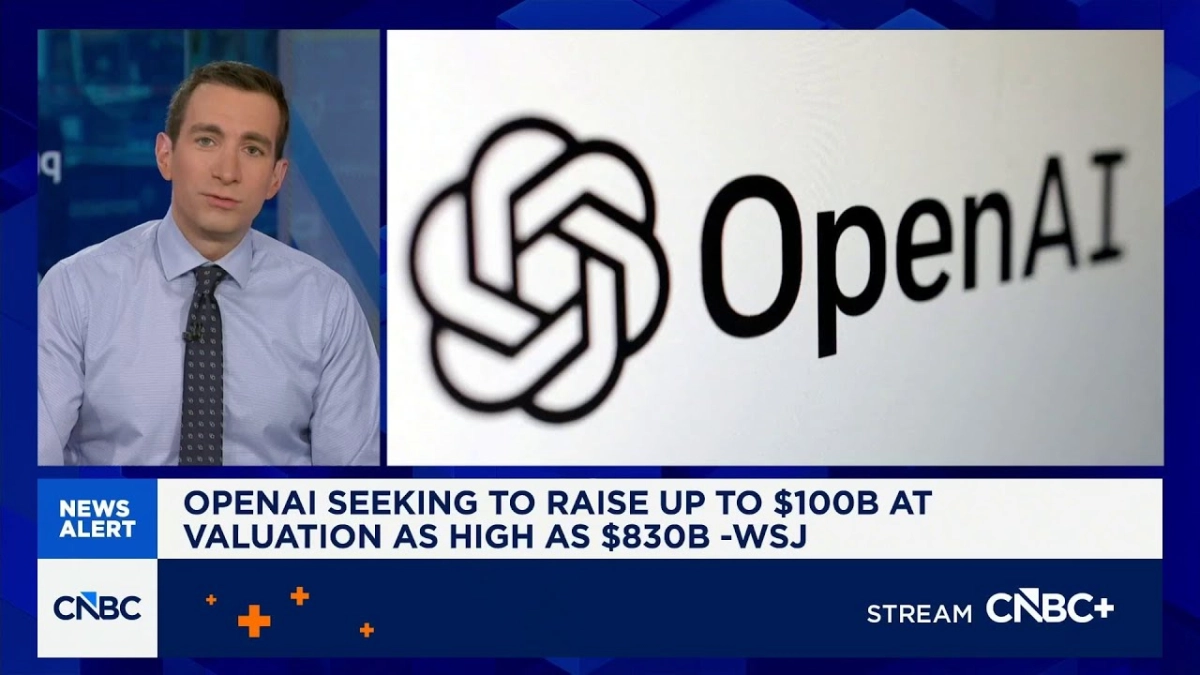
The artificial intelligence landscape is witnessing an unprecedented surge in valuation, epitomized by OpenAI's latest fundraising aspirations. On CNBC's Squawk Box, Andrew Ross Sorkin delivered a news alert that resonated across the financial world, reporting on the Wall Street Journal's revelation that OpenAI is reportedly looking to raise as much as $100 billion for its expansion plans, which could value the company as high as $830 billion. This announcement, coming on the heels of earlier reports suggesting a $750 billion valuation, underscores a rapidly accelerating market belief in the transformative power and commercial viability of advanced AI. Sorkin’s wry observation that "those numbers keep going up" perfectly encapsulates the dizzying trajectory of investment in foundational AI models.
This colossal fundraising target and valuation are not merely indicative of a booming tech market; they reflect a profound shift in strategic investment paradigms. OpenAI, the progenitor of ChatGPT and DALL-E, is not just building software; it is constructing the very infrastructure of future intelligence. The $100 billion capital infusion is earmarked for aggressive expansion, a necessity in a field where computational power, talent acquisition, and continuous research and development demand astronomical resources. This is a capital-intensive race to general artificial intelligence, and only those with deep pockets can truly compete at the frontier.
The sheer scale of this proposed valuation, pushing "close to the trillion-dollar mark" as Sorkin noted, places OpenAI in an elite league, rivaling the market caps of established tech giants. It signifies a collective conviction among investors that OpenAI is not just a participant but a potential architect of the next technological epoch. This isn't merely about incremental improvements; it's about betting on a company that aims to redefine human-computer interaction and reshape industries from healthcare to finance.

The reported timeline for the earliest fundraising round, expected to be completed by the end of the first quarter of the coming year, suggests an urgency that aligns with the breakneck pace of AI development. Furthermore, the anticipated involvement of sovereign wealth funds signals a global recognition of AI's strategic importance. These national funds are not just seeking financial returns; they are making geopolitical plays, securing stakes in technologies deemed critical for future economic and national security. This adds another layer of complexity to the competitive landscape, elevating the AI race beyond corporate rivalry to a matter of state-level strategic imperative.
Such a monumental valuation also raises pertinent questions for the broader startup ecosystem. While OpenAI commands vast capital, many smaller AI startups, equally innovative, face significant challenges in securing funding. The concentration of investment in a few frontier AI behemoths could potentially starve smaller players of the capital needed to innovate and scale, leading to an increasingly consolidated market. This dynamic could stifle diversity in AI development, pushing the industry towards a few dominant paradigms rather than a rich tapestry of approaches.
The rapid escalation from a $750 billion to an $830 billion valuation within a short span also highlights the speculative fervor surrounding AI. While the potential for AI is immense, the financial models underpinning such valuations are inherently forward-looking and carry significant risk. The profitability metrics for foundational AI are still evolving, and the path to sustained, massive revenue generation for companies like OpenAI, beyond enterprise subscriptions and API access, remains a subject of intense scrutiny. The demand for AI chips and the operational costs of running large language models are colossal, requiring continuous investment to maintain a competitive edge.
This era of hyper-valuation in AI is a testament to the technology's perceived potential. It reflects a belief that AI is not just another tech trend but a fundamental shift, akin to the internet or electricity, that will permeate every facet of society. The financial world is responding with a vigor that suggests a collective rush to capture a piece of this future, driving valuations to levels previously unimaginable for companies so young.