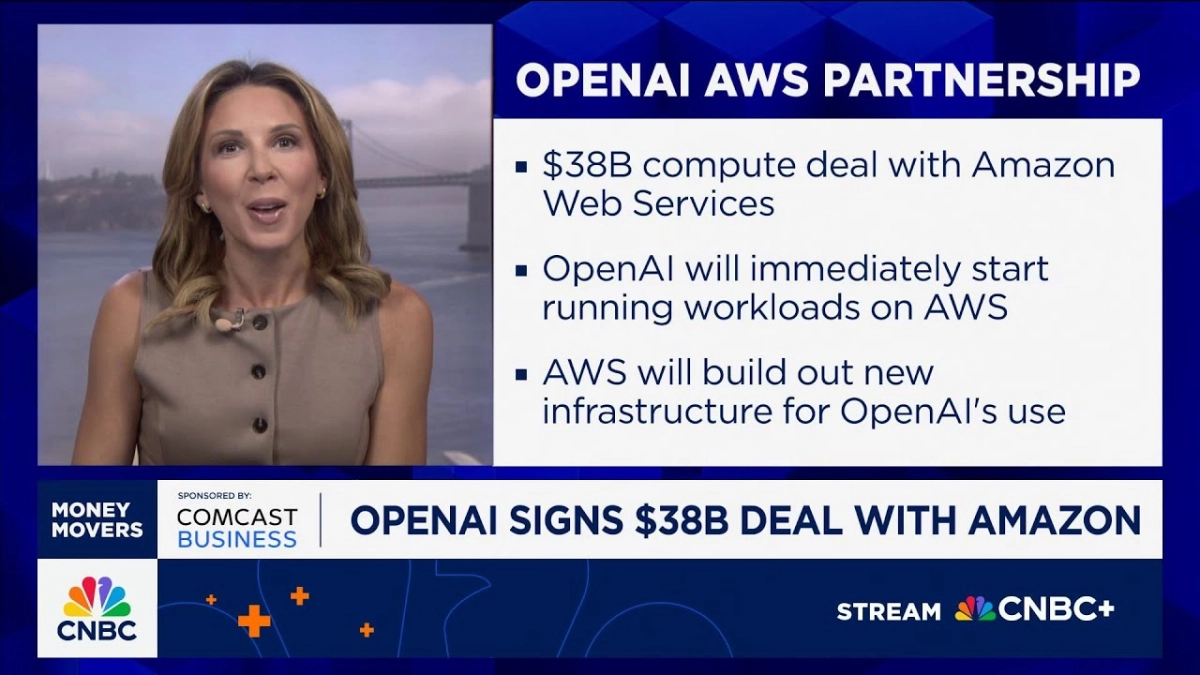
OpenAI’s staggering $38 billion compute deal with Amazon Web Services marks a profound recalibration of the generative AI giant’s strategic infrastructure, moving beyond its foundational alliance with Microsoft. This monumental partnership, discussed on CNBC’s ‘Money Movers,’ saw reporter MacKenzie Sigalos provide sharp analysis on the implications for OpenAI, Amazon, and the broader, intensely competitive cloud computing market. Sigalos highlighted how this agreement signifies not merely an expansion of OpenAI’s compute capacity but a calculated pivot towards diversification and greater autonomy.
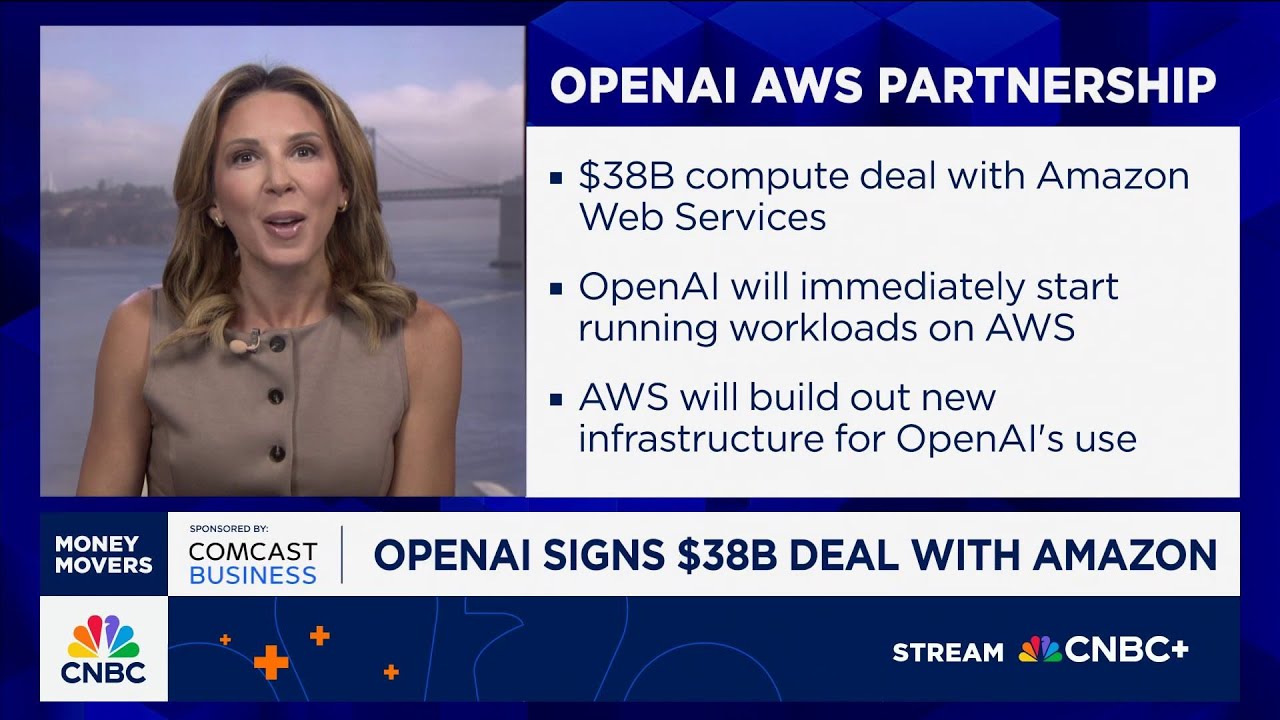
The core of the partnership involves OpenAI immediately gaining access to hundreds of thousands of Nvidia GPUs hosted on Amazon’s vast network. Furthermore, AWS has committed to building out new, custom infrastructure specifically designed to support OpenAI’s next-generation AI models. This phased deployment is already underway, with full operational capacity projected by the close of next year. For OpenAI, this represents its inaugural cloud deal with AWS, an arrangement whose sheer scale nearly mirrors the company’s current $40 billion SoftBank-led financing round, underscoring its relentless pursuit of computational power.
This move is a direct consequence of a critical shift in OpenAI's relationship with Microsoft. As Sigalos elucidated, "Microsoft's right of first refusal expired last week as part of its commercial restructuring, and that cleared the path for OpenAI to sign directly with Microsoft's biggest rival in the cloud wars, no permission needed." This contractual expiration allowed OpenAI to unshackle itself from an exclusive, albeit deeply beneficial, cloud relationship, opening the door to explore other providers. While OpenAI had previously engaged with other cloud entities like Oracle and Google, the AWS deal is of an entirely different magnitude, fundamentally altering the competitive dynamics.
The strategic imperative behind this diversification is multifaceted. By distributing its compute workload across multiple providers, OpenAI mitigates the inherent risks of vendor lock-in, ensuring resilience and negotiating leverage. It also allows the company to tap into specialized capabilities and pricing structures offered by different cloud giants, optimizing its operational efficiency and technological agility. This is not merely about securing more GPUs; it is about establishing a robust, distributed infrastructure capable of sustaining the exponential demands of advanced AI model training and deployment.
The insatiable demand for compute resources in the AI sector is perhaps the most significant undercurrent of this deal. Training increasingly complex AI models requires colossal computational power, and the race to acquire and deploy these resources is accelerating. OpenAI’s $38 billion commitment to AWS is a testament to this escalating need, demonstrating that access to cutting-edge hardware is as critical as algorithmic innovation. This immense investment in infrastructure reflects a broader industry trend where compute capacity has become a strategic bottleneck and a significant competitive differentiator.
For Amazon Web Services, securing OpenAI as a client is a substantial victory in the ongoing cloud wars. This deal contributes significantly to Amazon's projected record $210 billion Q4 revenue, signaling strong momentum in its cloud division. By bringing OpenAI into its ecosystem, AWS not only gains a marquee customer but also positions itself as a critical enabler for the future of AI development, directly challenging Microsoft Azure’s dominant position as OpenAI’s primary cloud partner. This new alliance intensifies the battle for AI workloads, pushing cloud providers to innovate further in specialized AI infrastructure and services.
This is a game-changer for OpenAI. As Sigalos noted, "Finally forging ties with the most dominant player in the cloud wars is a game-changer for them going forward." The ability to leverage AWS's unparalleled scale and global reach provides OpenAI with the foundational compute necessary to push the boundaries of AI research and development. This strategic independence also comes at a time when OpenAI is reportedly facing significant operational costs, with Bernstein estimating a $12 billion loss last quarter. OpenAI CEO Sam Altman has even hinted at an "impetus to go public" to demonstrate the company's financial viability and ability to honor its massive compute commitments. The AWS deal could be seen as a critical step in building the confidence required for such a public offering, showcasing a diversified and robust operational backbone.