

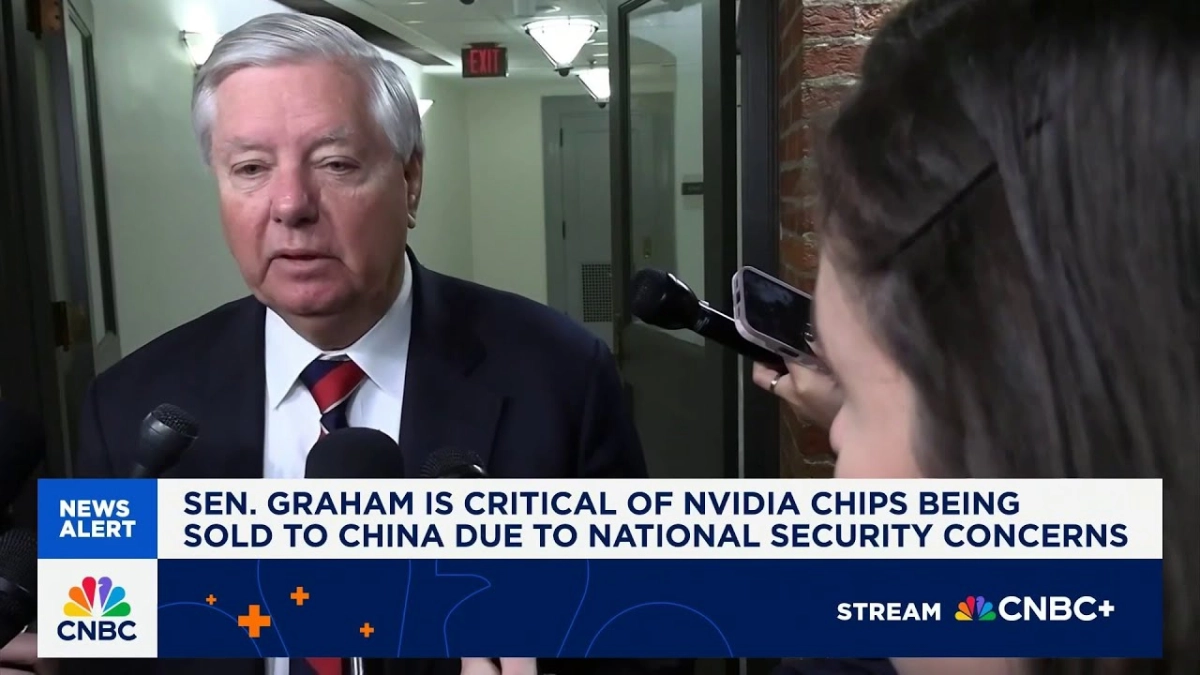
The recent decision by the Trump administration to permit Nvidia's H200 artificial intelligence chips to be sold to "approved customers" in China has ignited a sharp debate among Republican lawmakers, raising profound questions about America's strategic advantage in AI. This move, reported by CNBC's Emily Wilkins from Washington D.C., comes just two months after the Senate passed a legislative package that included a provision explicitly banning such sales, highlighting a fundamental tension between economic interests and national security concerns in the rapidly evolving AI landscape.
In her report, Emily Wilkins spoke with several prominent Republican senators, delving into their reactions and the underlying implications of allowing these high-performance AI chips to reach Chinese entities. The core of the discussion centered on whether facilitating access to advanced U.S. hardware could inadvertently bolster China's technological and military capabilities, thereby eroding the very AI edge the U.S. seeks to maintain. This geopolitical tightrope walk defines much of the current discourse in Washington, as policymakers grapple with the dual-use nature of cutting-edge technology.
Senator Josh Hawley, a Republican from Missouri, articulated a firm stance, emphasizing the necessity for China to have reduced access to U.S. hardware. His position reflects a broader sentiment among those who view technological exports, especially in critical areas like AI, as direct enablers of potential adversaries. The concern isn't merely commercial competition; it's about the foundational elements of future power dynamics.
Senator Lindsey Graham, a Republican from South Carolina, expressed a similar skepticism regarding the sales. He remarked, "I don't mind doing normal business with China, but if you can prove to me this will accelerate their military capability, I'll oppose it." This statement underscores a critical insight: the blurry line between commercial transactions and national security implications. For many, the risk that ostensibly commercial AI chips could be repurposed or integrated into military applications is too significant to ignore. The dual-use dilemma is ever-present, forcing a re-evaluation of what constitutes "normal business" in an era of intense technological competition.
Conversely, not all Republicans opposed the administration's decision. Senator Mike Rounds, a Republican from South Dakota, offered a contrasting perspective, supporting the allowance of H200 sales. His rationale hinges on the assertion that the H200 is "not the most advanced Nvidia chip." This introduces a nuanced, yet crucial, insight: the definition of "most advanced" is subjective and constantly shifting in the fast-paced world of AI hardware. While the H200 is undeniably powerful, the existence of even more advanced chips, or the rapid development cycle of new generations, might suggest that restricting slightly older technology could be a moot point, or even counterproductive.