

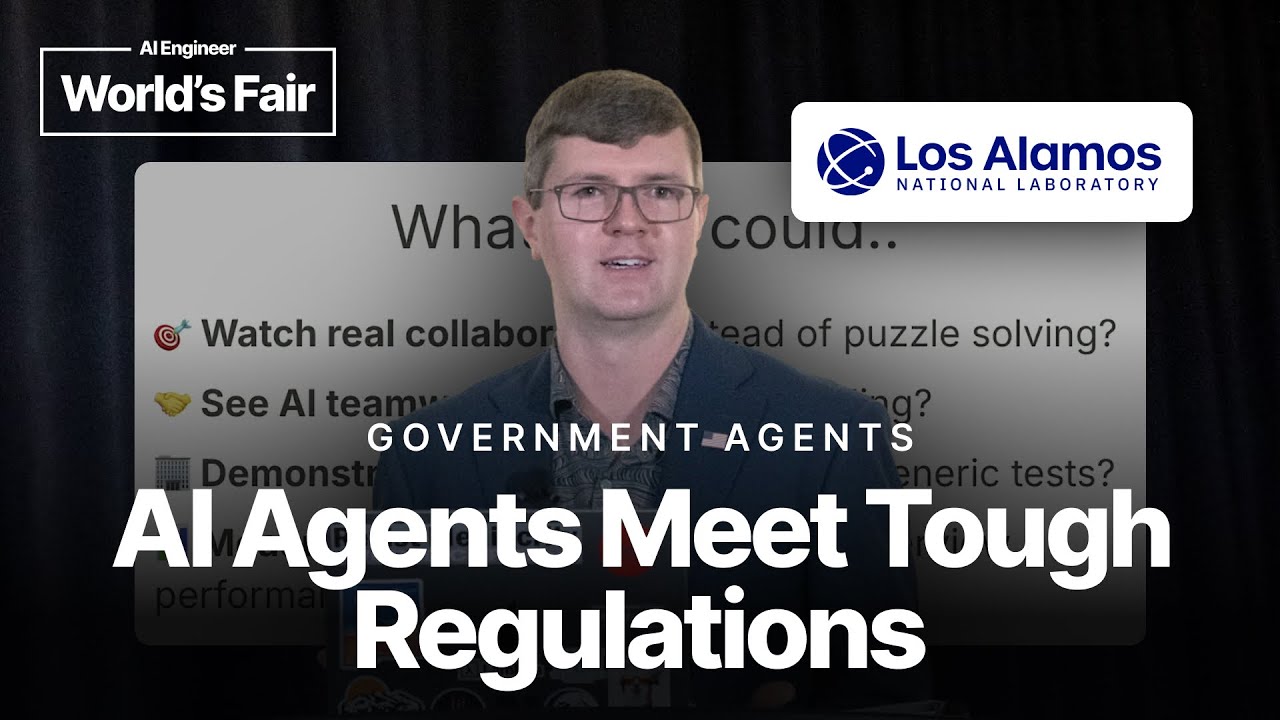
"People can die if we do this wrong." This stark reality underscores the unique challenges of integrating AI into national security, a point emphatically made by Mark Myshatyn, Enterprise AI Architect at Los Alamos National Laboratory (LANL).
Myshatyn spoke at the AI Engineer World's Fair, offering a rare glimpse into how a venerable institution like LANL, a cornerstone of U.S. nuclear security and scientific research, navigates the rapidly evolving landscape of artificial intelligence, particularly focusing on AI agents and the stringent regulatory environment they operate within.
Far from being newcomers to AI, LANL has a deep-seated history in the field. "We've actually been doing applied AIML for almost 70 years," Myshatyn noted, citing early work in 1956 on Los Alamos Chess and Monte Carlo methods, long before the current generative AI explosion. This legacy positions them uniquely to understand AI's foundational principles and its practical applications.
For LANL, the advent of AI agents represents a significant leap. It’s about empowering AI models to move beyond mere knowledge retrieval to active problem-solving and execution. Myshatyn highlighted how this shift allows them to "move science faster" and address complex national security challenges with unprecedented efficiency, a critical capability when facing demands to achieve "better, faster, cheaper, and more to protect our country."
Integrating these advanced AI capabilities into government workflows is not without immense regulatory hurdles. Myshatyn detailed the layers of compliance, including NIST 800-53 and FedRAMP, which dictate how AI systems must handle sensitive, controlled, and classified data. This isn't about simple office automation; it's about managing geopolitical and kinetic risks.