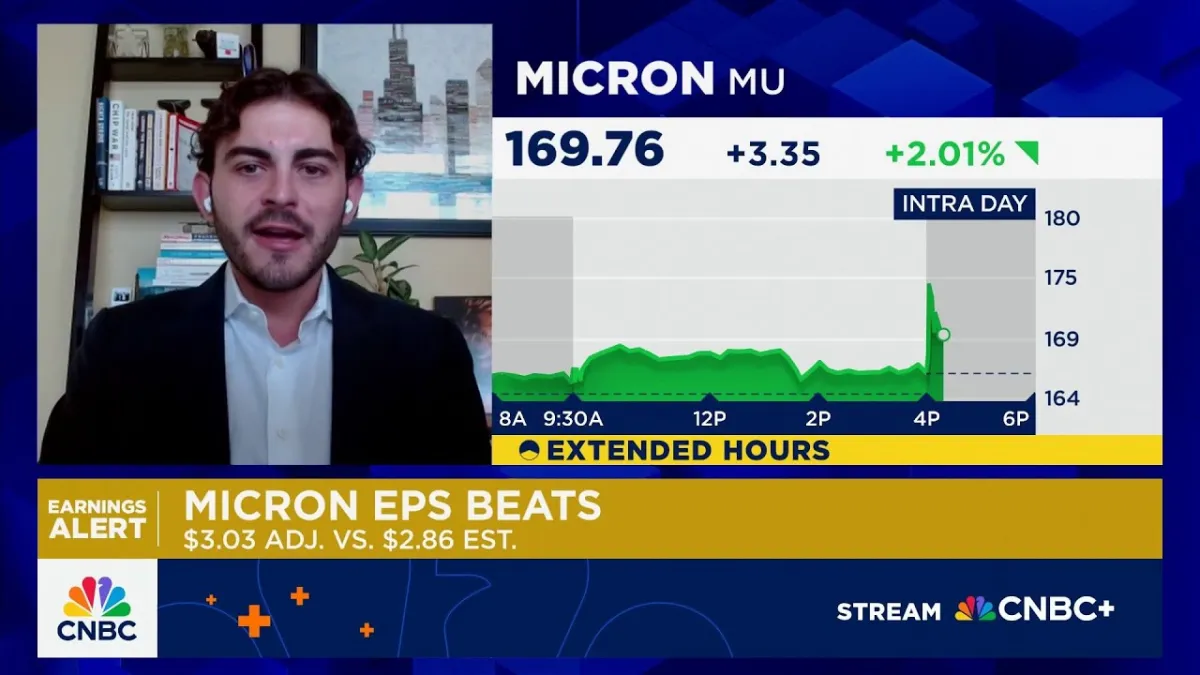
Micron Technology’s recent earnings guidance has ignited a fervent discussion among investors and industry analysts, largely centered on the unprecedented demand fueled by artificial intelligence. Morningstar analyst William Kerwin, speaking on CNBC’s ‘Closing Bell Overtime,’ provided a nuanced perspective on Micron’s strong performance and the broader implications for the memory chip market, addressing the sustainability of this AI-driven surge and the perennial boom-bust cycles that define the sector. His commentary offers critical insights for founders, venture capitalists, and AI professionals navigating the rapidly evolving semiconductor landscape.
Kerwin’s analysis began with a clear affirmation of Micron’s exceptional near-term outlook. He stated, “The strong guidance is really the story of the release so far here... this guidance blows the expectations out of the water quite frankly, especially when you consider profitability.” This robust guidance, which saw Micron exceed expectations for EPS and revenue while projecting a significant non-GAAP gross margin, underscores the immediate tailwinds benefiting memory manufacturers. The market had already anticipated strong results, with Micron having pre-announced a mid-quarter guidance raise in August, yet the actual figures still managed to surpass elevated expectations, particularly on the profitability front.
A core insight from Kerwin’s discussion is the dual nature of AI’s impact on the memory market: driving both strong demand and persistent supply constraints. The analyst highlighted, “Not only is AI demand strong, but it remains significantly supply constrained and that’s really a boost for the pricing from a company like Micron on its high-bandwidth memory chips.” This dynamic is crucial. High-bandwidth memory (HBM), essential for training and running complex AI models, requires specialized manufacturing processes and packaging, creating bottlenecks that restrict supply even as demand skyrockets. This imbalance translates directly into increased pricing power for producers like Micron, significantly improving their revenue and margin profiles in the short to medium term. The unprecedented scale and complexity of AI workloads necessitate vast quantities of advanced memory, fundamentally altering traditional demand patterns.
However, the conversation quickly pivoted to the inherent cyclicality of the memory industry, a pattern notorious for its dramatic swings between periods of oversupply and scarcity. The interviewer pressed Kerwin on whether this AI-driven demand could finally break the boom-bust cycle. Kerwin offered a cautious, yet optimistic, long-term view: “The way we see it is that AI is driving a particularly strong and particularly enduring upcycle for memory chips like those from Micron. But it is not eliminating cyclicality in the long term in our view.” This statement encapsulates a critical insight: while AI provides a powerful, sustained demand driver unlike previous cycles, it does not fundamentally alter the underlying supply-demand dynamics that can lead to imbalances over extended periods. Capital expenditure decisions, lead times for new fabs, and the potential for overinvestment by multiple players still pose risks.
Kerwin projects the immediate future to be exceptionally strong, noting, "Over the next two years, it looks pretty strong." This short-term clarity provides a window of opportunity for memory providers. The current high demand for HBM, coupled with the slow ramp-up of new capacity, suggests that favorable pricing and robust sales will likely persist for the next couple of years. This period allows companies to capitalize on the AI gold rush, funding further R&D and capacity expansion, albeit with an eye towards potential future market corrections.
Despite the overwhelmingly positive guidance and the clear demand signals from AI, Micron’s stock response was described as "relatively modest" by Kerwin. This leads to another vital insight: much of the anticipated upside from AI-driven demand has already been priced into the market. As Kerwin explained, “We think buying in at these levels is assuming even more upside from here and we think a lot of that upside is already baked in.” Micron’s stock had already doubled since the start of the year and surged over 40% in the preceding month, reflecting investor confidence in the AI narrative even before the official earnings release. This suggests that while Micron is executing well and benefiting immensely from the AI trend, the market has largely discounted these expected gains. For new investors, this implies a need for careful consideration, as future growth will rely on continued, perhaps even accelerated, AI adoption and Micron’s ability to maintain its competitive edge in HBM and other advanced memory technologies. The challenge for companies like Micron, therefore, is not just to meet the current demand, but to innovate and scale in a way that continues to outpace market expectations and potential supply increases from competitors.
The memory sector remains a high-stakes arena, where technological leadership and efficient capital deployment are paramount. The AI revolution has undeniably ushered in a new era of demand, particularly for advanced memory solutions, presenting an enduring upcycle that promises significant growth for key players. However, the ghost of cyclicality continues to loom, reminding industry leaders and investors that even in the most transformative periods, prudent management and a clear understanding of long-term market dynamics are essential to navigate the inherent volatilities of the semiconductor landscape.