

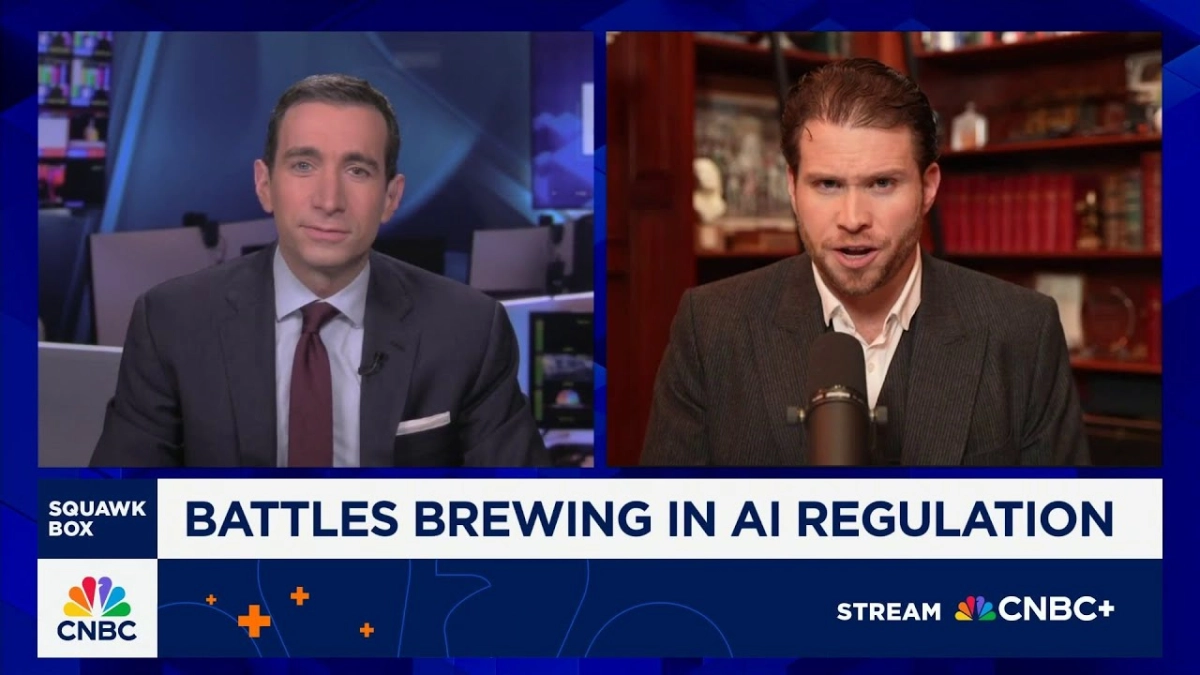
Joe Lonsdale, Palantir co-founder and 8VC founding partner, appeared on CNBC's Squawk Box to discuss the urgent and contentious landscape of AI regulation, a dialogue increasingly shaping the future of American technological leadership. He spoke with interviewer Andrew Ross Sorkin about the critical balance between innovation and oversight, arguing forcefully against a fragmented, state-by-state approach that he believes would ultimately cripple the United States in the global AI race. Lonsdale champions AI as a transformative force for societal good, a perspective he feels is under threat from ill-conceived regulatory efforts.
Lonsdale's core thesis centers on the immense potential of AI to drive disinflation and solve complex societal problems. He envisions a future where AI significantly reduces costs in healthcare, boosts productivity in construction to make housing more affordable, and personalizes education for all children. "We are on the verge of something amazing for our civilization," Lonsdale declared, highlighting the tens of thousands of builders in the country poised to leverage AI for these profound advancements. This optimistic outlook underpins his fervent opposition to regulatory frameworks he views as overly restrictive or punitive.
A significant concern for Lonsdale is the emergence of what he terms "crazy populists" on both the far left and far right who, for what he describes as "nefarious reasons," seek to impede AI progress. While acknowledging that some concerns about AI are reasonable and warrant compromise, he warns against a "patchwork of just really intense stuff" being proposed by states. This fragmentation, he argues, would effectively "break the whole AI wave." The issue, he contends, is not simply about regulation, but about the type of regulation and its potential to either foster or stifle innovation.
Lonsdale, identifying as a federalist on most issues, paradoxically views state-level AI regulation as a particular threat. He points to the Interstate Commerce Clause as a constitutional bulwark against such fragmentation, drawing parallels to the detrimental impact of California's emission standards on the national auto industry. His fear is that if companies are forced to navigate a labyrinth of differing regulatory agencies across 50 states, the sheer burden will render the U.S. uncompetitive. "If you force us to hop through regulatory agencies in every state, China's gonna win and the builders are gonna lose," he asserted, underscoring the geopolitical stakes of domestic policy.
He specifically cited a New York State initiative to ban AI in public education and healthcare, characterizing it as "insane." Such moves, Lonsdale argued, prevent the personalization of education and hinder efforts to make healthcare cheaper, directly contradicting AI's potential for positive impact. He dismissed these overly cautious approaches as "safetyism," a term implying an excessive focus on safety at the expense of progress. This "safetyism," he suggested, mirrors the European regulatory philosophy, which he bluntly stated has led to a "poor civilization."